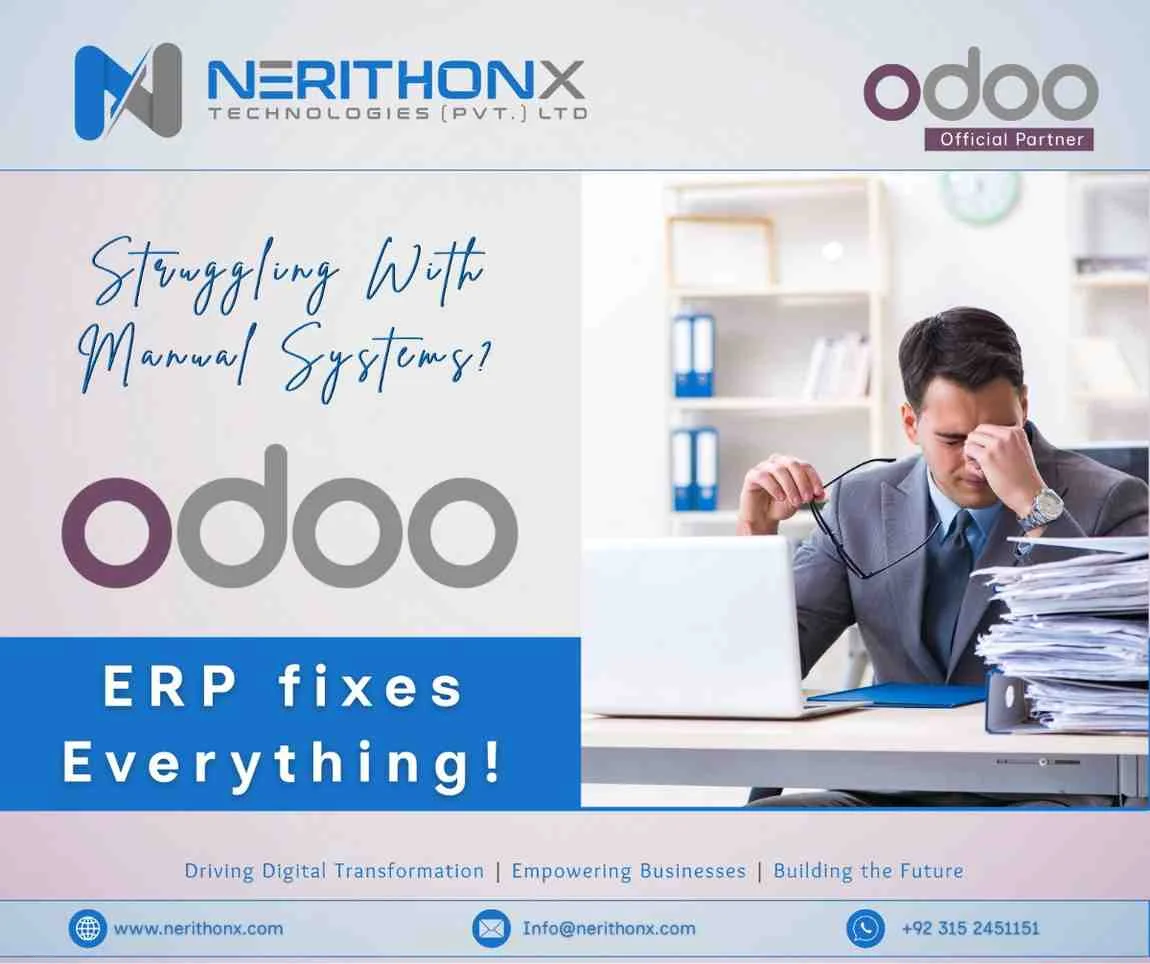
Manual systems slow you down because they split your work across spreadsheets, paper, and disconnected apps, and Odoo ERP fixes this by putting your data and workflows in one place. You stop duplicate entries, reduce human errors, and get real-time dashboards that show what is happening now. You can start small with a few modules, then scale without rebuilding everything. A safe switch needs clean data, clear roles, training, and a phased go-live plan. When you do it right, Odoo becomes your single source of truth for sales, inventory, accounting, purchasing, HR, and projects.
If you want help building it the right way, explore our Odoo customization services.
Why Manual Systems Fail (It’s the Process, Not the People)
Manual systems fail because the process is broken, not because the team is careless. Spreadsheets, paper forms, and disconnected tools force people to copy and paste the same data again and again, which creates errors and delays. One Excel stock sheet says “10 units,” another says “7,” and nobody knows which one is true. That is exactly why businesses outgrow manual systems as soon as orders, staff, and suppliers increase.
Manual work also fails because it cannot control versions and approvals at scale. When someone approves a price on email, another person confirms it on WhatsApp approvals, and a third person changes it in a spreadsheet, you lose traceability. In my 10 years implementing ERP and Odoo, I have seen teams waste hours fixing problems that started as small copy mistakes. This is also why automation matters for SMEs even when the business is not “big yet.”
If you feel this pain, it often means you are already showing the signs you need an ERP.
What Odoo ERP is and why it fixes the root cause
Odoo ERP fixes manual systems because it unifies your business operations into one shared workflow and one database. Instead of keeping sales in one tool and stock in another, Odoo connects Sales, CRM, Accounting, Inventory, Purchase, HR, Projects, Helpdesk, Documents, Dashboards, and Workflows. That is the “single source of truth,” and it protects data integrity like the NIST definition of data integrity describes.
Odoo also works because it is a modular ERP, so you can start with the apps that remove the most manual work first. You can learn the building blocks in Odoo modules explained and see the basics in what Odoo ERP is. Most teams gain speed fast because Odoo can streamline tasks, automate handoffs, centralize data, and synchronize updates across departments.
Odoo improves daily work because everyone sees the same real-time data at the same time. When your sales order updates inventory, accounting, and delivery in one flow, you reduce reconciliation work and avoid “spreadsheet truth fights.” This is the practical side of team collaboration inside Odoo and the performance side of the Odoo productivity guide.
7 Manual System Problems and How Odoo ERP Fixes Each One
1) Data silos
Data silos happen when each team owns its own file and tool, so the business loses one shared reality. Odoo removes silos by unifying sales, inventory, accounting, and purchasing into one system with shared records. Integrations also matter, and Odoo integrations that boost productivity help you connect email, payments, shipping, and more without manual transfers.
2) Manual errors and rework
Manual errors grow because duplicate entries make mistakes normal, not rare. Odoo reduces mistakes by validating fields, standardizing flows, and logging actions so you can trace who changed what. When you add an audit trail and role-based access, your team stops “fixing the same issue twice” and starts preventing it.
3) Slow reporting
Reporting is slow when you must compile data from spreadsheets and paper invoice register notes. Odoo speeds reporting by turning live transactions into KPI reporting and real-time dashboards without extra work. If you want the logic behind that, start with what a management information system is and then see how MIS improves decision-making.
4) Weak collaboration
Collaboration breaks when each person works from a different version of the truth. Odoo strengthens collaboration by keeping customer, order, stock, and finance data in one place, so handoffs stop depending on memory and chat messages. You can see this clearly in team collaboration inside Odoo.
5) No real-time inventory and order visibility
Visibility disappears when inventory is updated after the fact, not at the moment of change. Odoo gives real-time stock updates, reserved quantities, and order status tracking, so you can act before problems become shortages. This directly improves order-to-cash speed and reduces stockouts.
6) Slow approvals and handoffs
Approvals get stuck when they live in inboxes and chat apps. Odoo fixes approval bottlenecks by routing tasks to the right role, recording approval steps, and keeping a clear history for compliance. You get faster procure-to-pay cycles with fewer delays and fewer surprise costs.
7) Hard to scale without hiring more admin
Manual systems “scale” by adding more people to copy, check, and chase updates. Odoo scales by automating repeat work, centralizing data, and letting you add modules as needs expand, which is why many teams see how Odoo supports business growth after the initial rollout. If your workflows are already complex, learn from common ERP challenges in larger teams.
If your biggest pain is customer follow-up, read ERP vs CRM explained and then connect it to customer relationship management basics.
What to automate first (quick wins in 30 to 60 days)
Quick wins come from automating the tasks your team repeats every day. Start with invoicing, payment reminders, purchase approvals, stock updates, lead follow-up, and timesheets, because these are high-volume and easy to measure. Odoo supports automation rules through tools like Studio, and the Odoo documentation on automation rules shows how automated actions work.
Pick wins that remove copy-paste and stop rework loops. Use CRM software examples to spot where sales teams lose leads, and use CRM examples that improve sales follow-up to design a clean pipeline flow. Then lock in habits with customer relationship management best practices.
If you run a field team, location data can help routing and service zones, and that is where how GIS supports field operations can fit into the bigger system.
Before You Switch: A Quick ERP Readiness Checklist
You can predict ERP success by checking process clarity, data quality, and ownership. Use this quick checklist before you start implementation:
- You can name your core workflows (sales to cash, procure to pay, hire to retire).
- You know where duplicate entries happen.
- You can list your key reports and KPIs.
- You can define roles and approvals for each workflow.
- You can clean product, customer, and vendor data.
- You can commit time for training and change management.
- You can start with 2 to 4 modules, not everything at once.
If you want a deeper view of the journey, start with Odoo as a digital transformation engine.
A “manual cost” mini-calculator you can do in 5 minutes
Manual systems cost money because they convert time into invisible waste. Use this simple mini-calculator:
- Hours lost per week = (duplicate entry hours + rework hours + reporting hours).
- Weekly cost = hours lost per week × fully loaded hourly cost.
- Monthly cost = weekly cost × 4.
- Error cost add-on = average monthly error fixes + missed sales + rush shipping.
In my 10 years, the biggest surprise is how much “small” work adds up when every order needs extra checking. When you compare this cost to an ERP rollout, the ROI story becomes clear.
How to Switch to Odoo Safely: A Phased Rollout Plan
Map processes
A safe switch starts by mapping workflows before touching software. Define what happens now, what must happen next, and where the handoffs break, because this removes hidden rules that live only in people’s heads.
If you want the baseline, read what ERP implementation means in practice.
Pick 2 to 4 starter modules
A phased rollout works because it limits change and builds confidence. Start with the modules that remove the most manual work, like Sales, CRM, Inventory, and Accounting, then expand. This approach aligns with key benefits of Odoo for SMEs and helps teams adopt faster.
Clean data, then migrate
Data cleanup matters because bad data breaks good systems. Standardize product names, units, taxes, and customer records, then migrate, because you cannot automate chaos. This step reduces reconciliation pain later.
Configure, then customize only where needed
Configuration should solve most needs before customization. Use standard features first, then add customization only when a real business rule cannot be met.
If you need guidance, follow the Odoo implementation guide and avoid the traps in common Odoo implementation mistakes.
Test, train, then go live
Testing and training turn a new system into a new habit. Run real scenarios, test permissions, and train users by role, because role-based access reduces mistakes. If you want proof that training changes outcomes, see Odoo functional training results and the Odoo functional training program.
Measure ROI and improve
Measurement keeps momentum because it turns feelings into facts. Track cycle time, error rate, inventory accuracy, and close time, then improve the workflow in short loops. For many teams, cloud access also improves adoption, so review why cloud ERP is becoming the default.
When you need expert support, why work with a professional Odoo partner explains what to look for.
Customization that stays upgrade-safe
Upgrade-safe customization is possible when you customize the workflow, not the core in a fragile way. Start by learning what ERP customization really means and reviewing real Odoo customization examples so you can separate “nice to have” from “must have.” Then use the Odoo customization guide and the complete guide to Odoo customization to plan clean changes.
Customization stays safe when you follow strong technical standards. Learn the patterns in the technical overview of Odoo customization and protect your future upgrades with customize Odoo without breaking core features. If you are not sure where to start, use modules worth customizing first and keep development clean with Odoo development best practices.
If you need custom features, build them the right way. Follow how to build custom Odoo modules so your changes stay maintainable and testable.
If you are comparing editions, Odoo Enterprise vs Community helps you choose based on real needs.
Proof You Can Verify: Customer Stories and Research
Odoo earns trust because real organizations use it and expand it over time. In Toyota’s Odoo customer story, Toyota started with sales and inventory needs and later expanded, which shows modular growth in practice. In Sodexo’s Odoo customer story, the system supports a tailored operation with customized needs. In WWF’s Odoo customer story, Odoo supports project and budget control, which highlights flexibility.
ERP success also depends on planning and adoption, not only software. The IEEE study on ERP implementation failure factors and the MIT paper on ERP implementation challenges both point to governance, change management, and execution discipline as major factors. This is why roles, approvals, and training belong in your plan from day one.
Search engines also reward content that covers intent and entities clearly, which is why semantic structure matters. The BERT research paper shows how modern language models improve understanding of context, so clear wording and complete intent coverage help users and algorithms.
If you want to know who is behind this guidance, read about NerithonX Technologies. If you are scaling fast, you may also relate to Odoo ERP for growing companies and comparisons like Odoo vs SAP for scaling operations.
ROI measurement list (what to track after go-live)
ROI becomes real when you measure outcomes, not opinions. Track these metrics before and after rollout:
- Order-to-cash cycle time
- Procure-to-pay cycle time
- Inventory accuracy and stockouts
- Invoice error rate and credit note count
- Month-end closing time
- Lead response time and win rate
- On-time delivery rate
- Support ticket time to resolution
- Admin hours per order
- User adoption, like logins and task completion
Use these to optimize, then expand modules and integrations.
Next steps
A clean Odoo rollout replaces manual workflows with a system you can trust, measure, and improve. If you want a tailored plan, explore our Odoo customization services and review more Odoo ERP insights to plan your next phase.
FAQs (Frequently Asked Questions)
Why do spreadsheets and paper forms break as a business grows?
They break because the same data lives in many places, and people must copy it by hand. That creates data silos, duplicate entry, and version confusion. The bigger the team, the harder it is to reconcile changes. An ERP stops this by keeping one shared record that everyone updates.
What is the fastest way Odoo reduces manual work?
Odoo reduces manual work fastest by automating repeat actions like invoicing, reminders, approvals, and stock updates. It turns scattered steps into one workflow, so people stop copying data between tools. This also reduces human error, because the system validates and standardizes key fields.
Can Odoo replace Excel for inventory tracking?
Yes, Odoo can replace an Excel stock sheet by tracking stock moves in real time. It updates quantities when you sell, buy, receive, or deliver, so your numbers stay live. You also get traceability, like lot or serial tracking, and clear reservation rules for open orders.
How does Odoo improve reporting and dashboards?
Odoo improves reporting by turning daily transactions into real-time dashboards automatically. You do not need to export files and merge sheets to see KPIs. Because data is centralized, reports stay consistent across teams. You can also drill down from a KPI to the source document for validation.
What modules should I start with if I want quick wins?
Start with Sales, Inventory, Accounting, and CRM if your pain is order flow and follow-up. Add Purchase if approvals and supplier orders cause delays. Add Projects or Helpdesk if service work is hard to track. This phased approach delivers results fast without overwhelming the team.
How long does a safe Odoo implementation take?
A safe implementation depends on scope, data quality, and training time. A small phase can be weeks, while a multi-department rollout can take months. The safest path is phased go-live, so you stabilize one workflow before adding more. Testing and training usually decide the timeline more than software setup.
What causes ERP projects to fail most often?
They fail when teams skip process clarity, data cleanup, and change management. Bad data creates bad outputs, even in a good system. Weak training leads to workarounds, like side spreadsheets, which reintroduce silos. Clear roles, approvals, and ownership reduce these risks and improve adoption.
Do I need Odoo customization right away?
Not always, because configuration can solve many needs. Customize only when a real business rule cannot be handled by standard settings, workflows, or automation rules. Upgrade-safe customization focuses on clean modules and clear boundaries. This keeps future updates smooth and avoids breaking core functionality.
What is the difference between ERP and CRM in simple terms?
ERP runs the whole business, like inventory, accounting, purchasing, HR, and production. CRM focuses on customers, leads, and sales follow-up. Many teams need both, and Odoo connects them so sales activity links to orders, invoices, and support. This prevents gaps between “sold” and “delivered.”
How can I prove ROI after switching from manual systems to Odoo?
Prove ROI by tracking measurable changes, like fewer admin hours, fewer invoice errors, faster closing, better inventory accuracy, and faster order cycles. Compare your baseline before go-live to results after 30, 60, and 90 days. Tie each improvement to a cost, like hours saved or errors avoided.