As businesses grow, managing daily operations becomes more complex. Sales increase, inventory expands, teams get larger, and financial tracking becomes harder to control. Many companies try to manage this growth using spreadsheets or separate software tools, but over time this creates confusion, errors, and slow decision-making.
This blog explains how ERP systems help businesses solve these problems. We’ll cover what ERP software is, how it works, and why growing businesses rely on it to manage operations more efficiently. You’ll also learn how modern ERP platforms differ from traditional software and what to consider when choosing the right ERP for your business.
Before comparing different ERP systems or exploring specific platforms, it’s important to understand the basics.
What Is ERP and Why Does It Matter for Growing Businesses?
Running a growing business means juggling many moving parts. As operations expand, spreadsheets and disconnected software quickly become a bottleneck. That’s where enterprise resource planning (ERP) systems come in. ERP is a platform that streamlines and optimizes a company’s operations—everything from purchasing and manufacturing to sales, inventory, and payments. In simple terms, it is an all-in-one system that brings information from every department into a single source of truth.
By automating processes and improving data accuracy, ERP platforms increase efficiency, reduce costs, and improve customer satisfaction. Instead of working with scattered tools, businesses gain visibility into real-time data, which helps leaders make faster and better decisions.
There are two primary deployment models for ERP systems: on-premise and cloud-based. On-premise ERP systems require companies to install and manage their own servers. While this approach offers full control, it usually involves high upfront costs, ongoing maintenance, and longer customization timelines. Cloud-based ERP systems, on the other hand, are hosted and managed by third-party providers. They are more flexible, easier to scale, and especially attractive to small and medium businesses that want to grow without heavy infrastructure investments.
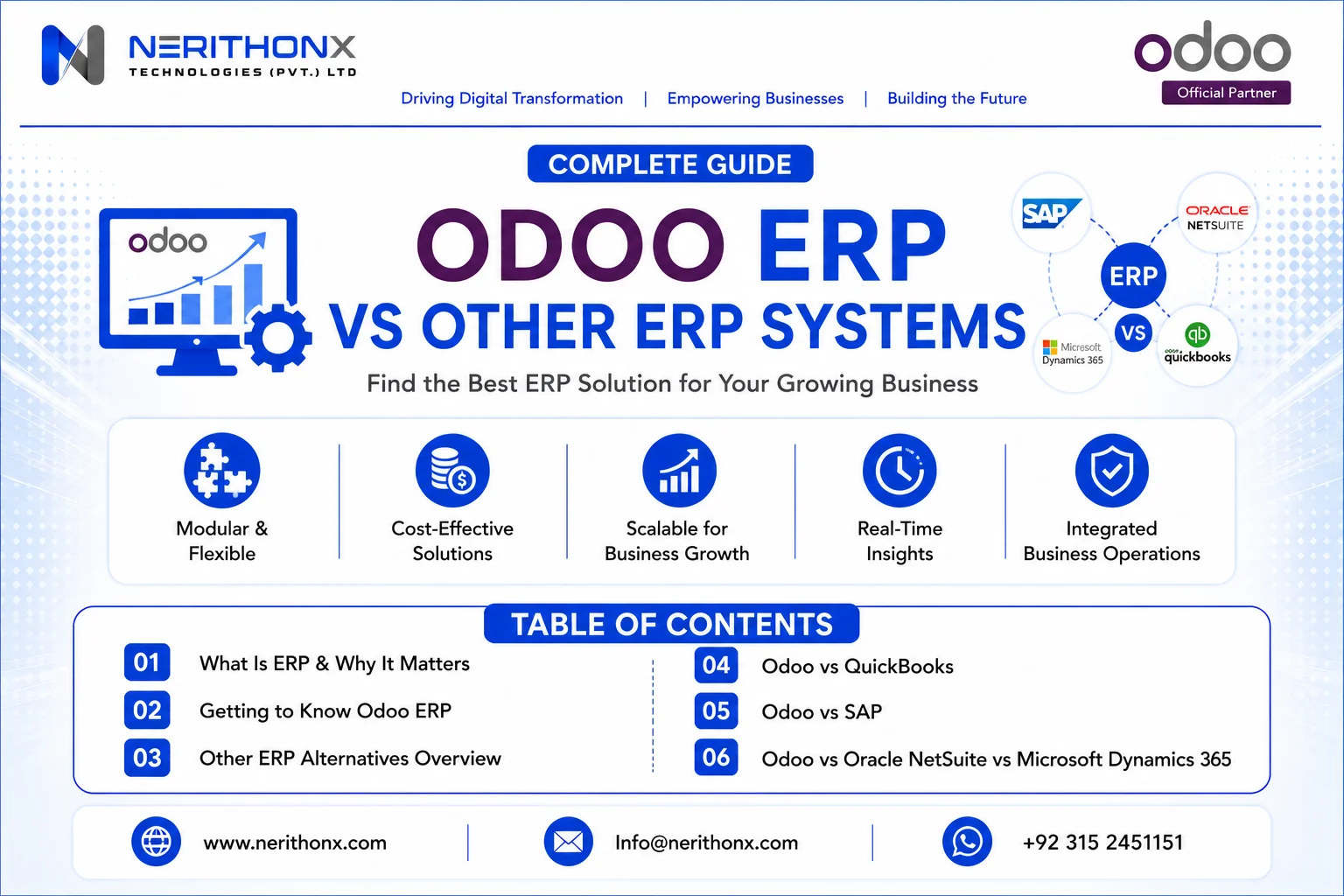
This article compares Odoo ERP—an open-source, modular platform—with other major ERP systems such as SAP, Oracle NetSuite, Microsoft Dynamics 365, and QuickBooks. We will examine features, pricing, scalability, and real-world suitability for growing businesses so you can make a confident decision.
Getting to Know Odoo – An Open-Source ERP Built for Growth
Odoo started as an open-source project and evolved into a full-scale business management platform used by millions of companies worldwide. Its core strength lies in its modular architecture. Businesses can install only the applications they need and add more as their operations grow.
Odoo offers modules for customer relationship management, accounting, sales, inventory, manufacturing, human resources, project management, e-commerce, and more. Because it is open source, companies are not locked into rigid workflows and can freely customize the system.
Odoo is available in two editions: Community and Enterprise. The Community edition is completely free and suitable for startups and small businesses that want essential functionality without licensing costs. The Enterprise edition includes advanced features, official support, and hosting options. Odoo’s pricing structure allows businesses to start small and scale gradually, avoiding costly platform migrations later.
Other ERP Alternatives Worth Considering
ERPNext is another open-source ERP platform with basic functionality and a strong community. It works well for small businesses but may lack enterprise-grade depth.
Acumatica is a cloud ERP known for flexible licensing and industry-specific modules. It offers strong usability but fewer third-party integrations compared to Odoo.
Katana focuses on manufacturing and inventory management and integrates well with e-commerce platforms. However, it lacks full ERP coverage and is better used as a specialized tool rather than a complete system.
These options highlight Odoo’s balanced position—broad functionality, affordability, and flexibility in one platform.
Odoo vs QuickBooks – Beyond Basic Accounting
QuickBooks is often the first accounting tool small businesses adopt. It is easy to use and well-suited for basic bookkeeping. However, as businesses grow, they often outgrow standalone accounting software.
Odoo goes far beyond accounting by integrating finance with sales, inventory, HR, and operations. Instead of adding multiple third-party tools to QuickBooks, businesses can manage everything in one system.
Odoo also offers stronger reporting, multi-currency support, and customizable dashboards. For companies transitioning from simple bookkeeping to full operational management, Odoo provides a natural next step.
Businesses considering Odoo vs QuickBooks should evaluate their current accounting needs, operational complexity, and plans for future growth.
Odoo vs SAP – Enterprise Power vs Business Agility
SAP is a global leader in enterprise software and is commonly used by large organizations with complex operations. Its solutions are powerful but often expensive and resource-intensive.
Odoo is designed with small and medium businesses in mind. Its modular structure allows companies to adopt only what they need, making implementation faster and less costly.
While SAP offers advanced analytics and deep industry-specific features, many growing businesses find Odoo’s capabilities more than sufficient—especially when considering cost, usability, and deployment speed.
For businesses evaluating Odoo vs SAP, the right choice ultimately depends on company size, operational complexity, budget, and long-term growth plans.
Odoo vs Oracle NetSuite – Open Customization vs Structured SaaS
Oracle NetSuite is a popular cloud-based ERP system, especially among mid-size companies. It provides strong financial management and global compliance features.
However, NetSuite follows a more rigid structure. Customization often requires adapting business processes to the software rather than the other way around. Development also relies on proprietary tools, which can increase costs.
Odoo’s open-source model allows businesses to shape the system around their workflows. Its pricing is also significantly more accessible, making it a strong alternative for companies that need flexibility without high licensing fees.
Odoo vs Microsoft Dynamics 365 – Simplicity vs Ecosystem Integration
Microsoft Dynamics 365 combines ERP and CRM capabilities and integrates tightly with Microsoft products like Office, Outlook, and Power BI. This makes it appealing to organizations already invested in the Microsoft ecosystem.
However, Dynamics can be costly and resource-heavy. Customizations often require advanced development skills, and licensing fees increase quickly as teams grow.
Odoo offers a simpler interface, lower cost, and broader customization options. While it lacks native AI features found in Dynamics, it integrates easily with third-party tools to fill those gaps.
For businesses comparing Odoo vs Microsoft Dynamics 365, the right choice depends on their budget, existing technology ecosystem, customization requirements, and long-term business needs.
Practical Factors to Consider When Choosing an ERP
Choosing the right ERP requires more than comparing features. Businesses should consider size, industry requirements, and long-term growth plans. Large enterprises may need the depth of SAP, while startups benefit from Odoo’s flexibility.
Total cost of ownership is critical. Beyond licensing, consider implementation, customization, training, and maintenance. Odoo’s open-source nature keeps long-term costs manageable.
Customization needs also matter. If workflows change often, an adaptable system like Odoo is ideal. Implementation speed, system integrations, and community support should also influence the final decision.
Pricing and Cost-Effectiveness
Cost is often the deciding factor for growing businesses. Odoo stands out because of its low total cost of ownership. Licensing is based on users, and businesses pay only for the applications they use. The Community edition can even run at zero licensing cost.
Compared to traditional ERP systems, Odoo is significantly more affordable. Enterprise-focused platforms often charge high licensing fees, annual maintenance costs, and additional fees for customization. Odoo’s open-source foundation eliminates vendor lock-in and gives businesses greater financial control.
Integration and Scalability
Odoo integrates all major business functions into a single platform. Accounting, sales, inventory, manufacturing, HR, and customer data stay synchronized in real time. This reduces errors, eliminates duplicate work, and improves overall efficiency.
Automation plays a key role. Tasks like invoice creation, bank reconciliation, payment processing, and inventory replenishment can run automatically. This allows teams to focus on strategy rather than repetitive manual work.
Scalability is built into Odoo’s design. Companies can add users, modules, and even manage multiple businesses from a single database. This makes Odoo suitable for companies planning expansion into new markets or regions.
How Can SMEs Benefit from an ERP Solution Like Odoo?
Centralized Operations
Odoo brings sales, accounting, inventory, and customer data into one system, reducing errors and manual work.
Cost-Effective Growth
SMEs can start with only the modules they need and expand later, keeping costs under control.
Easy Scalability
As the business grows, new features can be added without changing systems or migrating data.
Automation and Efficiency
Routine tasks like invoicing and reporting are automated, saving time and improving accuracy.
Better Business Visibility
Real-time dashboards and reports help SMEs make faster, smarter decisions.
Conclusion – Which ERP Is Best for Growing Businesses?
There is no universal answer when choosing an ERP. However, for most growing businesses, Odoo offers the best balance of affordability, flexibility, and functionality. Its modular design, open-source foundation, and strong community support make it an excellent long-term solution.
SAP, NetSuite, and Microsoft Dynamics remain strong options for specific use cases, particularly for large or highly regulated enterprises. But for startups, SMEs, and cost-conscious organizations, Odoo stands out as a practical and scalable ERP choice.
The best approach is to evaluate your business needs, budget, and growth goals carefully. With the right ERP in place, you won’t just manage operations—you’ll enable sustainable growth.
FAQS :
What is ERP software in simple words?
ERP software is a system that helps businesses manage sales, accounting, inventory, and operations in one place instead of using multiple tools.
Why do growing businesses need an ERP system?
Growing businesses need ERP to reduce manual work, avoid data errors, and keep all departments connected as operations become more complex.
Is Odoo ERP suitable for small and medium businesses?
Yes, Odoo is designed for small and medium businesses because it is affordable, flexible, and can grow with the business.
How is Odoo different from traditional ERP systems?
Odoo is open source and modular, allowing businesses to use only what they need, while traditional ERPs are often expensive and less flexible.
Can Odoo replace accounting software like QuickBooks?
Yes, Odoo can replace accounting software and also manage sales, inventory, and other operations in a single system.
Is Odoo ERP expensive to implement?
Odoo is generally more affordable than many ERP systems because it offers flexible pricing and a free community edition.
Can Odoo be customized for my business processes?
Yes, Odoo can be customized to match specific business workflows instead of forcing businesses to change how they work.
Does Odoo support business growth and scalability?
Yes, businesses can start with basic modules and add more features as they grow without switching platforms.
How long does it take to implement Odoo ERP?
Implementation time depends on business size and requirements, but Odoo is usually faster to deploy than traditional ERP systems.
Which businesses benefit the most from Odoo ERP?
Small and medium businesses in retail, manufacturing, services, and e-commerce benefit most from Odoo due to its flexibility and cost efficiency.