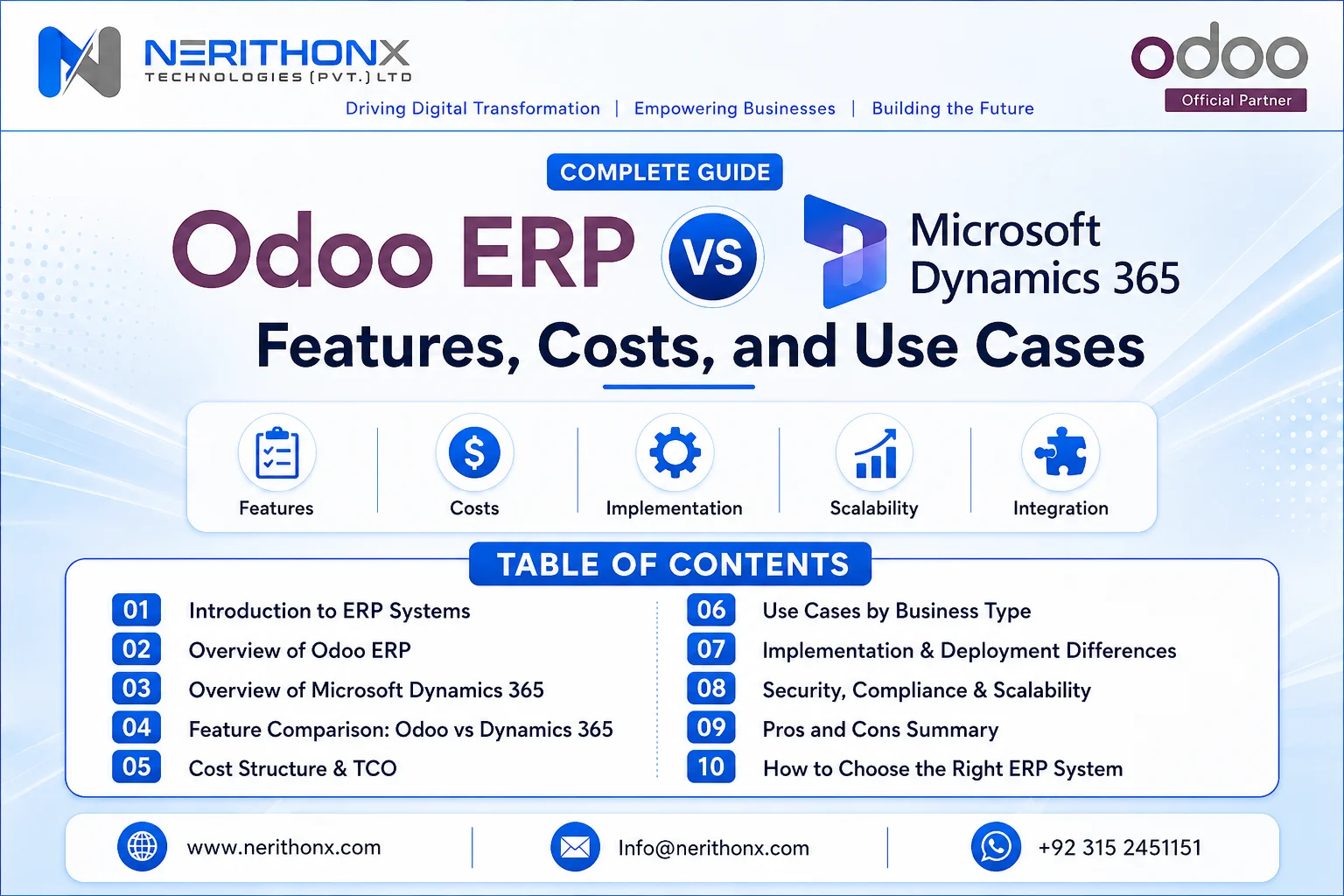
Odoo ERP vs Microsoft Dynamics 365: Features, Costs, and Use Cases
Choosing between Odoo ERP and Microsoft Dynamics 365 is not just about comparing features—it’s about understanding which system truly aligns with your business goals, operational complexity, and long-term growth strategy. Odoo is widely recognized for its modular structure, flexibility, and cost-effectiveness, making it a strong fit for startups and mid-sized businesses looking for scalability without heavy upfront investment. In contrast, Microsoft Dynamics 365 is designed for larger, more complex organizations, offering advanced capabilities, enterprise-grade security, and seamless integration within the Microsoft ecosystem, including tools like Azure, Power BI, and Microsoft 365.
In this in-depth guide by NeithonX Technologies, you’ll explore a comprehensive comparison of both platforms across key areas such as features, pricing models, implementation approaches, customization flexibility, and real-world use cases. It also highlights practical considerations like total cost of ownership, scalability, and integration capabilities—helping you move beyond surface-level comparisons. By the end, you’ll have a clearer understanding of which ERP system best fits your business needs, ensuring a more confident and strategic decision-making process.
Introduction to ERP Systems
Enterprise Resource Planning (ERP) systems have become a foundational part of modern business operations, enabling organizations to unify processes, improve efficiency, and make data-driven decisions. As companies grow and their workflows become more complex, the need for a centralized system becomes critical. This is where ERP platforms like Odoo and Microsoft Dynamics 365 come into focus, offering different approaches to solving operational challenges across industries.
What Is an ERP System?
An Enterprise Resource Planning (ERP) system is a centralized software platform that integrates core business functions—such as finance, sales, inventory, human resources, and operations—into a single unified system. Instead of using separate tools for each department, ERP systems create a shared database that enables real-time data flow across the organization. This improves visibility, reduces data silos, and allows decision-makers to rely on accurate, up-to-date information for planning and execution. Modern ERP solutions are typically cloud-based, scalable, and designed to support automation, analytics, and cross-functional collaboration.
Why Businesses Compare Odoo and Dynamics 365
Businesses often compare Odoo ERP and Microsoft Dynamics 365 because both platforms aim to solve the same core challenge—streamlining business processes—but take fundamentally different approaches. Odoo focuses on modularity, affordability, and customization, making it attractive for growing companies that need flexibility. On the other hand, Dynamics 365 is built for enterprise-scale operations, offering deep integrations with Microsoft tools, advanced analytics, and robust security frameworks. Comparing these systems helps organizations evaluate which solution better aligns with their size, budget, technical requirements, and long-term digital strategy.
Overview of Odoo ERP
Odoo ERP is a modular, open-source business management platform designed to unify multiple business functions within a single system. It is widely adopted by startups and mid-sized companies due to its flexibility, cost-effectiveness, and ability to scale as business needs evolve. Unlike traditional ERP systems that require heavy upfront investment, Odoo allows organizations to start with essential modules and expand gradually, making it a practical choice for businesses seeking agility and control over their operations.
Core Architecture and Technology Stack
Odoo is built on a modern, open-source technology stack that includes Python for backend development and PostgreSQL as its database system. Its architecture is modular, meaning each business function—such as CRM, accounting, or inventory—operates as an independent yet interconnected module. Odoo also offers tools like Odoo Studio, a low-code environment that enables users to customize workflows, forms, and applications without deep technical expertise. This architecture supports both cloud-based and on-premise deployments, giving businesses flexibility in how they manage and host their ERP system.
Key Features and Modules
Odoo provides a comprehensive suite of applications that cover a wide range of business operations. Core modules include CRM, Sales, Accounting, Inventory Management, Manufacturing (MRP), Human Resources, and Marketing Automation. Each module is designed to integrate seamlessly with others, ensuring smooth data flow across departments. Additionally, Odoo offers eCommerce, project management, and help desk functionalities, making it an all-in-one platform for managing end-to-end business processes. Its modular design allows businesses to implement only the features they need and expand over time.
Strengths and Limitations
One of Odoo’s main strengths is its flexibility and customization capability, driven by its open-source foundation. Businesses can tailor the system to fit unique workflows without being locked into rigid structures. It is also known for its relatively lower total cost of ownership compared to many enterprise ERP solutions. However, Odoo does have limitations, particularly for highly complex, large-scale enterprises where advanced features, deep analytics, or strict compliance requirements may be needed. Additionally, while customization is a strength, it can also lead to dependency on skilled developers for more advanced implementations.
Overview of Microsoft Dynamics 365
Microsoft Dynamics 365 is a cloud-based enterprise platform that combines ERP and CRM capabilities into a unified ecosystem. Designed for scalability and complex business environments, it is widely used by mid-sized to large enterprises that require advanced functionality, global reach, and strong data governance. Unlike modular open-source systems, Dynamics 365 operates as a suite of interconnected applications built on Microsoft’s cloud infrastructure, enabling organizations to manage operations, customer relationships, and financials within a highly integrated environment.
Cloud Ecosystem and Microsoft Integration
Dynamics 365 is deeply integrated with the broader Microsoft ecosystem, including Microsoft Azure, Microsoft 365 (Office, Teams, Outlook), and the Power Platform (Power BI, Power Apps, Power Automate). This integration allows seamless data flow across tools that businesses already use daily, enhancing productivity and collaboration. For example, users can access ERP data directly within Outlook, generate real-time dashboards using Power BI, and automate workflows through Power Automate. The platform also leverages AI capabilities like Microsoft Copilot, enabling intelligent insights, predictive analytics, and task automation across various business functions.
Core Features and Applications
Microsoft Dynamics 365 offers a wide range of applications tailored to different business needs. Key modules include Dynamics 365 Finance, Supply Chain Management, Sales, Customer Service, Human Resources, and Commerce. Each application can function independently but is designed to work seamlessly within the ecosystem. The platform provides advanced financial management, multi-entity consolidation, global compliance support, and robust reporting capabilities. Its CRM features also enable businesses to manage customer journeys, sales pipelines, and service operations with high precision and automation.
Strengths and Limitations
One of the primary strengths of Dynamics 365 is its enterprise-grade scalability, security, and integration capabilities. It is particularly valuable for organizations already invested in Microsoft technologies, as it extends and enhances their existing infrastructure. The platform also excels in advanced analytics and AI-driven insights, helping businesses make strategic decisions based on real-time data. However, Dynamics 365 can be complex and resource-intensive to implement, often requiring certified partners and significant investment. Its licensing and customization costs can be higher compared to more flexible systems like Odoo, making it less accessible for smaller businesses with limited budgets.
Feature Comparison: Odoo vs Dynamics 365
When comparing Odoo ERP and Microsoft Dynamics 365, the differences become more apparent at the feature level, where each platform reflects its core design philosophy. Odoo emphasizes simplicity, modularity, and ease of use, while Dynamics 365 focuses on depth, scalability, and enterprise-grade capabilities. Understanding how they perform across key functional areas helps businesses evaluate which system aligns better with their operational needs.
Feature Comparison Table
| Feature Area | Odoo ERP | Microsoft Dynamics 365 |
| CRM & Sales | User-friendly CRM, pipeline tracking, basic automation | Advanced CRM, AI-driven insights, deep integration with Outlook & Teams |
| Accounting & Finance | Core accounting, invoicing, basic reporting | Advanced finance, multi-entity consolidation, compliance, real-time analytics |
| Inventory & Supply Chain | Inventory tracking, warehouse management, basic MRP | Advanced supply chain, demand forecasting, logistics optimization |
| Customization | Highly flexible, open-source, Odoo Studio (low-code) | Powerful but structured, requires Power Platform & certified developers |
| AI & Automation | Basic automation, workflow rules, OCR features | Advanced AI with Copilot, predictive analytics, intelligent automation |
| Scalability | Best for SMBs and growing businesses | Designed for large enterprises and global operations |
| Integration Ecosystem | Moderate integrations, API-based flexibility | Deep integration with Microsoft ecosystem (Azure, M365, Power BI) |
CRM and Sales Capabilities
Odoo offers an intuitive and user-friendly CRM system that covers lead management, pipeline tracking, and basic sales automation. It is well-suited for small to mid-sized teams that need a straightforward solution without heavy complexity. In contrast, Dynamics 365 provides a more advanced CRM with AI-driven insights, predictive lead scoring, and deep integration with Microsoft tools like Outlook and Teams. It is designed for large sales teams that require detailed customer journey tracking and automation at scale.
Accounting and Financial Management
Odoo’s accounting module delivers essential financial features such as invoicing, expense tracking, bank reconciliation, and basic reporting. It is efficient for businesses with relatively simple financial structures. On the other hand, Dynamics 365 Finance is built for complex financial environments, offering multi-entity consolidation, advanced financial planning, compliance management, and real-time analytics. This makes it more suitable for enterprises operating across multiple regions and regulatory frameworks.
Inventory and Supply Chain
Odoo provides solid inventory management with features like stock tracking, warehouse management, and basic manufacturing (MRP). Its integration with sales and purchasing modules ensures smooth operational flow. Dynamics 365, however, offers a more advanced Supply Chain Management system, including demand forecasting, production planning, logistics optimization, and IoT integration. It is particularly beneficial for organizations with complex supply chains and global distribution networks.
Customization and Flexibility
Customization is one of Odoo’s strongest advantages. Its open-source nature and tools like Odoo Studio allow businesses to modify workflows, create custom modules, and adapt the system to unique requirements with relative ease. Dynamics 365 also supports customization through the Power Platform, but it typically involves a more structured approach and may require certified developers or partners. While powerful, customization in Dynamics 365 can be more resource-intensive compared to Odoo.
AI and Automation
Dynamics 365 leads significantly in AI and automation capabilities, particularly with tools like Microsoft Copilot, which enables intelligent recommendations, automated data entry, and predictive analytics across departments. Odoo also offers automation features such as workflow rules, scheduled actions, and basic AI functionalities (e.g., OCR for invoices), but its capabilities are generally more task-specific and less advanced than those of Dynamics 365.
Cost Structure and Total Cost of Ownership
Understanding the total cost of ownership (TCO) is critical when comparing Odoo ERP and Microsoft Dynamics 365, as the real investment goes far beyond initial licensing. Costs typically include licensing, implementation, customization, infrastructure, training, and ongoing maintenance. While Odoo is generally considered more cost-effective and flexible, Dynamics 365 involves higher upfront and ongoing costs but delivers enterprise-grade capabilities, scalability, and vendor-managed reliability.
Licensing Models
Odoo and Dynamics 365 follow fundamentally different pricing approaches. Odoo offers a modular and open-source-based pricing model, including a free Community version and relatively low-cost enterprise subscriptions starting around $20–$30 per user/month depending on features.
In contrast, Microsoft Dynamics 365 uses a per-user, per-module subscription model, where businesses pay separately for each application (Finance, Sales, Supply Chain, etc.). Pricing typically starts around $65–$210 per user/month, depending on modules and capabilities.
👉 This means:
- Odoo → predictable, lower entry cost with bundled flexibility
- Dynamics 365 → higher cost, but deeper functionality and enterprise support
Implementation Costs
Implementation is often the largest hidden cost in ERP adoption. Odoo typically has a faster and more affordable implementation cycle, often ranging from 1–4 months, especially for SMBs using standard modules.
Dynamics 365 implementations are more complex and can take 6–14 months or longer, particularly for large enterprises with multiple entities, integrations, and compliance requirements.
In terms of cost:
- Odoo projects may range from $10K–$80K
- Dynamics 365 projects can range from $150K to $1M+ depending on scope
Key difference:
- Odoo → faster deployment, lower implementation barrier
- Dynamics 365 → structured, resource-intensive, but enterprise-ready
Maintenance and Scaling Costs
Ongoing costs vary significantly based on how the system is managed and scaled. Odoo provides flexible hosting options (cloud or on-premise) and allows businesses to control maintenance costs, especially if they have in-house technical expertise.
Dynamics 365 operates on a fully managed cloud infrastructure via Microsoft Azure, where maintenance, security, and updates are handled by Microsoft—but at a higher recurring cost.
As businesses scale:
- Odoo scales incrementally by adding modules, keeping costs relatively controlled
- Dynamics 365 scaling often increases licensing and infrastructure costs significantly due to its enterprise architecture
In practice:
- Odoo → lower long-term cost, more control, but requires technical management
- Dynamics 365 → higher recurring cost, but reduced operational burden and stronger enterprise support
Cost Comparison Summary Table
| Cost Factor | Odoo ERP | Microsoft Dynamics 365 |
| Licensing Model | Modular, open-source, low-cost subscription | Per-user + per-module subscription |
| Starting Price | ~$20–$30/user/month | ~$65–$210/user/month |
| Implementation Time | 1–4 months | 6–14+ months |
| Implementation Cost | $10K–$80K | $150K–$1M+ |
| Maintenance | Flexible (self-managed or partner-based) | Fully managed via Microsoft Azure |
| Scalability Cost | Incremental, cost-controlled | High but enterprise-ready |
| Total Cost of Ownership | Lower, especially for SMBs | Higher, justified by enterprise capabilities |
Overall, the cost difference reflects a deeper strategic distinction: Odoo prioritizes affordability and flexibility, while Dynamics 365 prioritizes scalability, reliability, and enterprise-level performance. The right choice depends on whether a business values cost efficiency and control or standardization and advanced capabilities at scale.
Use Cases by Business Type
The suitability of Odoo ERP vs Microsoft Dynamics 365 varies significantly depending on business size, operational complexity, and growth stage. Each platform is designed with different organizational needs in mind, making it essential to evaluate use cases based on real-world business scenarios rather than features alone.
Startups and Small Businesses
For startups and small businesses, Odoo ERP is often the more practical choice due to its low entry cost, modular structure, and ease of deployment. These businesses typically need an all-in-one system to replace multiple disconnected tools for accounting, CRM, and inventory. Odoo allows them to start with essential modules and scale gradually as they grow, without heavy upfront investment or long implementation timelines.
In contrast, Microsoft Dynamics 365 may be excessive for most small businesses, as its advanced capabilities and pricing structure are better suited to organizations with more complex requirements and larger budgets.
Mid-Market Companies
Mid-sized companies (typically 50–500 employees) operate in a transitional phase where scalability and process efficiency become critical. Odoo ERP works well for businesses that want flexibility and the ability to customize workflows as they expand. Its modular approach allows companies to add advanced features like manufacturing or warehouse management over time.
However, Microsoft Dynamics 365 becomes increasingly relevant at this stage, especially for organizations experiencing rapid growth or requiring advanced reporting, integration, and multi-department coordination. Companies already using Microsoft tools often benefit from the seamless ecosystem integration that Dynamics 365 provides.
Large Enterprises
For large enterprises with complex operations, multiple subsidiaries, and global presence, Microsoft Dynamics 365 is generally the more suitable solution. It offers enterprise-grade scalability, advanced financial management, compliance capabilities, and robust security, which are essential for managing large-scale operations. Its integration with Azure and Power BI also supports advanced analytics and strategic decision-making.
While Odoo can be customized to support enterprise needs, it may require significant development effort and may not natively provide the same level of depth in areas like compliance, global financial consolidation, or advanced AI capabilities.
Industry-Specific Use Cases
Different industries have unique operational requirements, and both platforms cater to them in different ways.
- Retail & eCommerce: Odoo is effective for small to mid-sized retailers due to its integrated eCommerce and inventory modules, while Dynamics 365 supports large-scale retail operations with advanced customer insights and omnichannel capabilities.
- Manufacturing: Odoo provides flexible manufacturing (MRP) features suitable for smaller production environments, whereas Dynamics 365 offers advanced production planning, demand forecasting, and supply chain optimization for complex manufacturing ecosystems.
- Finance & Regulated Industries: Dynamics 365 is better suited for industries requiring strict compliance, audit trails, and multi-entity financial control, such as banking or healthcare.
- Service-Based Businesses: Odoo’s project management and CRM tools make it a strong fit for agencies and service providers, while Dynamics 365 supports large service organizations with advanced resource planning and analytics.
Overall, the choice between Odoo and Dynamics 365 depends heavily on business scale, operational complexity, and industry requirements. Odoo aligns well with organizations seeking flexibility and cost efficiency, while Dynamics 365 is designed for businesses that require structured, scalable, and enterprise-grade solutions.
Implementation and Deployment Differences
The implementation and deployment approach of an ERP system plays a critical role in its success, impacting timelines, costs, and long-term flexibility. Odoo ERP and Microsoft Dynamics 365 differ significantly in how they are deployed, how long they take to implement, and how customization is handled. These differences often reflect the broader positioning of each platform—Odoo as a flexible, modular system and Dynamics 365 as a structured, enterprise-grade solution.
Deployment Models (Cloud, On-Premise, Hybrid)
Odoo offers flexible deployment options, including cloud (Odoo Online), on-premise, and hybrid environments. This allows businesses to choose how they host and manage their system based on budget, control, and data security preferences. Organizations with in-house IT teams often prefer on-premise deployment for greater control, while smaller businesses may opt for Odoo’s managed cloud for simplicity.
Microsoft Dynamics 365 is primarily a cloud-first solution hosted on Microsoft Azure, designed to deliver scalability, security, and automatic updates. While limited hybrid options exist, most implementations are cloud-based, enabling seamless integration with Microsoft services like Microsoft 365 and Power Platform. This approach reduces infrastructure management but limits control compared to on-premise systems.
Time to Implement
Implementation timelines vary based on business size and complexity, but there is a clear distinction between the two platforms. Odoo ERP is generally faster to deploy, especially for small and mid-sized businesses using standard modules, with implementation timelines often ranging from a few weeks to a few months.
In contrast, Microsoft Dynamics 365 implementations are more structured and can take several months to over a year, particularly for large enterprises with complex workflows, multiple integrations, and compliance requirements. The longer timeline reflects the depth of configuration, testing, and stakeholder alignment required for enterprise-scale deployments.
Customization Approach
Customization is a key differentiator between Odoo and Dynamics 365. Odoo’s open-source architecture allows businesses to modify existing modules or build new ones using Python, offering a high degree of flexibility. Tools like Odoo Studio also enable low-code customization, making it accessible for non-developers to adjust workflows and interfaces.
Microsoft Dynamics 365 supports customization through the Power Platform (Power Apps, Power Automate) and extensions within its ecosystem. While highly powerful, this approach is more structured and often requires certified developers or implementation partners. Customizations are typically governed by best practices to maintain system integrity, which can increase complexity but ensures stability in large-scale environments.
Overall, Odoo prioritizes flexibility, faster deployment, and customization freedom, while Dynamics 365 emphasizes standardization, scalability, and enterprise-grade reliability in its implementation approach.
Security, Compliance, and Scalability
Security, compliance, and scalability are critical factors when evaluating ERP systems, especially for organizations handling sensitive data or operating across multiple regions. Both Odoo ERP and Microsoft Dynamics 365 provide essential safeguards, but they differ in depth, standardization, and enterprise readiness. Odoo offers flexible security configurations suitable for growing businesses, while Dynamics 365 delivers enterprise-grade security, global compliance frameworks, and large-scale cloud infrastructure.
Data Security Measures
Odoo provides standard security features such as user access controls, role-based permissions, data encryption, and secure hosting options. When deployed on Odoo’s cloud, basic security management is handled by the provider, while on-premise deployments allow organizations to implement their own security protocols. However, the level of security largely depends on how the system is configured and maintained.
Microsoft Dynamics 365, built on Microsoft Azure, offers advanced security capabilities including multi-layered protection, identity management (Azure Active Directory), threat detection, data encryption at rest and in transit, and continuous monitoring. These features are designed to meet the needs of large enterprises that require robust protection against cyber threats and data breaches.
Regulatory Compliance
Odoo supports compliance requirements through configurable workflows and reporting, but achieving full compliance often depends on customization and third-party modules. This makes it suitable for businesses with moderate regulatory requirements or those operating in less complex compliance environments.
In contrast, Dynamics 365 is designed with global compliance standards in mind, including support for regulations such as GDPR, ISO standards, and industry-specific requirements. It provides built-in audit trails, financial controls, and reporting tools that help organizations meet strict regulatory obligations, making it a preferred choice for highly regulated industries like finance, healthcare, and government.
Scalability Across Regions
Odoo is scalable and can support business growth by adding modules and users over time. It is effective for companies expanding within a region or scaling gradually, especially when supported by proper infrastructure and customization. However, managing large-scale, multi-country operations may require additional configuration and technical expertise.
Microsoft Dynamics 365 is built for global scalability, leveraging Azure’s worldwide data centers to support multi-region deployments, multi-currency operations, and multi-entity organizations. It is particularly well-suited for enterprises operating across different countries, as it provides standardized processes, localization support, and consistent performance at scale.
Overall, Odoo offers flexible and cost-effective security and scalability, while Dynamics 365 delivers structured, enterprise-level security, compliance, and global scalability—making the choice highly dependent on the organization’s size, regulatory exposure, and expansion strategy.
Pros and Cons Summary
When evaluating Odoo ERP vs Microsoft Dynamics 365, the decision often comes down to trade-offs between flexibility vs structure, cost vs capability, and simplicity vs depth. Each platform offers distinct advantages depending on business size, technical requirements, and long-term strategy.
Advantages of Odoo ERP
Odoo ERP stands out for its modularity, affordability, and customization flexibility. Its open-source foundation allows businesses to tailor the system to their specific workflows without being locked into rigid structures. The platform is relatively easy to implement, making it ideal for startups and mid-sized companies that need a quick, scalable solution. Additionally, Odoo’s wide range of integrated modules—covering CRM, accounting, inventory, and more—enables businesses to manage operations within a single unified system while keeping costs under control.
Advantages of Dynamics 365
Microsoft Dynamics 365 excels in enterprise-grade performance, scalability, and ecosystem integration. Built on Microsoft Azure, it offers advanced security, compliance, and global infrastructure support. Its deep integration with tools like Microsoft 365, Power BI, and Power Platform enhances productivity and data-driven decision-making. Dynamics 365 also leads in AI and automation capabilities, enabling organizations to leverage predictive analytics and intelligent insights across departments. This makes it particularly valuable for large enterprises with complex operations and regulatory requirements.
Key Trade-Offs
The core trade-off between the two platforms lies in cost vs capability and flexibility vs standardization. Odoo provides a cost-effective and adaptable solution, but may require additional customization for complex enterprise needs. Dynamics 365, while more expensive and complex to implement, delivers a structured and robust system designed for large-scale operations.
In practical terms:
- Odoo → Best for businesses prioritizing flexibility, lower costs, and faster deployment
- Dynamics 365 → Best for organizations needing advanced features, scalability, and enterprise-level reliability
Ultimately, the right choice depends on how well the ERP system aligns with the organization’s operational complexity, budget, and long-term growth strategy.
How to Choose the Right ERP System
Selecting the right ERP system is a strategic decision that goes beyond feature comparison. It requires aligning the system with your organization’s size, operational complexity, budget constraints, and long-term growth plans. Whether evaluating Odoo ERP or Microsoft Dynamics 365, businesses should focus on how well the platform fits their current needs while supporting future expansion without excessive rework or cost.
Business Size and Complexity
The scale and complexity of your business operations are key factors in ERP selection. Smaller organizations with simpler workflows often benefit from systems like Odoo, which offer ease of use, modular adoption, and faster implementation. As business complexity increases—such as managing multiple departments, subsidiaries, or global operations—solutions like Dynamics 365 become more suitable due to their structured processes, advanced capabilities, and enterprise-level controls.
Budget Considerations
Budget should be evaluated in terms of total cost of ownership (TCO) rather than just initial licensing fees. This includes implementation, customization, training, maintenance, and future scaling costs. Odoo generally provides a lower-cost entry point and flexible pricing, making it accessible for growing businesses. Dynamics 365, while more expensive, offers comprehensive features and managed infrastructure, which can justify the investment for organizations requiring advanced functionality and reliability.
Integration Needs
ERP systems rarely operate in isolation, so integration with existing tools is critical. Businesses already using Microsoft products—such as Office 365, Teams, or Power BI—may find Dynamics 365 more advantageous due to its seamless ecosystem integration. On the other hand, Odoo supports API-based integrations and customization, making it suitable for organizations with diverse or evolving technology stacks that require flexibility rather than tight ecosystem dependency.
Long-Term Scalability
An ERP system should support not only current operations but also future growth. Odoo allows businesses to scale incrementally by adding modules and users, making it ideal for gradual expansion. However, organizations planning for rapid growth, global operations, or complex regulatory environments may benefit more from Dynamics 365, which is designed for high scalability, multi-entity management, and global deployment.
Ultimately, choosing the right ERP system is about finding the balance between immediate practicality and long-term sustainability. A well-aligned ERP will not only streamline operations today but also act as a foundation for future business growth and digital transformation.
Conclusion
The comparison between Odoo ERP and Microsoft Dynamics 365 ultimately highlights two distinct approaches to enterprise resource planning. Odoo offers a flexible, modular, and cost-effective solution that aligns well with startups and growing businesses seeking agility and control. In contrast, Microsoft Dynamics 365 delivers a robust, scalable, and enterprise-grade platform designed to handle complex operations, global expansion, and advanced data-driven decision-making.
Rather than focusing solely on features, the right choice depends on how well the system fits your organization’s size, operational complexity, budget, and long-term strategy. Businesses that prioritize customization, faster implementation, and lower costs may find Odoo more suitable, while those requiring deep integrations, advanced analytics, and strong compliance frameworks may benefit more from Dynamics 365.
Ultimately, selecting an ERP system is a strategic investment. A well-informed decision ensures not only smoother operations today but also a strong technological foundation for future growth and digital transformation.
FAQS :
1. What is the main difference between Odoo ERP and Microsoft Dynamics 365?
Odoo focuses on modular flexibility and affordability, while Dynamics 365 offers enterprise-grade features, deeper integrations, and advanced scalability.
2. Which ERP is more suitable for small businesses?
Odoo is generally better for small businesses due to its lower cost, simpler implementation, and modular approach.
3. Is Microsoft Dynamics 365 only for large enterprises?
Primarily yes, but it can also be used by mid-sized businesses with complex operations and higher budgets.
4. Which ERP system is more cost-effective?
Odoo typically has a lower total cost of ownership, while Dynamics 365 requires a higher investment but delivers advanced capabilities.
5. Can Odoo handle enterprise-level requirements?
Odoo can support enterprise needs with customization, but it may require additional development and technical resources.
6. How do Odoo and Dynamics 365 differ in customization?
Odoo offers more flexibility with open-source customization, while Dynamics 365 uses structured customization through the Microsoft ecosystem.
7. Which ERP has better AI and automation features?
Microsoft Dynamics 365 provides more advanced AI capabilities, including predictive analytics and Copilot integration.
8. What are the implementation time differences?
Odoo typically takes weeks to a few months, while Dynamics 365 implementations can take several months to over a year.
9. Which ERP integrates better with existing tools?
Dynamics 365 integrates seamlessly with Microsoft tools, while Odoo supports flexible API-based integrations.
10. How should a business choose between Odoo and Dynamics 365?
The decision depends on business size, budget, complexity, and long-term scalability requirements.