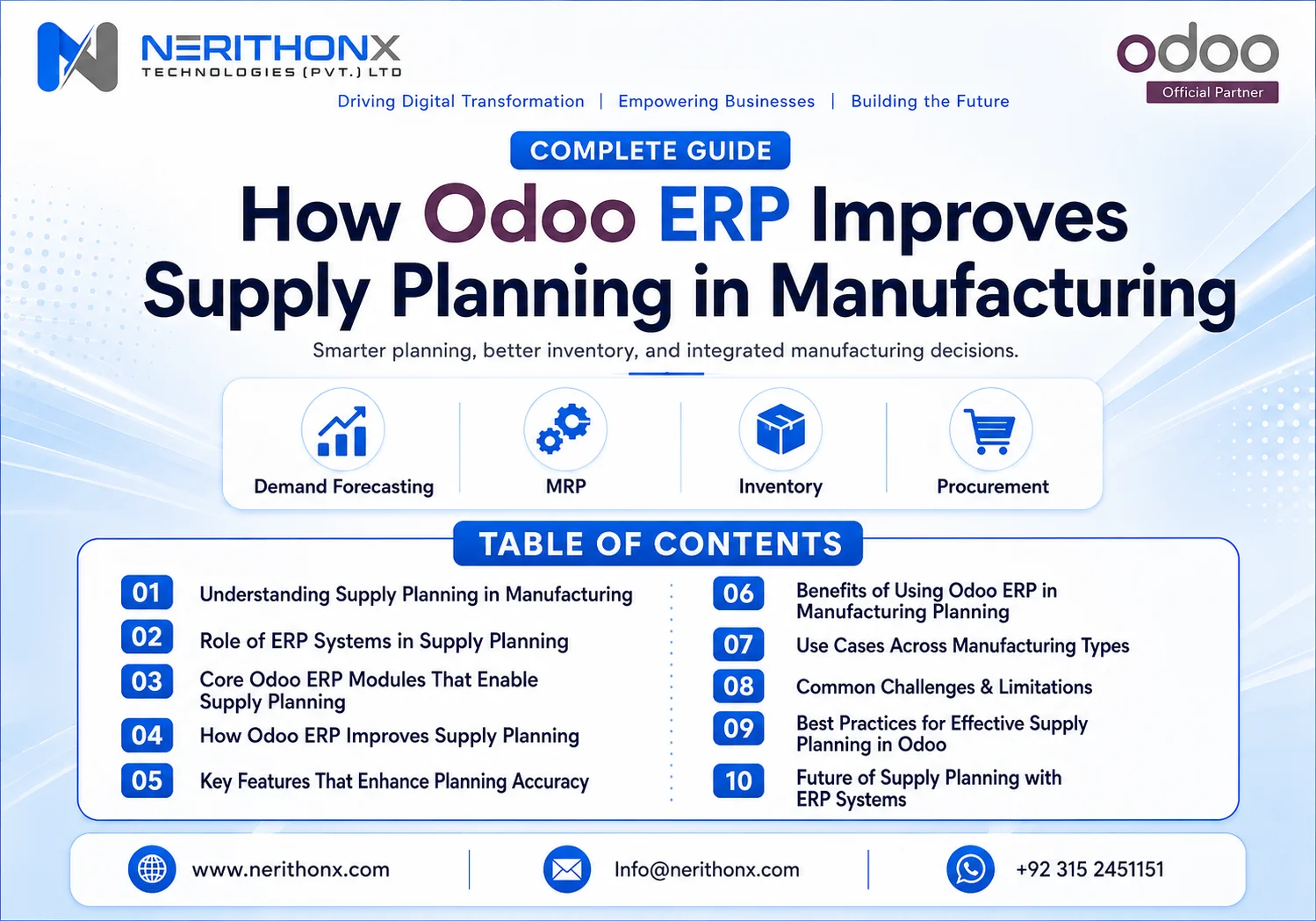
ERP improves supply planning in manufacturing by connecting demand, inventory, procurement, MRP, and production into one real-time system.
In modern manufacturing, supply planning goes beyond managing inventory—it requires aligning demand, production, and procurement in real time. Traditional methods often fall short due to fragmented data and delayed decision-making, leading to inefficiencies like stockouts or overstocking. This is where Odoo ERP introduces a more integrated and data-driven approach.
Odoo ERP improves supply planning by connecting key functions such as demand forecasting, MRP, inventory management, and procurement into a unified system. This enables manufacturers to make informed decisions, optimize stock levels, and streamline production workflows with greater accuracy and visibility.
In this blog, you’ll explore how Odoo transforms supply planning at a system level—how it processes data, automates decisions, and improves operational efficiency. But what exactly makes Odoo different from traditional planning systems, and how does it turn complexity into clarity? As you read on, you’ll uncover the mechanisms that make modern supply planning more responsive and scalable.
At Nerithonx Technologies, we analyze how ERP systems reshape manufacturing processes, and this guide is designed to give you a clear, practical understanding of that transformation.
Understanding Supply Planning in Manufacturing
What Is Supply Planning?
Supply planning in manufacturing is the process of aligning materials, production, and procurement with customer demand. It ensures that the right resources are available at the right time to keep production running smoothly.
It combines demand forecasting, inventory management, and production scheduling into a coordinated system—often powered by ERP tools—to enable accurate and timely decision-making.
Key Challenges in Traditional Planning Systems
Traditional planning systems, such as spreadsheets or disconnected tools, often create inefficiencies:
-
- Outdated data leads to slow decision-making
-
- Inaccurate forecasts cause stockouts or excess inventory
-
- Disconnected processes create gaps between procurement, inventory, and production
-
- Limited visibility makes it hard to track operations
-
- Manual errors reduce planning accuracy
These limitations highlight why modern, integrated systems are essential for effective supply planning.
Role of ERP Systems in Supply Planning
Evolution from Manual to ERP-Based Planning
Supply planning has evolved from manual methods—such as spreadsheets and isolated systems—to fully integrated ERP-based solutions. Traditional approaches relied heavily on static data and human input, making them slow, error-prone, and difficult to scale.
ERP systems transformed this process by introducing real-time data, automation, and centralized control. Instead of reacting to issues after they occur, manufacturers can now anticipate demand, adjust production plans, and manage inventory proactively.
Why Integrated Systems Matter
Integrated ERP systems connect key functions like inventory, procurement, sales, and production within a single platform. This eliminates data silos and ensures that all departments work with consistent, up-to-date information.
As a result, manufacturers gain better visibility, faster decision-making, and improved coordination across the supply chain. This integration is essential for maintaining efficiency, reducing costs, and responding effectively to changing market demands.
Core Odoo ERP Modules That Enable Supply Planning
Odoo MRP (Manufacturing Resource Planning)
The MRP module is central to supply planning in Odoo. It converts demand into production orders by analyzing Bills of Materials (BoMs), work orders, and available resources. It helps manufacturers plan what to produce, when to produce it, and which materials are required—ensuring efficient production scheduling and minimal delays.
Inventory Management Module
Odoo’s Inventory module provides real-time visibility into stock levels across warehouses. It tracks raw materials, work-in-progress, and finished goods, enabling accurate stock control and automated replenishment. This ensures that materials are available when needed without overstocking.
Purchase & Procurement Module
The Purchase module manages supplier interactions and automates procurement processes. It generates purchase orders based on demand, lead times, and inventory rules. This ensures timely availability of raw materials while optimizing supplier coordination and reducing manual effort.
Sales Integration for Demand Signals
Odoo integrates sales data directly into the supply planning process. Customer orders and sales forecasts act as demand signals that trigger production and procurement activities. This alignment ensures that planning decisions are based on actual market demand, improving accuracy and responsiveness.
How ERP Improves Supply Planning in Manufacturing with Odoo (Step-by-Step)
Demand Forecasting & Data Inputs
Odoo starts by collecting demand signals from sales orders, historical data, and forecasts. This data forms the foundation for planning, helping manufacturers anticipate future needs instead of reacting to shortages or excess stock.
Master Production Scheduling (MPS)
Based on demand, Odoo generates a Master Production Schedule (MPS) that defines what products need to be produced and when. It balances demand with available capacity, ensuring production plans are realistic and aligned with business priorities.
Material Requirements Planning (MRP)
The MRP engine breaks down production plans into detailed material requirements using Bills of Materials (BoMs). It calculates the exact quantity and timing of raw materials needed, reducing waste and preventing production delays.
Automated Procurement & Replenishment
Odoo automates procurement by generating purchase orders based on inventory levels, lead times, and demand forecasts. Reordering rules ensure that materials are stock replenished at the right time without manual intervention.
Real-Time Inventory Synchronization
All planning activities are continuously updated with real-time inventory data. This ensures accurate stock visibility across warehouses, enabling faster decisions and better coordination between procurement, production, and sales.
Key Features That Enhance Planning Accuracy
Reordering Rules & Safety Stock
Odoo uses automated reordering rules to maintain optimal inventory levels. By defining minimum and maximum stock thresholds along with safety stock, the system ensures that materials are replenished before shortages occur—reducing the risk of production disruptions.
Lead Time Management
Accurate lead time configuration allows Odoo to plan procurement and production activities effectively. It considers supplier delivery times, manufacturing durations, and internal processing delays to ensure materials and products are available exactly when needed.
BoM Structuring and Dependencies
Bills of Materials (BoMs) in Odoo define product structures and component relationships. Proper BoM configuration enables precise material calculations, ensuring that all dependencies are accounted for during planning and avoiding bottlenecks in production.
Multi-Warehouse Coordination
Odoo supports planning across multiple warehouses by synchronizing inventory data in real time. This allows manufacturers to allocate stock efficiently, transfer materials between locations, and maintain balanced inventory levels across the supply network.
Benefits of Using Odoo ERP in Manufacturing Planning
Inventory Optimization
Odoo ERP enables precise inventory control by aligning stock levels with actual demand. Through real-time tracking and automated replenishment, manufacturers can minimize excess inventory while avoiding stockouts, ensuring optimal resource utilization.
Cost Reduction
By reducing overstocking, preventing production delays, and automating procurement processes, Odoo helps lower operational costs. Improved planning accuracy also minimizes waste, storage expenses, and unnecessary purchasing.
Production Efficiency
Odoo streamlines production workflows by synchronizing materials, work orders, and schedules. This reduces downtime, eliminates bottlenecks, and ensures smoother execution of manufacturing operations.
Data-Driven Decision Making
With centralized and real-time data, Odoo provides clear visibility into all planning activities. Manufacturers can make informed decisions based on accurate insights, improving responsiveness and long-term strategic planning.
Use Cases Across Manufacturing Types
Discrete Manufacturing
In discrete manufacturing—such as electronics, machinery, or automotive components—Odoo ERP helps manage complex Bills of Materials (BoMs), work orders, and production schedules. It ensures that each component is available at the right stage of assembly, improving coordination and reducing delays.
Process Manufacturing
For process-based industries like food, chemicals, or pharmaceuticals, Odoo supports batch production and formula-based planning. It helps maintain consistency in production, manage quantities in bulk, and ensure that raw materials are accurately allocated across batches.
Make-to-Order vs Make-to-Stock
Odoo ERP supports both production strategies:
-
- Make-to-Order (MTO): Production is triggered only after receiving customer orders, reducing excess inventory and aligning closely with demand.
-
- Make-to-Stock (MTS): Products are manufactured based on forecasts and stored as inventory, ensuring quick fulfillment of customer demand.
By handling both models within the same system, Odoo allows manufacturers to adapt their planning strategy based on product type, demand patterns, and operational goals.
Common Challenges & Limitations
Data Dependency Risks
Odoo ERP relies heavily on accurate and consistent data. If inputs such as inventory levels, lead times, or Bills of Materials (BoMs) are incorrect, the entire planning process can be affected—leading to poor decisions and operational inefficiencies.
Implementation Complexity
Implementing Odoo for manufacturing planning requires proper configuration of modules, workflows, and data structures. Without careful setup and alignment with business processes, organizations may face delays, user resistance, or suboptimal system performance.
Forecast Accuracy Issues
Demand forecasting in Odoo depends on historical data and assumptions. Sudden market changes, seasonal fluctuations, or incomplete data can reduce forecast accuracy, impacting production planning and inventory management.
Best Practices for Effective Supply Planning in Odoo
Data Standardization
Accurate planning starts with clean and consistent data. Standardizing inputs such as product information, Bills of Materials (BoMs), lead times, and inventory records ensures that Odoo can generate reliable planning outputs and minimize errors.
Continuous Forecast Adjustment
Supply planning should not be static. Regularly updating forecasts based on real-time sales data, market trends, and seasonal changes helps maintain planning accuracy and prevents mismatches between demand and supply.
Integration Across Departments
Effective supply planning requires alignment between sales, procurement, inventory, and production. Odoo’s integrated system enables seamless data flow across departments, ensuring that all planning decisions are based on shared, up-to-date information.
Comparing ERP-Based Planning vs Traditional Methods
Manual Planning Limitations
Traditional planning methods rely on spreadsheets and disconnected systems, which often lead to outdated data and slow decision-making. These approaches lack real-time visibility, making it difficult to respond to demand changes or supply disruptions. Additionally, heavy dependence on manual input increases the risk of errors and inconsistencies across planning processes.
ERP-Driven Planning Advantages
ERP-based planning systems like Odoo provide a centralized and automated approach. They integrate data from multiple functions—such as inventory, production, and procurement—ensuring accuracy and consistency. With real-time insights, automated workflows, and improved coordination, ERP systems enable faster, more reliable, and scalable supply planning.
Future of Supply Planning with ERP Systems
AI & Predictive Planning
The future of supply planning is increasingly driven by artificial intelligence and predictive analytics. ERP systems are evolving to analyze historical data, detect patterns, and forecast demand with greater accuracy. This enables manufacturers to anticipate disruptions, optimize inventory levels, and make proactive decisions rather than reactive adjustments.
Industry 4.0 Integration
Modern ERP systems are becoming a core part of Industry 4.0 by integrating with technologies such as IoT, smart sensors, and connected machines. This allows real-time data collection from the shop floor, improving visibility into production performance and supply chain activities. As a result, manufacturers can achieve more responsive, automated, and intelligent supply planning processes.
Conclusion
Supply planning is a critical function in manufacturing, directly impacting efficiency, cost control, and overall operational performance. As traditional methods struggle to keep up with increasing complexity, ERP systems like Odoo provide a more structured and data-driven approach by integrating demand, inventory, procurement, and production into a single platform.
Throughout this guide, we explored how Odoo ERP enhances supply planning through real-time visibility, automation, and coordinated workflows. From forecasting demand to managing materials and synchronizing inventory, it enables manufacturers to move from reactive processes to proactive, optimized planning.
As manufacturing continues to evolve with digital transformation and Industry 4.0, the role of integrated ERP systems will become even more essential. Understanding these systems is no longer optional—it is key to building efficient, scalable, and future-ready manufacturing operations.
FAQs
1. What is supply planning in manufacturing?
Supply planning is the process of aligning materials, production, and procurement with expected demand to ensure smooth manufacturing operations.
2. How does Odoo ERP support supply planning?
Odoo connects forecasting, inventory, procurement, and production in one system, enabling accurate and automated planning decisions.
3. What is the role of MRP in Odoo?
MRP calculates material requirements based on production plans, ensuring the right components are available at the right time.
4. Can Odoo reduce inventory costs?
Yes, by optimizing stock levels and automating replenishment, Odoo helps reduce excess inventory and storage costs.
5. How does Odoo improve demand forecasting?
It uses historical data and sales inputs to generate more accurate and data-driven forecasts.
6. What industries can benefit from Odoo supply planning?
Industries like discrete manufacturing, food processing, and electronics benefit due to complex production and inventory needs.
7. Does Odoo support multi-warehouse planning?
Yes, it provides real-time visibility and coordination across multiple warehouse locations.
8. What are reordering rules in Odoo?
They are automated settings that trigger stock replenishment when inventory reaches predefined levels.
9. Is Odoo suitable for small manufacturers?
Yes, it is scalable and works well for small to mid-sized manufacturers with growing operational needs.
10. What is the main advantage of ERP over manual planning?
ERP offers real-time data, automation, and integration, making planning faster, more accurate, and more reliable.



One Response
As a manufacturing professional, I appreciate how the blog highlights the role of Odoo ERP in streamlining supply planning—especially the way it integrates demand forecasting with inventory management. It’s great to see a platform that supports data-driven decision-making, which is crucial for staying agile in today’s fast-paced production environments. The emphasis on real-time visibility really resonates with the challenges many manufacturers face in balancing supply and demand efficiently.