Pharmaceutical manufacturers handle sensitive and controlled operations. They must manage formulas, raw materials, batches, expiry dates, quality checks, production records, inventory movements, supplier records, documentation, and reporting. When these processes are managed manually through spreadsheets, paper records, and disconnected systems, it becomes difficult to maintain visibility, reduce errors, track batches, control quality, and prepare accurate records. This is where pharma manufacturing software becomes important.
Pharma manufacturing is not like simple production. Every batch, material, formula, quality check, expiry date, and inventory movement can affect the final product record. For growing pharmaceutical businesses and SMEs, manual control becomes harder as products, suppliers, batches, warehouses, and users increase.
A connected ERP-based system can help pharmaceutical manufacturers manage production, inventory, quality, purchasing, accounting, costing, and reporting from one platform.
Important note: ERP software can support controlled workflows, documentation, traceability, and reporting. However, regulatory compliance depends on correct configuration, validation where required, SOPs, documentation, user training, internal controls, and applicable country or industry regulations. Businesses should consult qualified regulatory, quality, validation, and compliance professionals for official requirements.
What Is Pharma Manufacturing Software?
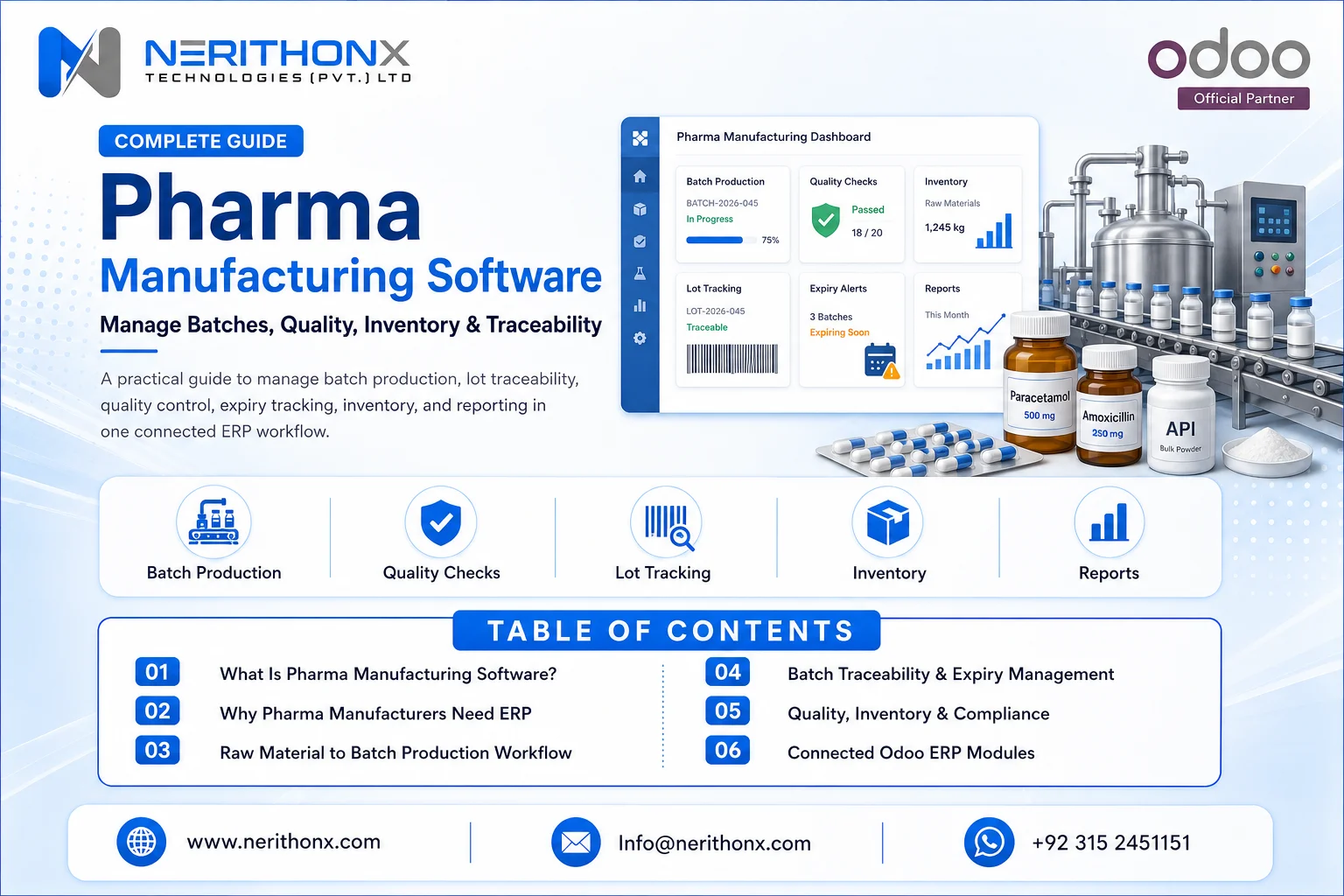
Pharma manufacturing software is a digital system that helps pharmaceutical businesses manage formulas, batch production, raw materials, inventory, quality checks, expiry dates, documentation, traceability, purchasing, production planning, costing, reporting, and controlled workflows.
In simple words, it helps answer important questions:
- Which formula or recipe is approved for production?
- Which raw materials are required for a batch?
- Are the materials available in stock?
- Which lot number was used in production?
- What is the expiry date of each material or finished product?
- Which quality checks were completed?
- Which batch is ready, held, rejected, or released?
- What is the cost of each batch?
- Which finished goods were delivered to which customer?
- Can the business trace a product back to raw materials?
Pharma manufacturing software brings production, quality, inventory, purchasing, and reporting into one connected workflow.
Why Pharma Manufacturing Needs Specialized Software
Pharma production is sensitive and controlled. A small mistake in formula, batch record, expiry date, quality check, or inventory movement can create serious operational risk.
Pharmaceutical businesses need specialized software because:
- Pharma production is controlled and documentation-heavy
- Batch accuracy matters
- Raw material tracking is important
- Quality checks must be documented
- Expiry dates must be controlled
- Formula and recipe control is critical
- Inventory mistakes can affect production
- Traceability supports recall readiness
- Manual records increase the risk of errors
- Management needs reliable reports
- Different countries may have different regulatory expectations
A normal spreadsheet cannot easily manage lot tracking, expiry status, batch costing, quality checks, supplier records, production planning, and user access control together.
Common Problems Without Pharma Manufacturing Software
Without proper software, pharma manufacturers often depend on Excel sheets, paper batch records, manual stock registers, and disconnected quality documents.
Common problems include:
- Manual batch records
- Spreadsheet-based inventory
- Poor lot tracking
- Unclear expiry status
- Raw material shortages
- Wrong formula or recipe versions
- Weak quality documentation
- Paper-based inspection records
- Delayed production planning
- Poor supplier visibility
- Disconnected purchase, inventory, production, quality, and accounting teams
- Difficult batch costing
- No real-time dashboard
- Weak recall readiness
- Difficult audit preparation
- No clear stock status by lot or expiry date
- No controlled access to sensitive records
- Repeated manual data entry
These issues make daily operations slower and riskier. They also make it difficult for management to see the true production, inventory, quality, and financial position of the business.
How Pharma Manufacturing Software Works
A practical pharma manufacturing workflow usually works step by step.
- Raw material is purchased.
- Supplier and material records are created.
- Lot or batch number is assigned.
- Expiry date is recorded where needed.
- Material is inspected or quality checked.
- Approved material is moved to stock.
- Formula or Bill of Materials is selected.
- Manufacturing order is planned.
- Required raw materials are reserved.
- Batch production is executed.
- In-process quality checks are performed.
- Finished goods are inspected.
- Finished batch is moved to inventory.
- Batch cost is calculated.
- Records and reports are updated.
- Products are dispatched with lot and expiry traceability.
- Issues can be investigated using batch history.
This workflow helps connect departments. Purchase knows what materials are needed. Inventory knows what is available. Production knows what to manufacture. Quality knows what to inspect. Accounting can track costs. Management can review reports.

Key Features of Pharma Manufacturing Software
The best pharma manufacturing software should support full production and quality workflows, not only basic stock entry.
Formula and Recipe Management
Formula or recipe management helps define the ingredients and quantities required to produce a medicine, nutraceutical, cosmetic, or healthcare product.
It should support controlled changes, version visibility, and review where required by internal process.
Bill of Materials
A Bill of Materials, or BoM, lists the raw materials, packaging materials, and components needed for a finished product.
In pharma workflows, the BoM may represent a formula, packaging structure, or production recipe.
Batch Manufacturing
Batch manufacturing allows products to be produced in controlled quantities. Each batch should have a unique batch or lot number for traceability.
Master Batch Record Support
A master batch record is a standard approved instruction set for manufacturing a product. Software can help structure this information digitally, depending on the process and configuration.
Batch Manufacturing Record Support
A batch manufacturing record captures what happened during actual production. It may include material usage, quantities, operators, quality checks, timings, deviations, and approvals.
Manufacturing Orders
Manufacturing orders help plan and execute production. They define the product, quantity, components, operations, and production status.
Material Requirements Planning
MRP helps calculate what materials are required for planned production and whether stock is available.
Production Planning
Production planning helps schedule batches based on demand, materials, work centers, capacity, and delivery requirements.
Work Centers and Operations
Work centers represent machines, production areas, or departments. Operations define the steps needed to manufacture a product.
Shop Floor Tracking
Shop floor tracking helps teams record production progress, work order status, component usage, time, and quality activities during production.
Raw Material Inventory
The system should track raw material stock by product, location, supplier, lot number, and expiry date where applicable.
Lot and Serial Number Tracking
Lot tracking helps trace batches of raw materials, semi-finished goods, and finished goods. Serial tracking may be useful for individual item tracking where required.
Expiry Date Management
Expiry date management helps identify expired or near-expiry stock and supports safer inventory movement.
FEFO/FIFO Support Where Applicable
FEFO means First Expired, First Out. It is useful for expiry-sensitive items. FIFO means First In, First Out. The suitable removal method depends on the business process and product type.
Quality Control
Quality control helps verify incoming materials, in-process production, and finished goods.
Quality Checks
Quality checks help record inspection results such as pass/fail checks, measurements, worksheets, or instructions.
Quality Alerts
Quality alerts help notify quality teams when defects, deviations, or issues are found.
Nonconformance and Deviation Tracking
Nonconformance and deviation tracking helps record when a process, material, or product does not meet expected requirements.
CAPA Tracking
Corrective and Preventive Action, or CAPA, helps businesses track root causes, corrective actions, preventive actions, responsibility, deadlines, and closure status. CAPA may require customization depending on workflow requirements.
Supplier Management
Supplier records help track vendors, purchase history, material quality, delivery performance, and supplier-related issues.
Purchase Planning
Purchase planning helps ensure required raw materials and packaging materials are available before production starts.
Warehouse Management
Warehouse management helps control raw materials, packaging, semi-finished goods, finished goods, quarantine stock, approved stock, rejected stock, and stock transfers.
Product Costing
Product costing helps calculate raw material cost, operation cost, overheads where configured, scrap, wastage, and finished goods cost.
Accounting Integration
Accounting integration connects purchases, inventory valuation, manufacturing cost, sales, invoicing, and financial reports.
Document Management
Document management helps organize SOPs, specifications, batch documents, quality documents, and internal records where configured.
Audit Trail and Activity Tracking
Audit trails and activity tracking support accountability by showing important user actions where available and configured.
User Access Control
Different teams need different access. QA, production, inventory, purchase, accounting, and management users should have role-based rights.
Reports and Dashboards
Reports help management review batch status, production progress, material shortages, quality issues, stock expiry risk, costing, and sales fulfillment.
Multi-Warehouse and Multi-Company Support
Growing pharma businesses may operate multiple warehouses, branches, factories, or companies. ERP can help centralize and separate records where needed.
Integration with Barcode, Labels, or Third-Party Tools
Barcode scanning, label printing, lab systems, e-commerce, accounting tools, or third-party systems may be integrated depending on business needs, technical feasibility, and provider support.
Pharma Manufacturing Software vs General Manufacturing ERP
General manufacturing ERP supports production, inventory, purchasing, sales, and accounting.
Pharma manufacturing software needs stronger focus on:
- Batch control
- Formula accuracy
- Quality documentation
- Expiry tracking
- Lot traceability
- Recall readiness
- Controlled records
- User access control
- Documentation workflows
A flexible ERP like Odoo can be configured and customized for pharma workflows, but pharma-specific needs must be carefully mapped before implementation.
Pharma Manufacturing Software vs QMS Software
QMS software focuses mainly on quality processes such as inspections, nonconformance, CAPA, audits, complaints, and documentation.
Pharma manufacturing software connects quality with production, inventory, purchasing, formulas, batch records, costing, dispatch, and reporting.
For pharma businesses, quality should not stay separate from production and inventory. Quality checks should connect with materials, batches, manufacturing orders, stock movements, and finished goods.
Pharma Manufacturing Software vs LIMS
LIMS means Laboratory Information Management System. It focuses mainly on laboratory information, sample testing, test results, and lab workflows.
Pharma manufacturing software focuses on:
- Production
- Inventory
- Batch manufacturing
- Materials
- Formulas
- Quality checks
- Costing
- Purchasing
- Sales
- Business operations
Some pharma businesses may need both ERP and LIMS. Integration depends on the company’s process, system requirements, and regulatory expectations.
Benefits of Pharma Manufacturing Software
Pharma manufacturing software gives practical benefits to pharmaceutical manufacturers and SMEs.
Key benefits include:
- Better production visibility
- Better batch control
- Improved inventory accuracy
- Reduced manual record work
- Better expiry tracking
- Improved quality documentation
- Better supplier and purchase planning
- Better traceability
- Faster issue investigation
- Better costing visibility
- Better management reporting
- Improved coordination between departments
- Scalable operations for growing pharma businesses
The goal is not only digitalization. The goal is better control, better visibility, and better decision-making.
Batch Manufacturing and Formula Management
Batch manufacturing and formula management are central parts of pharma production.
Formulas and recipes must be controlled because they define what materials are used and in what quantity. If the wrong formula version is used, production output and records can be affected.
A proper ERP workflow helps teams:
- Define BoMs or formulas
- Use approved production structures
- Reserve required raw materials
- Track actual consumption
- Record batch output
- Track wastage or scrap
- Review production status
- Connect quality checks with the batch
Changes to formulas should be reviewed and documented according to the company’s internal process. ERP can support this workflow, but the company must define the approval rules and quality responsibilities.
Batch manufacturing and formula management are central parts of pharma production.
Formulas and recipes must be controlled because they define what materials are used and in what quantity. If the wrong formula version is used, production output and records can be affected.
A proper ERP workflow helps teams:
- Define BoMs or formulas
- Use approved production structures
- Reserve required raw materials
- Track actual consumption
- Record batch output
- Track wastage or scrap
- Review production status
- Connect quality checks with the batch
Changes to formulas should be reviewed and documented according to the company’s internal process. ERP can support this workflow, but the company must define the approval rules and quality responsibilities.
Lot Tracking, Expiry Management, and Traceability
Lot tracking is important in pharma manufacturing because businesses need to know which raw materials were used in which batch and where finished goods were delivered.
Expiry management helps reduce the risk of using expired or near-expiry stock incorrectly.
Traceability helps answer questions such as:
- Which supplier provided this raw material?
- Which lot was used in production?
- Which finished batch contains this material?
- Where is this finished batch stored?
- Which customer received this batch?
- Which stock is expired or close to expiry?
Traceability supports recall readiness. Actual recall procedures depend on company policy, internal SOPs, and regulatory requirements.

Quality Control in Pharma Manufacturing Software
Quality control helps ensure that materials and products meet defined requirements.
In pharma manufacturing software, quality workflows may include:
- Incoming material checks
- In-process quality checks
- Finished product inspection
- Quality alerts
- Defect or deviation recording
- Quarantine and release workflow where configured
- Quality reports
- QA/QC team responsibilities
Quality teams may inspect raw materials when received. Production teams may perform in-process checks during manufacturing. Finished goods may need final quality review before release.
ERP can help record and manage quality workflows, but official quality requirements must be defined by qualified quality professionals.
Electronic Batch Records and Documentation
Electronic batch records are digital records of batch production activities.
They may include:
- Product name
- Batch number
- Formula or BoM
- Raw materials used
- Operators
- Production steps
- Timings
- Quality checks
- Deviations
- Approvals
- Output quantity
- Wastage or scrap
- Final status
Digital records can reduce manual paperwork and make searching easier. However, electronic records require proper access control, approvals, activity tracking, backup planning, and document control.
21 CFR Part 11 is a regulatory concept related to electronic records and electronic signatures in FDA-regulated contexts. ERP software does not automatically become compliant with 21 CFR Part 11. If applicable, businesses must evaluate requirements with qualified regulatory and validation professionals.
Inventory and Warehouse Management for Pharma
Pharma inventory needs strong control because raw materials, packaging materials, semi-finished goods, and finished goods may require different handling.
Important inventory areas include:
- Raw material stock
- Packaging material stock
- Semi-finished goods
- Finished goods
- Quarantine location
- Approved stock
- Rejected stock
- Expiry-based stock visibility
- Lot-wise stock reports
- Warehouse transfers
- Stock adjustments with control
- Barcode support where configured
A proper warehouse structure helps separate approved, rejected, quarantine, and expired stock. This improves visibility and reduces operational confusion.
Pharma Production Planning and MRP
Pharma production planning helps decide what to produce, when to produce, and which materials are required.
Production planning may include:
- Demand forecasting
- Material requirements planning
- Purchase planning
- Batch scheduling
- Work centers
- Manufacturing orders
- Raw material reservation
- Production status tracking
- Production delay visibility
- Connection with sales and inventory
MRP helps identify material shortages before production starts. This is important because delayed raw materials can delay the full batch schedule.
Costing and Accounting in Pharma Manufacturing Software
Pharma manufacturers need costing visibility to understand batch cost, product profitability, and inventory value.
A pharma ERP system can support:
- Raw material costing
- Batch-wise costing
- Manufacturing overheads where configured
- Scrap or wastage visibility
- Purchase cost tracking
- Inventory valuation
- Sales and invoicing connection
- Management reports
- Accounting integration
When production and accounting are disconnected, finance teams may not get accurate cost information. ERP connects manufacturing with inventory and accounting for better financial control.
Data Security and User Access in Pharma ERP
Pharma records are sensitive. Not every user should access or edit every record.
A good pharma ERP setup should include role-based access for:
- QA users
- QC users
- Production users
- Inventory users
- Purchase users
- Accounting users
- Managers
- System administrators
Access rights matter because formula records, batch records, quality results, supplier records, stock adjustments, and accounting entries must be controlled.
Audit trails and activity logs support accountability where available. Backups and secure hosting are also important. User training helps reduce mistakes and improves system discipline.
GMP, FDA, 21 CFR Part 11, and Compliance Awareness
GMP and cGMP are quality and manufacturing control concepts used in pharmaceutical industries. They focus on controlled production, quality systems, documentation, and process discipline.
FDA 21 CFR Part 11 relates to electronic records and electronic signatures in FDA-regulated contexts.
Different countries have different regulatory expectations. Pharma businesses in Pakistan, UAE, Saudi Arabia, UK, USA, Canada, Europe, and other regions may need to follow different rules depending on product type, market, and regulatory authority.
ERP software can support:
- Controlled workflows
- Documentation
- Traceability
- Quality checks
- User access control
- Reporting
- Batch records
- Inventory visibility
However, ERP software alone does not guarantee GMP, FDA, ISO, or 21 CFR Part 11 compliance. Compliance depends on validated processes where required, correct configuration, documentation, SOPs, training, controls, and qualified review.
Businesses should consult regulatory, validation, and quality professionals for official requirements.
How Odoo ERP Can Support Pharma Manufacturing Workflows
Odoo ERP is a flexible business system that can support pharma manufacturing workflows through manufacturing, inventory, quality, purchase, accounting, reporting, and customization.
Relevant Odoo areas include:
- Odoo Manufacturing
- Odoo Inventory
- Odoo Purchase
- Odoo Sales
- Odoo Quality
- Odoo Accounting
- Odoo Maintenance
- Odoo Barcode
- Odoo PLM where relevant
- Odoo Documents where relevant
- Odoo Reporting
- Odoo Access Rights
- Odoo Studio and customization where appropriate
A practical Odoo-based pharma workflow may include:
- Products and raw materials are created.
- BoMs or formulas are configured.
- Suppliers and purchase workflows are set.
- Lot and serial tracking is enabled where needed.
- Expiration dates are configured for expiry-sensitive products.
- Inventory locations are created for approved, quarantine, and rejected stock where required.
- Manufacturing orders are generated.
- Work centers and work orders are used for production steps.
- Quality control points trigger quality checks.
- Quality alerts record defects or issues.
- Finished goods move to inventory with lot and expiry tracking.
- Accounting and costing reports are updated.
- Role-based access controls user permissions.
- Custom workflows support pharma-specific needs.
Odoo can support many pharma manufacturing requirements, but it must be carefully configured and customized around the business process. It should not be presented as automatically compliant or validated without proper review.

When Should a Pharma Business Use Manufacturing Software?
A pharma business should consider manufacturing software when manual control becomes difficult.
Common signs include:
- Batch records are manual
- Inventory is managed in Excel
- Expiry tracking is difficult
- Quality records are scattered
- Production delays are increasing
- Raw material shortages happen often
- Lot tracking is weak
- Formula changes are hard to control
- Management cannot see real-time production reports
- Audit preparation takes too much time
- Accounting is disconnected from production
- The business is growing and manual control is not enough
If these problems are happening regularly, a connected ERP-based manufacturing system can improve visibility and control.
How to Choose the Right Pharma Manufacturing Software
Choosing the right pharma manufacturing software depends on business size, production complexity, quality requirements, and regulatory expectations.
Use this checklist:
- Business size
- Type of pharma manufacturing
- Batch complexity
- Formula and BoM support
- Lot and expiry tracking
- Quality workflow support
- Inventory and warehouse control
- Purchase and supplier management
- Production planning
- Documentation needs
- User access control
- Audit trail support
- Reporting dashboards
- Accounting integration
- Customization options
- Cloud or on-premise needs
- Validation and compliance support requirements
- Training and support
- Implementation partner experience
- Total cost of ownership
- Post-go-live support
Do not choose software only because it has many features. Choose a system that fits real workflows and can be adopted by production, quality, inventory, purchase, accounting, and management teams.
Pharma Manufacturing Software Implementation Process
A proper implementation process reduces mistakes and improves user adoption.
A practical implementation may include:
- Business process study
- Requirement gathering
- Regulatory and quality requirement review by qualified stakeholders
- Workflow mapping
- Master data cleaning
- Product and material setup
- Formula and BoM setup
- Lot and expiry rules setup
- Inventory location setup
- Quality workflow setup
- User roles and access rights
- Reports and document format planning
- System configuration
- Customization where needed
- Testing
- User training
- Data migration
- Go-live planning
- Post-go-live support
- Continuous improvement
Master data cleaning is very important. If product names, formulas, units of measure, lots, expiry dates, suppliers, or stock balances are wrong, reports and production planning can also become wrong.
Common Implementation Mistakes to Avoid
Pharma ERP implementation can fail if the process is rushed.
Avoid these mistakes:
- Starting without process mapping
- Ignoring quality and regulatory users
- Importing dirty data
- Poor formula or BoM setup
- Weak lot and expiry tracking setup
- Giving too many users admin rights
- Not defining quality checks
- No inventory location structure
- No staff training
- Over-customizing before testing standard workflows
- Skipping validation planning where required
- Ignoring reports and KPIs
- No backup plan
- No post-go-live support
- Not involving production users during testing
- Not documenting important workflows
A good implementation should be practical, tested, and understood by users.
Important Pharma Manufacturing KPIs
KPIs help management review production and quality performance.
Important pharma manufacturing KPIs include:
- Batch completion rate
- Production lead time
- On-time batch release
- Material shortage rate
- Quality check pass rate
- Deviation count
- CAPA closure time if used
- Rejected batch count
- Scrap or wastage rate
- Inventory expiry risk
- Lot traceability accuracy
- Stockout rate
- Supplier on-time delivery
- Batch cost variance
- Order fulfillment rate
- Audit readiness indicators where applicable
These KPIs help management identify delays, quality issues, material problems, supplier weaknesses, and costing gaps.
Pharma Manufacturing Software for Global Businesses
Pharma manufacturers in Pakistan, UAE, Saudi Arabia, UK, USA, Canada, Europe, and other international markets face similar operational challenges.
These include:
- Batch control
- Quality documentation
- Supplier management
- Expiry tracking
- Traceability
- Production planning
- Inventory visibility
- Costing
- Reporting
- User access control
A flexible ERP system can be adapted to different workflows, warehouses, currencies, companies, users, reports, and approval structures.
This makes ERP-based pharma manufacturing useful for:
- pharma manufacturing software in Pakistan
- pharma manufacturing software in UAE
- pharma manufacturing software in Saudi Arabia
- pharma manufacturing software in UK
- pharma manufacturing software in USA
- pharma manufacturing software in Canada
- pharma manufacturing software in Europe
- Odoo pharma manufacturing software for global businesses
Regulatory expectations vary by country. The software and workflows should be adapted to local rules, internal SOPs, quality requirements, warehouses, users, currencies, and reporting needs.
How NerithonX Technologies Helps
NerithonX Technologies helps businesses plan, implement, customize, integrate, train, and support Odoo ERP workflows.
For pharma manufacturing businesses, NerithonX Technologies can help with:
- Odoo implementation
- Odoo customization
- Odoo integration
- Odoo migration
- Odoo support and maintenance
- Odoo training
- ERP consulting
- Business automation
- Pharma manufacturing workflow planning
- Inventory and batch tracking setup
- Quality workflow setup
- Manufacturing process configuration
- Accounting and costing setup
- Reporting and dashboard setup
- User access planning
- Post-go-live support
NerithonX Technologies does not need to make fake compliance, validation, FDA, GMP, or ISO claims. The practical value is helping businesses design better ERP workflows for production, inventory, batch tracking, quality checks, expiry management, costing, and reporting.
Need pharma manufacturing software for your business?
NerithonX Technologies can help you plan, implement, customize, and support Odoo ERP workflows for batch manufacturing, inventory, quality checks, lot tracking, expiry management, accounting, reporting, and business automation.
Final Thoughts
Pharma manufacturing software helps pharmaceutical businesses improve production visibility, batch control, inventory accuracy, quality documentation, expiry tracking, costing, and reporting.
The right ERP-based system can connect formulas, raw materials, purchasing, manufacturing orders, quality checks, finished goods, lot traceability, expiry dates, accounting, and management dashboards.
For SMEs and growing pharma manufacturers, this can reduce manual record work and improve coordination between departments.
ERP software can support controlled workflows and documentation, but it does not automatically guarantee regulatory compliance. Pharma businesses should define SOPs, validation needs, documentation requirements, user training, and internal controls with qualified professionals.
If your business is still managing pharma production through spreadsheets, paper records, and disconnected systems, a connected ERP workflow can help you build better visibility and control.
FAQ
Frequently Asked Questions
What is pharma manufacturing software?
Pharma manufacturing software is a digital system that helps pharmaceutical businesses manage formulas, batch production, raw materials, inventory, quality checks, expiry dates, documentation, traceability, costing, and reporting.
Why do pharmaceutical manufacturers need specialized software?
Pharmaceutical manufacturers need specialized software because they must manage batch accuracy, formula control, raw material tracking, expiry dates, quality documentation, lot traceability, and controlled records.
What features should pharma manufacturing software include?
It should include formula management, BoMs, batch manufacturing, manufacturing orders, MRP, lot tracking, expiry management, quality checks, quality alerts, inventory control, costing, reporting, access rights, and accounting integration.
What is the difference between pharma manufacturing software and general ERP?
General ERP supports business operations such as production, inventory, purchase, sales, and accounting. Pharma manufacturing software needs stronger focus on batch control, formula accuracy, quality documentation, expiry tracking, traceability, and controlled records.
How does pharma manufacturing software support batch traceability?
It links raw material lots, manufacturing orders, finished goods batches, expiry dates, stock movements, quality checks, and deliveries so businesses can trace batch history more clearly.
Can pharma manufacturing software help with expiry tracking?
Yes. Pharma manufacturing software can help track expiry dates for raw materials and finished goods, identify near-expiry stock, and support expiry-based warehouse movement where configured.
What are electronic batch records?
Electronic batch records are digital records of batch production activities, including formula, materials used, production steps, quality checks, operators, timings, deviations, approvals, and final output.
Is Odoo good for pharma manufacturing workflows?
Odoo can support pharma manufacturing workflows through Manufacturing, Inventory, Quality, Purchase, Sales, Accounting, lot tracking, expiration dates, quality checks, quality alerts, reporting, access rights, and customization.
Does ERP software guarantee GMP or FDA compliance?
No. ERP software does not automatically guarantee GMP, FDA, ISO, or 21 CFR Part 11 compliance. Compliance depends on correct configuration, validation where required, SOPs, documentation, training, internal controls, and qualified review.
Can NerithonX Technologies help implement Odoo for pharma manufacturing?
Yes. NerithonX Technologies can help businesses plan, implement, customize, integrate, train, and support Odoo ERP workflows for batch manufacturing, inventory, quality checks, lot tracking, expiry management, accounting, reporting, and business automation.