Many businesses start with separate tools for sales, accounting, inventory, support, HR, and reporting. In the beginning, this may look manageable. A small team can use spreadsheets, simple invoicing software, WhatsApp groups, and separate CRM tools.
But when the business grows, the problems become clear.
Sales teams do not know the latest stock position. Finance teams wait for invoice details. Inventory teams update records late. Management cannot see real-time reports. Data becomes scattered, and decision-making becomes slow.
This is where business software becomes important.
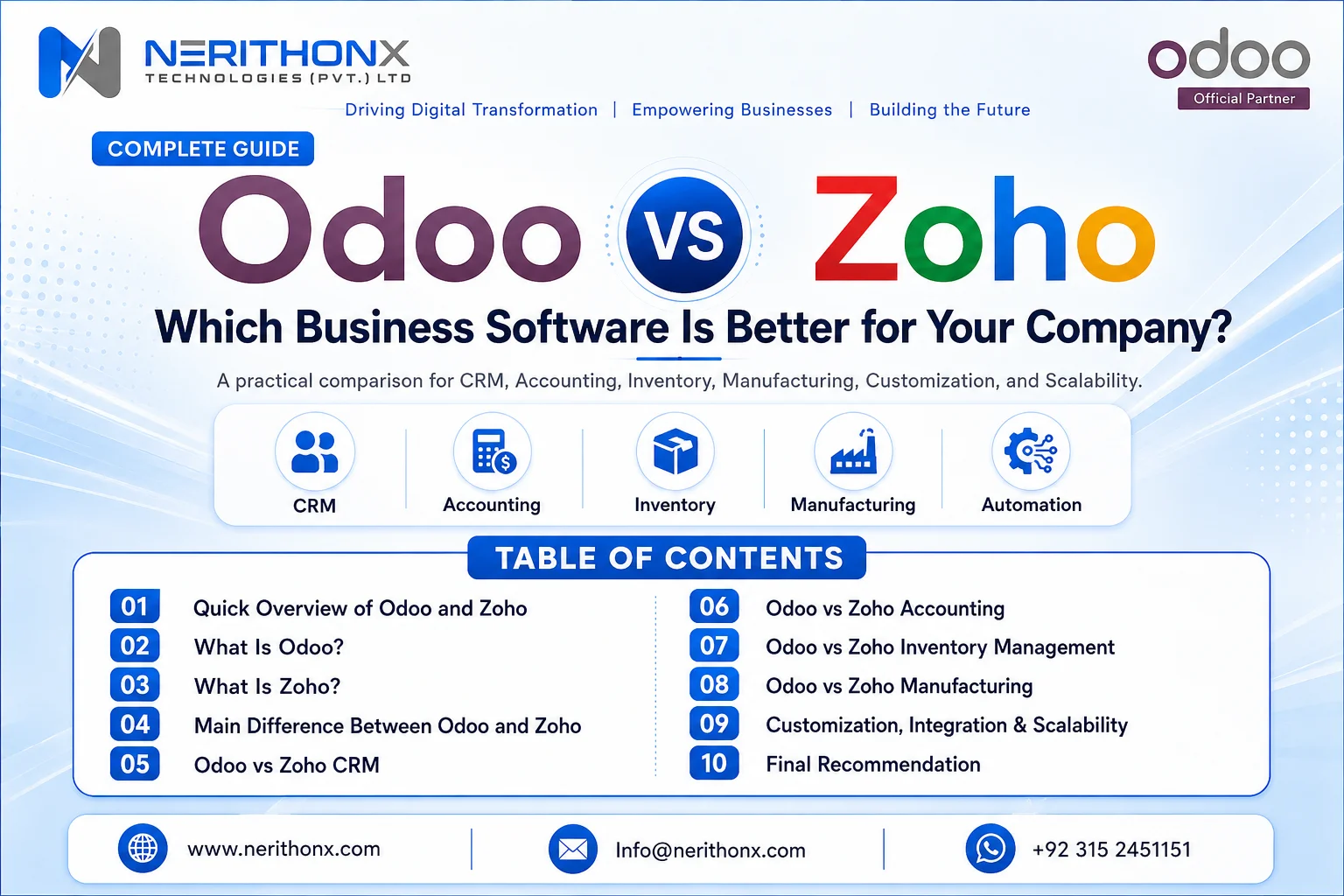
Two popular options many companies compare are Odoo and Zoho. Both are powerful platforms, but they are not the same. Odoo is known as an integrated ERP and business management platform, while Zoho is a cloud-based business app suite with strong CRM, finance, support, marketing, and productivity tools. Odoo’s official platform positioning focuses on integrated business apps, while Zoho One is officially presented as a unified software platform with 50+ apps.
So, in this detailed Odoo vs Zoho comparison, we will explain which software is better for your company based on CRM, accounting, inventory, manufacturing, customization, scalability, pricing factors, and Pakistani business needs.
Quick Overview of Odoo and Zoho
Odoo and Zoho both help businesses manage daily operations, but their main approach is different.
Odoo is an ERP and integrated business management platform. It connects departments such as sales, accounting, inventory, purchase, manufacturing, HR, POS, eCommerce, website, and projects inside one system.
Zoho is a cloud-based business software ecosystem. It provides many ready-to-use apps for CRM, marketing, support, finance, collaboration, communication, HR, and productivity. Zoho One includes 50+ apps for different business areas.
In simple words:
Zoho is better when a business needs quick cloud apps and simple business management.
Odoo is better when a business needs a complete ERP system with connected departments, customization, inventory, accounting, manufacturing, and long-term scalability.
What Is Odoo?
Odoo is a complete ERP platform that helps companies manage different business departments in one connected system.
It includes apps such as:
- CRM
- Sales
- Accounting
- Inventory
- Purchase
- Manufacturing
- POS
- eCommerce
- HR
- Website
- Project Management
- Helpdesk
- Marketing
- Reporting
The biggest strength of Odoo is its modular structure. A business can start with one or two apps, such as CRM and Sales, and later add Accounting, Inventory, Manufacturing, HR, or eCommerce as the company grows.
For example, a distribution company in Pakistan can start with Sales and Inventory. Later, it can connect Purchase, Accounting, Barcode, POS, and Delivery workflows. This makes Odoo useful for businesses that want long-term automation instead of using separate tools.
Odoo is also strong in customization. If a company has a specific approval process, custom invoice format, inventory rule, manufacturing flow, or reporting requirement, Odoo can be configured or customized according to that workflow.
What Is Zoho?
Zoho is a cloud-based software ecosystem that provides many business applications under one brand.
Zoho One is one of its most popular offerings. It includes 50+ apps covering sales, marketing, support, communication, collaboration, productivity, finance, operations, HR, business process, legal, and security areas.
Zoho is especially strong for:
- CRM
- Lead management
- Sales automation
- Email marketing
- Customer support
- Online accounting
- Team collaboration
- Productivity tools
- Cloud-based business operations
For small businesses and service-based teams, Zoho can be a very good choice because many apps are ready to use. A company can quickly start using Zoho CRM, Zoho Books, Zoho Desk, Zoho Campaigns, and other tools without heavy implementation.
Zoho works well for businesses that want simple cloud software and do not need deep ERP workflows.
Main Difference Between Odoo and Zoho
The main difference is simple:
Odoo is ERP-centered.
Zoho is app-suite-centered.
Odoo focuses on connected business operations. Zoho focuses on providing many cloud apps for different business needs.
|
Comparison Point |
Odoo |
Zoho |
|
Platform Type |
ERP and integrated business management system |
Cloud-based business app suite |
|
Best For |
Complete ERP, operations, automation, customization |
CRM, productivity, support, marketing, simple business apps |
|
CRM |
Strong when connected with sales, inventory, invoices, projects |
Strong standalone CRM for sales teams |
|
Accounting |
Powerful when connected with ERP workflows |
Strong cloud accounting through Zoho Books |
|
Inventory |
Strong for warehouses, purchasing, delivery, valuation, manufacturing |
Useful for simple inventory, orders, and warehouses |
|
Manufacturing |
Strong MRP workflows |
Not usually the first choice for deep manufacturing ERP |
|
Customization |
High customization through modules, workflows, reports, and development |
Good configuration, but less ERP-level customization |
|
Integration |
Strong internal integration across ERP modules |
Strong integration inside Zoho ecosystem and cloud tools |
|
Ease of Use |
User-friendly after proper setup and training |
Easier for beginners and small teams |
|
Scalability |
Strong for multi-department and long-term ERP growth |
Good for teams using cloud apps |
|
Implementation Need |
Needs proper planning, setup, and training |
Usually faster to start |
|
Best Business Type |
Trading, manufacturing, retail, services, distribution, multi-branch companies |
Small teams, service businesses, sales teams, support teams |
Odoo vs Zoho CRM
CRM is one of the most important areas in the Odoo vs Zoho comparison.
Zoho CRM is popular because it is easy to start, cloud-based, and focused on sales teams. It helps businesses manage leads, contacts, deals, pipelines, follow-ups, customer communication, and sales reporting.
Odoo CRM also manages leads, opportunities, pipelines, activities, quotations, and customer communication. But its biggest strength appears when CRM is connected with other departments.
For example, in Odoo, a lead can become a quotation, then a sales order, then a delivery order, then an invoice, and later a customer support or project task. This is useful for companies that do not want CRM to work separately from sales, inventory, accounting, and operations.
CRM Comparison
|
CRM Feature |
Odoo CRM |
Zoho CRM |
|
Lead Management |
Yes |
Yes |
|
Pipeline Tracking |
Yes |
Yes |
|
Sales Automation |
Yes |
Yes |
|
Customer Communication |
Yes |
Yes |
|
Reporting |
Yes |
Yes |
|
Sales Order Connection |
Strong |
Available through integrations |
|
Inventory Connection |
Strong inside ERP |
Depends on connected apps |
|
Invoicing Connection |
Strong inside ERP |
Available with Zoho Books integration |
Conclusion:
Zoho CRM is strong for sales teams and quick CRM adoption. Odoo CRM is stronger when CRM must connect with quotations, sales orders, inventory, invoicing, projects, and after-sales workflows.
Odoo vs Zoho Accounting
Accounting is another major decision point for businesses.
Zoho Books is a strong cloud accounting software. It supports invoicing, payments, banking, tax-related features, and financial management for small businesses. Zoho describes Zoho Books as online accounting software with invoicing, payments, banking, and tax features.
Odoo Accounting is also powerful, especially when finance needs to connect with sales, purchase, inventory, POS, and other ERP operations.
For example, when a sales invoice is created in Odoo, it can be linked with the sales order, customer, delivery, inventory movement, payment, and accounting entries. This helps finance teams avoid duplicate work and manual reconciliation.
Accounting Comparison
|
Accounting Feature |
Odoo Accounting |
Zoho Books |
|
Customer Invoices |
Yes |
Yes |
|
Vendor Bills |
Yes |
Yes |
|
Payments |
Yes |
Yes |
|
Bank Reconciliation |
Yes |
Yes |
|
Financial Reports |
Yes |
Yes |
|
Tax Configuration |
Yes |
Yes |
|
Sales Integration |
Strong inside ERP |
Strong with Zoho ecosystem |
|
Purchase Integration |
Strong inside ERP |
Available |
|
Inventory Integration |
Strong inside ERP |
Available with Zoho Inventory |
|
POS Integration |
Strong inside ERP |
Depends on setup |
Conclusion:
Zoho Books is strong as cloud accounting software. Odoo Accounting becomes more powerful when finance must connect with complete ERP operations.
Odoo vs Zoho Inventory Management
For businesses that deal with products, stock control is very important.
Zoho Inventory helps businesses manage orders, shipping, and warehouses. Zoho also describes features for managing multiple warehouses, stock transfers, and warehouse reports.
Odoo Inventory is stronger when inventory needs to connect deeply with purchase, sales, accounting, barcode, warehouse routes, delivery, manufacturing, and valuation.
For example, a Pakistani trading company may need to manage multiple warehouses, purchases from vendors, sales orders, delivery challans, invoices, stock valuation, and reorder rules. Odoo can connect these workflows in one system.
Inventory Comparison:
|
Inventory Feature |
Odoo Inventory |
Zoho Inventory |
|
Stock Tracking |
Yes |
Yes |
|
Multiple Warehouses |
Yes |
Yes |
|
Purchase Flow |
Strong |
Available |
|
Sales Delivery Flow |
Strong |
Available |
|
Reordering |
Yes |
Yes |
|
Barcode |
Yes |
Available depending on setup |
|
Inventory Valuation |
Strong with accounting |
Available depending on setup |
|
Manufacturing Connection |
Strong |
Limited compared to ERP MRP |
|
Accounting Connection |
Strong inside ERP |
Available through Zoho finance apps |
Conclusion:
Zoho Inventory is useful for simple inventory and online sellers. Odoo Inventory is stronger for businesses with warehouses, purchasing, sales, manufacturing, and accounting connected in one system.
Odoo vs Zoho Manufacturing
Manufacturing is one area where Odoo usually becomes the stronger choice.
Odoo Manufacturing supports manufacturing workflows such as planning, reporting, work orders, Bills of Materials, production tracking, and work center planning. Odoo’s official manufacturing feature page mentions work orders, Bills of Materials, planning, and work center capacity.
A manufacturing company may need:
- Bill of Materials
- Raw material consumption
- Work orders
- Production planning
- Inventory connection
- Purchase planning
- Quality checks
- Maintenance
- Costing
- Production reports
Odoo can manage these workflows depending on proper implementation and configuration.
Zoho is not bad, but it is usually not the first choice for companies that need deep manufacturing ERP workflows. Zoho can work well for sales, CRM, finance, support, and general business apps, but manufacturing companies often need more connected ERP logic.
Conclusion:
For manufacturing businesses, Odoo is usually the better option because it is designed for ERP-level operations.
Odoo vs Zoho Customization
Every business has its own working style.
Some companies need simple software. Others need custom approval flows, reports, user roles, invoice formats, warehouse rules, customer portals, or integrations.
Odoo is better when the business needs software to match its exact workflow. With professional Odoo Customization Services, businesses can configure custom modules, reports, approval flows, automations, and third-party integrations according to their real process.Zoho also supports customization and automation inside its ecosystem. But for deep ERP-level customization, Odoo is usually more flexible.
Customization Comparison
|
Customization Need |
Odoo |
Zoho |
|
Workflow Customization |
Strong |
Good |
|
Custom Modules |
Strong |
Limited compared to ERP development |
|
Custom Reports |
Strong |
Good |
|
Approval Flows |
Strong |
Available |
|
Automation |
Strong |
Strong inside Zoho ecosystem |
|
Third-Party Integrations |
Strong |
Strong |
|
ERP-Level Process Design |
Strong |
Limited compared to Odoo |
Conclusion:
Odoo is better when the business needs software to match its exact workflow. Zoho is better when the business wants ready-made cloud apps with less customization complexity.
Odoo vs Zoho Integration
Both Odoo and Zoho support integrations.
Zoho works well inside its own app ecosystem. For example, Zoho Books can integrate with Zoho CRM so teams can manage customer and accounting information together.
Odoo is strong when internal business modules need to work together in one ERP system. Sales, purchase, inventory, accounting, manufacturing, HR, POS, website, and projects can work as connected departments.
For companies using different external platforms, both systems can be integrated with third-party tools depending on requirements, APIs, and implementation.
Conclusion:
Zoho is strong for cloud app ecosystem integration. Odoo is stronger when business departments need one connected ERP workflow.
Odoo vs Zoho Ease of Use
Zoho may feel easier for beginners because many apps are cloud-based and ready to use. A small sales or support team can start quickly with Zoho CRM, Zoho Desk, or Zoho Books.
Odoo is also user-friendly, but it needs proper setup. If Odoo is implemented without process mapping, user training, and correct configuration, users may feel confused.
The real difference is not only software design. It is implementation quality.
For example, if a company wants sales, purchase, inventory, accounting, and manufacturing connected, Odoo needs proper planning before go-live. Once implemented correctly, users can manage daily work in one system instead of switching between multiple tools.
Conclusion:
Zoho is usually easier for quick start. Odoo is better when the business is ready for proper ERP implementation and long-term process automation.
Odoo vs Zoho Scalability
Zoho can scale for teams using CRM, marketing, support, finance, and productivity tools. It is a good option for businesses that want cloud apps for different departments.
Odoo scales better for businesses that want one ERP system across sales, accounting, inventory, manufacturing, HR, POS, eCommerce, and custom operations.
A small business can start with Odoo CRM and Sales. Later, it can add Inventory, Accounting, Purchase, HR, Manufacturing, Website, POS, or custom modules. This modular growth makes Odoo a strong choice for growing companies.
Conclusion:
Zoho scales well as a cloud app suite. Odoo scales better as a complete ERP system.
Odoo vs Zoho Pricing: What Should You Compare?
Pricing should not be compared only by subscription cost.
Many businesses make the mistake of choosing software only because it looks cheaper at the start. But the real cost depends on business needs, users, modules, setup, integrations, training, and future growth.
When comparing Odoo vs Zoho pricing, check these points:
- Number of users
- Required apps
- Implementation cost
- Customization cost
- Integration cost
- Training cost
- Support cost
- Data migration cost
- Reporting requirements
- Long-term scalability
- Future module expansion
A software that looks cheaper today may become expensive later if it cannot support your business workflow.
Conclusion:
Do not compare only monthly price. Compare total business value, implementation quality, and future scalability.
Which One Is Better for Pakistani Businesses?
Pakistani businesses, especially in cities like Peshawar and Islamabad, often need software that connects sales, purchase, inventory, accounting, HR, approvals, and reporting.
Many SMEs still use spreadsheets, manual registers, WhatsApp messages, and separate accounting tools. This creates problems in stock visibility, payment tracking, customer follow-ups, approvals, and management reporting.
Zoho can work well for small teams that need CRM, support, marketing, and simple finance tools. It is useful when a business wants quick cloud-based apps without heavy ERP implementation.
Odoo is often a better choice for businesses that need:
- Complete ERP
- Workflow automation
- Inventory control
- Accounting connection
- Manufacturing
- Custom approval flows
- Multi-department operations
- Local ERP implementation support
- Long-term scalability
For Pakistani companies dealing with trading, distribution, retail, manufacturing, services, construction, or multi-branch operations, Odoo can provide stronger operational control when implemented properly.
When Should You Choose Zoho?
You should choose Zoho when:
- You mainly need CRM
- You want quick cloud-based apps
- You have a small team
- You do not need deep ERP workflows
- You need marketing, support, sales, and productivity tools quickly
- You want less implementation complexity
- You prefer ready-made apps with faster adoption
- Your business processes are simple and do not require heavy customization
Zoho is a good option for businesses that want to start quickly with cloud software.
When Should You Choose Odoo?
You should choose Odoo when:
- You need a complete ERP system
- You need sales, inventory, accounting, and purchase connected
- You need manufacturing or warehouse control
- You need customized workflows
- You need multi-department automation
- You want long-term scalability
- You need local ERP implementation and support
- You want one connected system instead of scattered tools
- You need custom reports, approvals, and operational visibility
- You want to automate real business processes, not just install software
Odoo is a better choice when your business needs operational control and ERP-level automation.
Common Mistakes When Choosing Between Odoo and Zoho
Many businesses choose software without proper analysis. This creates problems after implementation.
Here are common mistakes to avoid:
- Choosing only by price
- Ignoring future growth
- Not mapping business processes first
- Not checking required modules
- Ignoring customization needs
- Not planning data migration
- Not training users
- Buying software without proper implementation support
- Comparing features without understanding actual workflows
- Selecting software without involving finance, sales, inventory, and operations teams
The right software decision should be based on business processes, not only feature lists.
Final Recommendation: Odoo or Zoho?
Both Odoo and Zoho are strong platforms.
Zoho is a good choice for small teams that need simple, quick, cloud-based apps for CRM, support, marketing, collaboration, and finance.
Odoo is a stronger choice for companies that need complete ERP, connected departments, customization, inventory, accounting, manufacturing, and scalable automation.
So the final recommendation is:
Choose Zoho if your business needs quick cloud apps and simple team management.
Choose Odoo if your business needs complete ERP, connected operations, customization, and long-term growth.
For growing Pakistani businesses, Odoo often becomes the better long-term solution because it can connect departments and automate real business workflows.
Why Choose NerithonX Technologies for Odoo Implementation?
NerithonX Technologies (Pvt.) Ltd. helps businesses in Pakistan implement, customize, migrate, integrate, and support Odoo ERP systems.
The focus is not just software installation. The focus is real business workflow improvement.
NerithonX Technologies works with companies to understand their current process, identify gaps, configure the right Odoo modules, customize where needed, train users, and support the system after go-live.
Businesses choose NerithonX Technologies because of:
- Official Odoo Partner status
- 7+ years of experience
- 20+ Odoo experts
- 19+ businesses transformed
- Odoo implementation experience in Pakistan
- Focus on Peshawar, Islamabad, and growing Pakistani businesses
- Practical support from planning to go-live
- Training and post-go-live support
- Customization based on real business workflows
If your company is comparing Odoo vs Zoho, NerithonX Technologies can help you analyze your requirements and decide whether Odoo ERP is the right fit for your business growth.
Final Thoughts
Odoo and Zoho are both strong platforms, but they are not the same.
Zoho is strong for quick app-based business management. It is useful for CRM, marketing, support, finance, collaboration, and productivity.
Odoo is stronger for ERP-based automation and connected business operations. It is better for companies that need accounting, sales, purchase, inventory, manufacturing, HR, POS, website, and reporting in one system.
The best choice depends on your business model, team size, operations, customization needs, and future growth plans.
If your business is comparing Odoo vs Zoho and wants expert guidance, NerithonX Technologies can help you analyze your requirements and implement the right Odoo ERP solution for long-term growth.
FAQ
Frequently Asked Questions
What is the main difference between Odoo and Zoho?
The main difference is that Odoo is ERP-centered, while Zoho is app-suite-centered. Odoo is better for connected business operations, while Zoho is strong for quick cloud apps.
Is Odoo better than Zoho?
Odoo is better for businesses that need complete ERP, customization, inventory, accounting, manufacturing, and connected departments. Zoho is better for simple cloud apps and quick CRM adoption.
Is Zoho better for small businesses?
Yes, Zoho can be better for small businesses that mainly need CRM, support, marketing, accounting, and productivity tools without complex ERP workflows.
Which is better for accounting, Odoo or Zoho?
Zoho Books is strong for cloud accounting. Odoo Accounting is better when finance needs to connect with sales, purchase, inventory, POS, and complete ERP operations.
Which is better for inventory management?
Odoo is usually better for advanced inventory, warehouses, purchasing, sales deliveries, valuation, and manufacturing connection. Zoho Inventory is good for simpler inventory needs.
Which is better for manufacturing?
Odoo is better for manufacturing because it supports ERP workflows such as Bills of Materials, work orders, production planning, inventory connection, quality, and maintenance.
Can Pakistani businesses use Odoo or Zoho?
Yes, Pakistani businesses can use both Odoo and Zoho. Zoho is useful for quick cloud apps, while Odoo is stronger for ERP implementation, workflow automation, and connected operations.
Why choose NerithonX Technologies for Odoo implementation?
Odoo can support pharma manufacturing workflows through Manufacturing, Inventory, Quality, Purchase, Sales, Accounting, lot tracking, expiration dates, quality checks, quality alerts, reporting, access rights, and customization.
Does ERP software guarantee GMP or FDA compliance?
No. ERP software does not automatically guarantee GMP, FDA, ISO, or 21 CFR Part 11 compliance. Compliance depends on correct configuration, validation where required, SOPs, documentation, training, internal controls, and qualified review.
Can NerithonX Technologies help implement Odoo for pharma manufacturing?
NerithonX Technologies helps Pakistani businesses implement, customize, migrate, integrate, and support Odoo ERP with proper workflow planning, user training, and post-go-live support.