
Many businesses still manage stock using Excel sheets, manual registers, WhatsApp messages, delayed purchase approvals, and disconnected warehouse records. These methods may work when the business is small, but as sales, purchases, warehouses, and product lines increase, stock control becomes harder.
The result is usually the same: stock errors, overstocking, stockouts, late deliveries, wrong purchasing decisions, and poor visibility between sales, purchase, warehouse, finance, and management teams.
This is where AI Inventory Management becomes important.
In 2026, artificial intelligence is becoming a practical part of inventory and ERP systems. It helps businesses understand stock data faster, improve demand planning, automate repetitive inventory tasks, reduce reporting delays, and make smarter stock control decisions.
But AI is not magic. AI works best when the business has proper inventory workflows, accurate product data, trained users, and a correctly implemented ERP system.
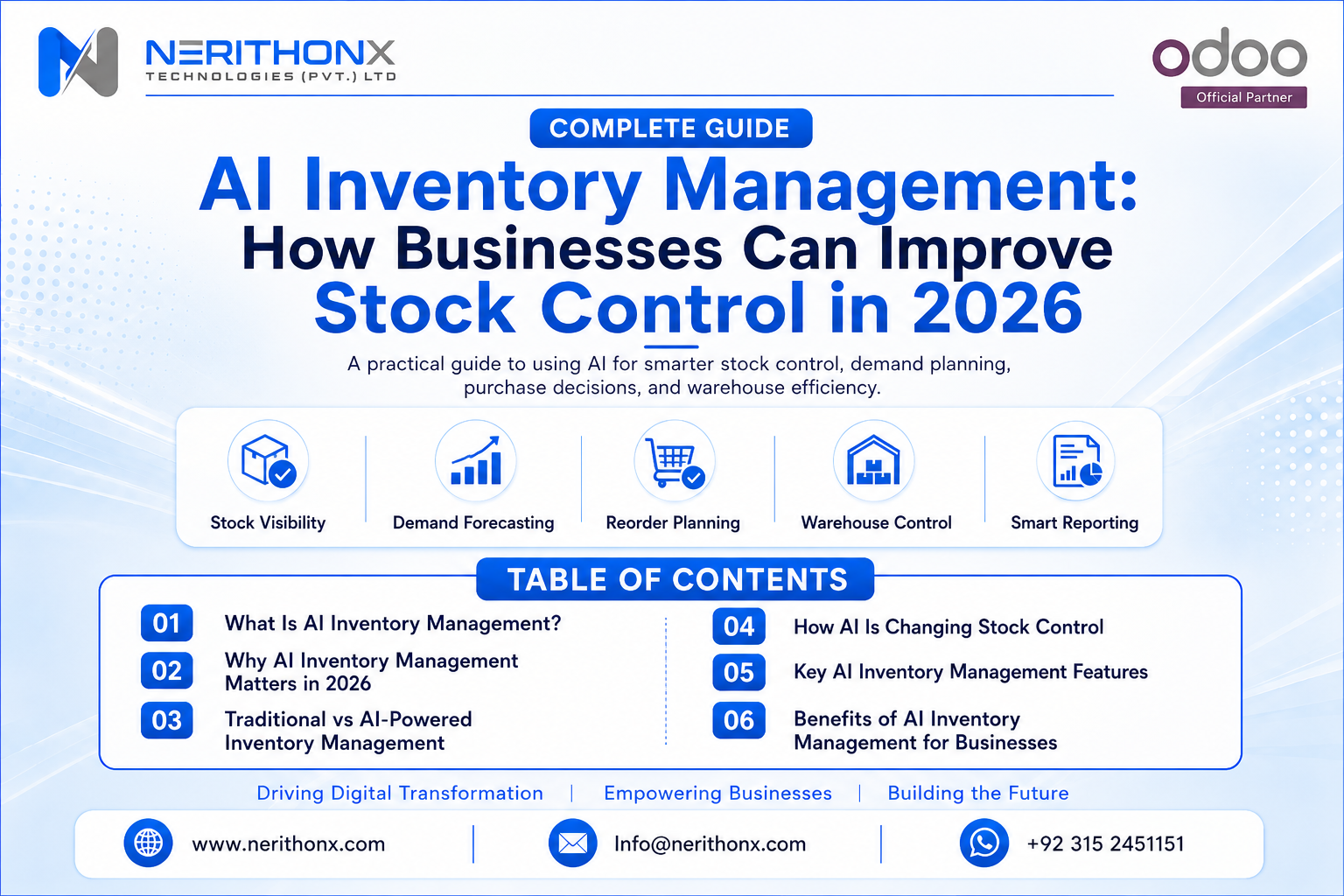
What Is AI Inventory Management?
AI Inventory Management means using artificial intelligence with inventory or ERP systems to support stock control, demand forecasting, purchase planning, warehouse operations, reporting, and decision-making.
It is not a separate tool that automatically fixes every stock problem. AI inventory management works best when it is connected with real business data from:
- Sales orders
- Purchase orders
- Inventory movements
- Warehouses
- Product categories
- Suppliers
- Manufacturing orders
- Customer demand
- Delivery records
- Returns
- Stock adjustments
- Accounting and costing data
When this data is accurate, AI can help inventory teams understand what is happening, what may happen next, and where action is needed.
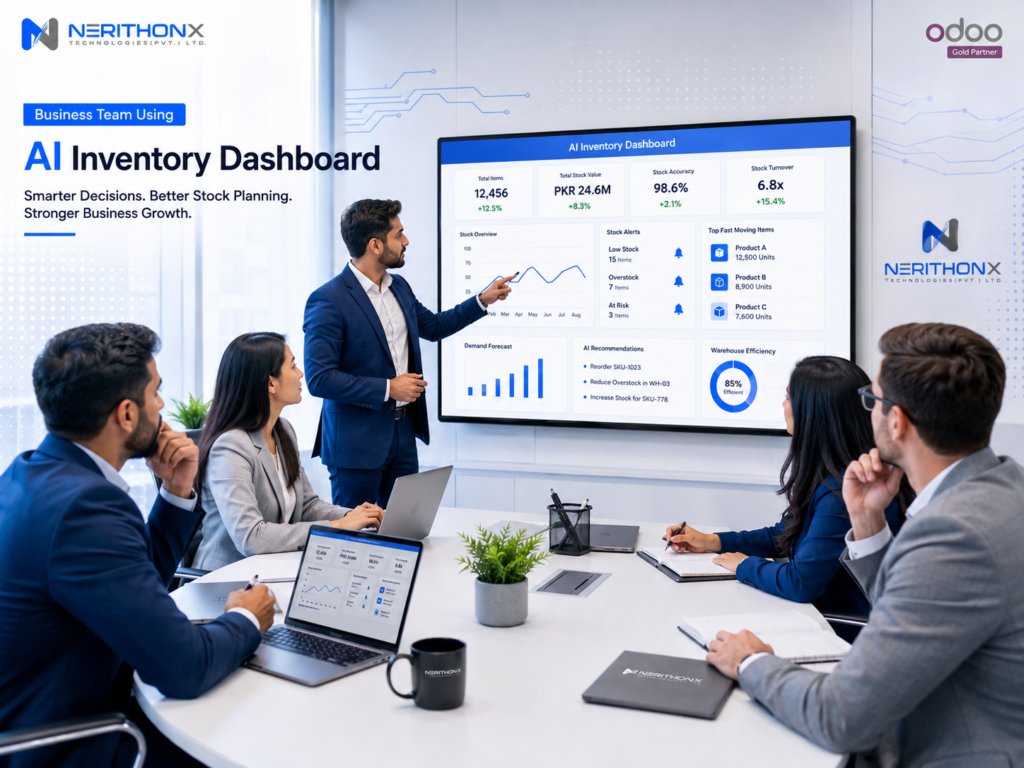
For example, instead of manually checking hundreds of products, AI can help highlight products that are moving fast, products that are not moving, items at risk of shortage, and areas where purchase planning needs attention.
Why AI Inventory Management Matters in 2026
Businesses in 2026 need faster stock visibility, better purchase planning, fewer stock mistakes, improved warehouse control, and more accurate reporting.
Traditional inventory management is often reactive. A business finds out about a stock problem after it has already affected sales, production, or delivery.
AI inventory management helps companies move toward proactive stock planning.
It can support businesses with:
- Faster access to stock information
- Better reorder planning
- Reduced manual stock checking
- Smarter purchase decisions
- Improved demand forecasting
- Better warehouse visibility
- Faster stock movement analysis
- Early detection of stock risks
- Improved customer delivery performance
For growing businesses, this matters because inventory is directly connected with cash flow, customer satisfaction, purchase cost, warehouse efficiency, and production planning.
Traditional Inventory Management vs AI-Powered Inventory Management
Area | Traditional Inventory Management | AI-Powered Inventory Management |
Stock Visibility | Users check reports manually | AI can summarize stock status faster |
Demand Forecasting | Based on manual judgment or past sales only | AI can analyze sales history, trends, and patterns |
Reorder Planning | Manual reorder decisions | AI can support reorder suggestions |
Reporting | Delayed reports from Excel or ERP | Faster summaries and exception alerts |
Slow-Moving Stock | Often found too late | AI can highlight products with low movement |
Stockout Detection | Usually noticed after shortage | AI can help detect shortage risks earlier |
Purchase Planning | Based on manual review | AI can support purchase priority decisions |
Warehouse Operations | Manual tracking and checking | AI can support movement and location analysis |
Decision Support | Managers depend on static reports | AI can help explain patterns and risks |
User Experience | Users search data manually | Users can ask questions and get faster insights |
Traditional inventory management records stock movements. AI-powered inventory management helps businesses understand stock patterns, identify risks, and act faster.
How AI Is Changing Stock Control in 2026
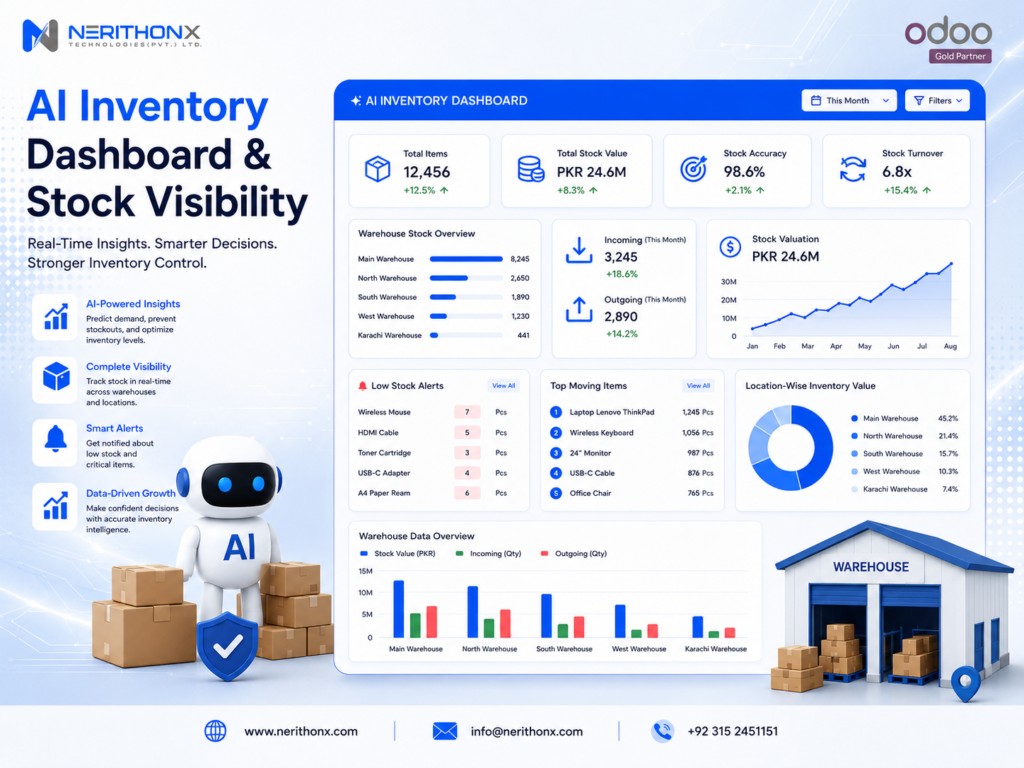
Better Stock Visibility
Stock visibility is one of the biggest challenges for growing businesses.
Managers need to know what is available, what is reserved, what is incoming, what is moving fast, and what is stuck in the warehouse.
AI can help by summarizing inventory data and highlighting important stock situations. For example, it can support managers in understanding which products need attention, which locations have stock differences, and where movement is slower than expected.
This helps businesses make faster decisions instead of waiting for manual reports.
Smarter Demand Forecasting
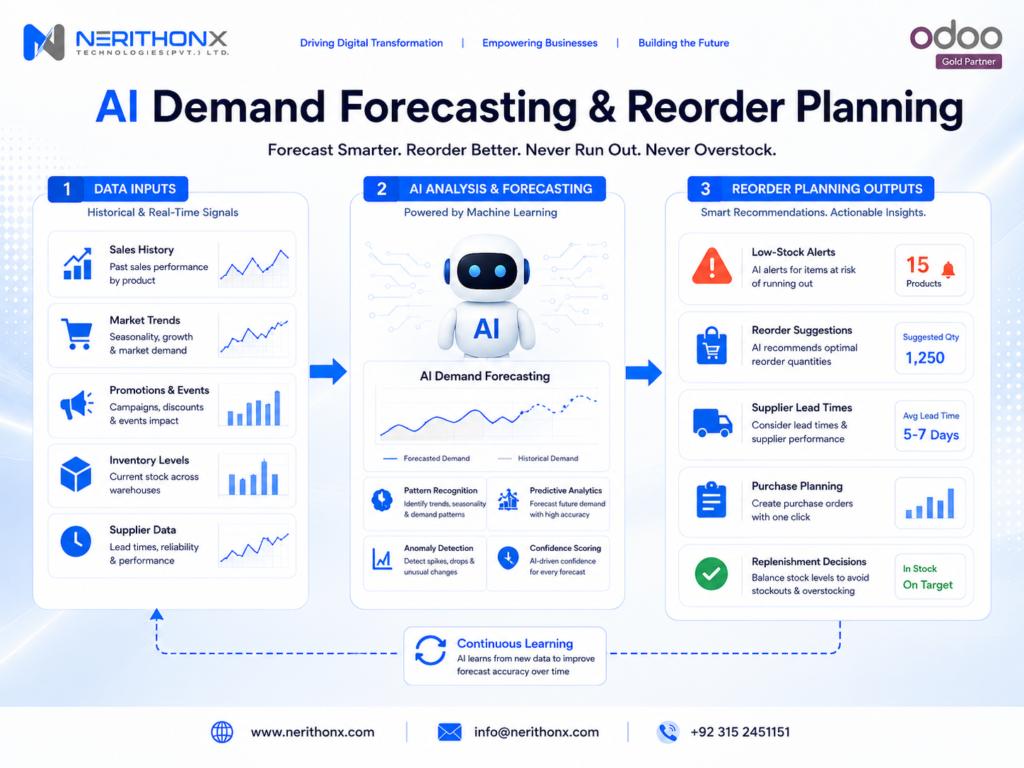
Demand forecasting is not only about guessing future sales. It is about understanding customer demand, seasonal patterns, product movement, sales history, and market behavior.
AI can support demand forecasting by analyzing historical data and identifying patterns that may not be easy to see manually.
For example, a retail business may notice that certain products sell faster during specific months. A manufacturing company may see that raw material demand increases before major production cycles. A distribution business may find that some products move faster in certain locations.
With the right ERP setup, AI can support better demand planning and reduce guesswork.
Faster Reorder Planning
Reorder planning is one of the most practical areas where AI inventory management can help.
Many businesses reorder products only when someone notices low stock. This creates delays, urgent purchases, supplier pressure, and sometimes stockouts.
AI can support reorder planning by checking stock levels, sales trends, supplier lead time, and demand patterns.
This does not mean AI should place every purchase order automatically without review. It means AI can help the purchase team understand what needs attention and why.
Reduced Overstocking and Stockouts
Overstocking blocks cash. Stockouts damage sales and customer trust.
Both problems usually happen because inventory decisions are made without proper data visibility.
AI stock control can help detect products that are over-purchased, under-stocked, or at risk of shortage. It can also support managers in comparing stock levels with movement history and expected demand.
With the right setup, businesses can make better purchase decisions and avoid unnecessary inventory pressure.
Slow-Moving and Dead Stock Detection
Slow-moving stock is a silent loss for many businesses.
Products remain in the warehouse for months, cash gets stuck, storage space is wasted, and management may not notice the issue until it becomes serious.
AI can help identify products that are not moving according to expected patterns. It can support reports that show slow-moving items, dead stock risk, and products that need discounting, promotion, transfer, or purchase control.
This gives management time to act before inventory becomes a bigger financial problem.
Smarter Purchase Management
Purchase teams often work under pressure. They need to decide what to buy, when to buy, how much to buy, and which supplier to use.
AI inventory management can support purchase teams with supplier history, reorder needs, expected demand, and purchase priority insights.
For example, AI can help summarize which products are close to minimum stock, which suppliers usually take longer, and which purchase orders need follow-up.
This improves purchase planning and reduces repetitive manual checking.
Improved Warehouse Operations
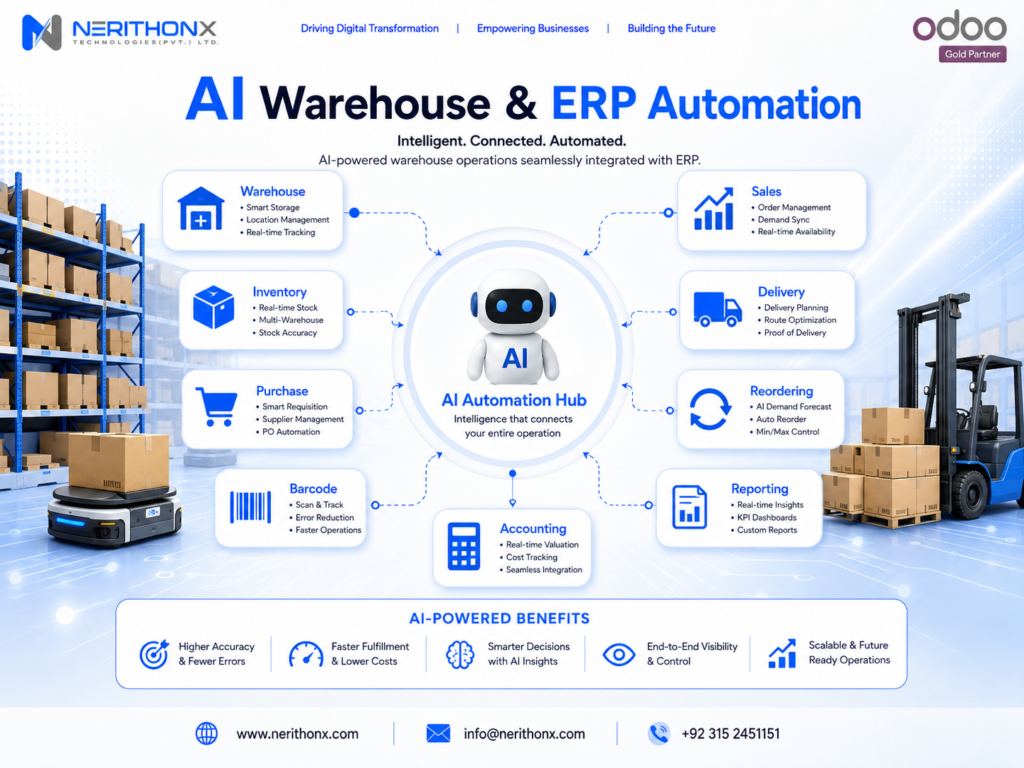
Warehouse teams need clear stock locations, accurate picking, proper receiving, internal transfers, and delivery control.
AI can support warehouse operations by summarizing stock movements, identifying unusual activity, showing location-based stock insights, and helping teams understand where delays or errors may happen.
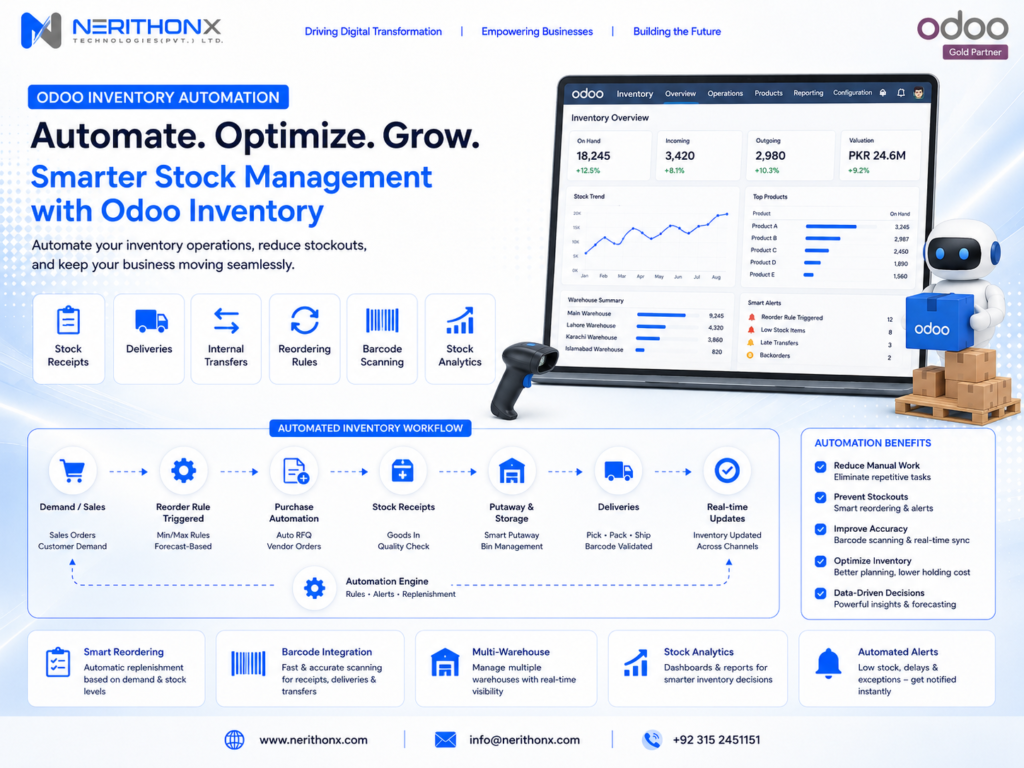
In systems like Odoo, inventory workflows can include stock receipts, deliveries, internal transfers, warehouse locations, and barcode operations. Odoo Inventory is described by Odoo as both an inventory application and warehouse management system, with features such as lead time management, automated replenishment, and advanced routes. (Odoo)
Better Inventory Reporting
Many businesses have inventory data but cannot use it properly.
Reports are delayed, Excel files are outdated, and managers do not get quick answers.
AI can help managers get quick stock summaries, inventory value insights, movement reports, and exception alerts. It can also help explain data in simple language.
Instead of only viewing numbers, managers can understand what those numbers mean for purchasing, sales, warehouse, and finance.
Improved Manufacturing Stock Control
Manufacturing companies face additional inventory challenges.
They need raw materials, semi-finished goods, finished goods, production planning, and consumption tracking.
AI can support raw material planning, finished goods availability, manufacturing consumption checks, and shortage alerts.
For example, if production demand is increasing but raw material stock is low, AI-supported reporting can help management notice the risk earlier.
AI Inventory Management and Odoo: What Businesses Should Know
Odoo Inventory is a powerful solution for businesses that want to control products, warehouses, stock movements, and inventory operations in one connected system.
Odoo can manage:
- Products
- Warehouses
- Locations
- Stock receipts
- Deliveries
- Internal transfers
- Reordering rules
- Purchase integration
- Sales integration
- Manufacturing integration
- Barcode operations
- Inventory valuation
- Reporting and dashboards
Odoo documentation also covers reordering rules through the Inventory app’s replenishment workflow, helping businesses define when and how replenishment should be triggered. (Odoo) Odoo Barcode can also be used for real-time inventory operations such as receipts, deliveries, and internal transfers using scanners or the mobile app. (Odoo)
AI-related capabilities in Odoo, AI-assisted workflows, reporting support, document automation, smart search, AI agents, and third-party AI integrations depend on the Odoo version, edition, configuration, hosting setup, and implementation approach.
Odoo’s AI documentation explains that Ask AI can assist users inside an Odoo database using natural language, while Odoo AI agents are described as smart assistants that can understand natural language, perform tasks, and interact with Odoo tools depending on their configuration. (Odoo)
This means Odoo Inventory becomes more powerful when product data, warehouse rules, purchase workflows, sales flows, and reporting dashboards are properly configured.
AI can support inventory teams, but it cannot replace proper ERP implementation, warehouse discipline, user training, approval rules, and management review.
Practical AI Inventory Management Use Cases for Businesses
AI for Retail Businesses
Retail businesses need fast stock movement, accurate availability, and timely replenishment.
AI can help retail businesses with:
- Fast-moving product analysis
- Seasonal stock planning
- Low-stock alerts
- Better reorder decisions
- Product performance summaries
For example, a retail store can use AI-supported dashboards to understand which products are selling quickly and which products are sitting too long.
AI for Manufacturing Companies
Manufacturing businesses need strong control over raw materials and finished goods.
AI can support manufacturers with:
- Raw material shortage alerts
- Finished goods availability insights
- Production demand planning
- Consumption pattern analysis
- Purchase requirement support
This helps production, purchase, and warehouse teams work with better visibility.
AI for Distribution and Wholesale Businesses
Distribution and wholesale companies usually manage larger product quantities, multiple customers, suppliers, and delivery schedules.
AI inventory management can support:
- Warehouse stock visibility
- Delivery demand planning
- Supplier performance insights
- Product movement summaries
- Slow-moving stock detection
This helps businesses reduce delays and improve stock planning across locations.
AI for Purchase Teams
Purchase teams need accurate data before making buying decisions.
AI can support purchase teams with:
- Purchase priority suggestions
- Supplier lead-time insights
- Reorder planning support
- Over-purchase warning
- Vendor bill and purchase document summaries
This allows purchase managers to focus on decisions instead of manually searching reports.
AI for Management
Business owners and directors need quick visibility.
AI can support management with:
- Inventory dashboard summaries
- Stock risk alerts
- Inventory value insights
- Fast-moving and slow-moving product reports
- Better decision support
This helps leaders understand stock performance without waiting for long manual reporting cycles.
AI Agents in Inventory Management: The Next Step
An AI agent is a smart assistant that can understand instructions, use business data, and help users perform tasks inside an ERP or inventory system depending on setup.
In inventory management, AI agents may help users:
- Find low-stock products
- Summarize today’s stock movements
- Search purchase orders
- Check slow-moving inventory
- Prepare stock report summaries
- Create follow-up tasks for purchase teams
- Help answer stock availability questions
- Assist warehouse or sales teams with product information
However, AI agents should not be used without proper control.
They should be configured with correct permissions, trusted data sources, approval rules, and business controls. Gartner has also highlighted the growth of task-specific AI agents in enterprise applications, while emphasizing the need for governance, integration, and control. (Gartner)
For inventory management, this means AI agents should support teams, not bypass proper approval workflows or stock control rules.
Benefits of AI Inventory Management for Growing Businesses
AI inventory management can help growing businesses improve:
- Better stock visibility
- Faster inventory decisions
- Reduced manual reporting
- Improved purchase planning
- Better demand forecasting
- Lower risk of stockouts
- Reduced overstocking
- Faster warehouse operations
- Better customer delivery planning
- Improved manufacturing material planning
- Better inventory value control
- More scalable business operations
These benefits depend on implementation quality, data accuracy, workflow design, and user training.
Risks and Challenges of AI Inventory Management
AI inventory management is powerful, but businesses must implement it carefully.
Common risks include:
- Poor inventory data quality
- Wrong product categories
- Incorrect stock quantities
- Weak warehouse workflows
- Wrong units of measure
- Unclear reorder rules
- Over-reliance on AI
- Privacy and access control risks
- Lack of user training
- AI output needing human review
- Cost without clear business value
- Poor ERP implementation
AI can only support decision-making when the system has clean and reliable data.
If stock quantities are wrong, product categories are messy, warehouse locations are unclear, or users are not trained, AI will not produce reliable results.
That is why AI inventory management should be implemented with clean data, proper workflows, correct access rights, trained users, and regular monitoring.
How to Prepare Your Business for AI Inventory Management
Before using AI for inventory, businesses should prepare properly.
Here is a practical checklist:
- Map your inventory workflows
- Clean product, vendor, customer, and warehouse data
- Correct units of measure and product categories
- Verify stock quantities and locations
- Define reorder rules and purchase workflows
- Connect sales, purchase, inventory, and manufacturing data
- Identify high-impact AI use cases
- Set user access and approval permissions
- Train inventory, warehouse, purchase, and sales teams
- Test AI results before full use
- Monitor accuracy and stock performance
- Work with an experienced ERP implementation partner
This step-by-step approach helps businesses avoid confusion and get practical value from AI inventory management.
AI Inventory Management for Pakistani Businesses
Many Pakistani businesses still use Excel sheets, WhatsApp communication, manual purchase approvals, handwritten stock registers, and disconnected accounting or inventory records.
This creates confusion between sales, purchase, warehouse, production, and finance teams.
For businesses in Pakistan, especially in cities like Peshawar and Islamabad, AI inventory management can support better:
- Stock visibility
- Purchase planning
- Sales order fulfillment
- Warehouse control
- Manufacturing raw material planning
- Inventory reporting
- Slow-moving stock detection
- Customer delivery performance
- Team productivity
Pakistani SMEs do not need to automate everything at once. They can start with clean inventory workflows, Odoo Inventory implementation, reporting dashboards, reorder planning, and then move toward AI-supported insights.
Common Mistakes Companies Make with AI Inventory Management
Many companies fail to get value from AI because they add AI before fixing the basics.
Common mistakes include:
- Adding AI before fixing inventory workflows
- Using poor-quality stock data
- Not defining inventory goals
- Not training warehouse users
- Ignoring stock counting and verification
- Giving too much access without permissions
- Expecting AI to solve every inventory issue
- Ignoring human review
- Not testing AI outputs
- Choosing tools without ERP implementation support
- Not connecting inventory with sales, purchase, accounting, and manufacturing
AI should be part of a proper ERP and inventory strategy, not a shortcut for weak operations.
Is AI Inventory Management Suitable for SMEs?
Yes, AI inventory management can be useful for SMEs when implemented step by step.
Small and medium businesses do not need to automate everything on day one. They can start with practical use cases such as:
- Low-stock alerts
- Reorder planning
- Inventory dashboards
- Slow-moving stock reports
- Purchase planning
- Sales demand analysis
- Warehouse movement summaries
- Stock availability checks
This allows SMEs to improve stock control without making the system too complex.
The best approach is to start with proper inventory workflows, clean product data, accurate stock counts, and useful dashboards. After that, AI can be added where it brings real business value.
Why Choose NerithonX Technologies for AI Inventory Management and Odoo Implementation?
NerithonX Technologies (Pvt.) Ltd. helps businesses in Pakistan implement, customize, migrate, integrate, and support Odoo ERP systems.
The team focuses on real business workflows, not just software installation.
As an Official Odoo Partner, NerithonX Technologies supports businesses with:
- Odoo ERP implementation in Pakistan
- Odoo Inventory implementation
- Odoo customization and integration
- ERP automation and inventory reporting
- AI-ready inventory workflow planning
- Odoo training and post-go-live support
- Practical implementation for businesses in Peshawar, Islamabad, and across Pakistan
With 7+ years of experience, 20+ Odoo experts, and 19+ businesses transformed, NerithonX Technologies helps companies move from manual inventory control to smarter, more connected ERP-based operations.
Final Thoughts
AI Inventory Management in 2026 is not about replacing inventory teams.
It is about helping businesses control stock better, reduce manual work, improve visibility, plan purchases smarter, and make faster business decisions.
For the best results, businesses need accurate inventory data, proper ERP workflows, trained users, and realistic AI use cases.
If your business wants to improve stock control, automate inventory workflows, or implement AI-ready Odoo Inventory, NerithonX Technologies can help you plan and implement the right ERP solution for long-term growth.
FAQs
1. What is AI Inventory Management?
AI Inventory Management means using artificial intelligence with inventory or ERP systems to improve stock control, forecasting, purchase planning, warehouse operations, and reporting.
2. How can AI improve stock control in 2026?
AI can help businesses analyze stock patterns, detect low-stock risks, identify slow-moving products, support reorder planning, and improve inventory visibility.
3. Can Odoo help with AI inventory management?
Yes. Odoo Inventory can manage products, warehouses, locations, receipts, deliveries, reordering rules, barcode operations, reporting, and integrations. AI-related features depend on version, configuration, and implementation.
4. What are AI agents in inventory management?
AI agents are smart assistants that can understand instructions, use business data, and help users perform inventory-related tasks depending on system setup and permissions.
5. Is AI inventory management useful for small businesses?
Yes. SMEs can start with practical use cases like low-stock alerts, inventory dashboards, reorder planning, slow-moving stock reports, and purchase planning.
6. What business areas can AI inventory management improve?
It can improve stock visibility, warehouse operations, purchase planning, demand forecasting, manufacturing material planning, reporting, and management decision-making.
7. What are the risks of AI inventory management?
Risks include poor data quality, wrong stock quantities, weak workflows, over-reliance on AI, access control issues, lack of training, and poor ERP implementation.
8. Why choose NerithonX Technologies for Odoo Inventory implementation?
NerithonX Technologies helps businesses in Pakistan implement, customize, integrate, and support Odoo ERP with a focus on real workflows, reporting, automation, training, and long-term support.




One Response
It’s fascinating to see how AI is transforming inventory management and stock control. Beyond efficiency gains, I think the real challenge will be integrating these systems smoothly while ensuring staff are trained to use the insights effectively. Balancing automation with human oversight will be key to maximizing value.