Choosing the right ERP system is a major business decision.
An ERP system affects sales, accounting, inventory, purchase, manufacturing, HR, reporting, approvals, customer service, and daily operations. If the wrong system is selected, the business may face slow workflows, duplicate data entry, poor reporting, user resistance, and extra costs.
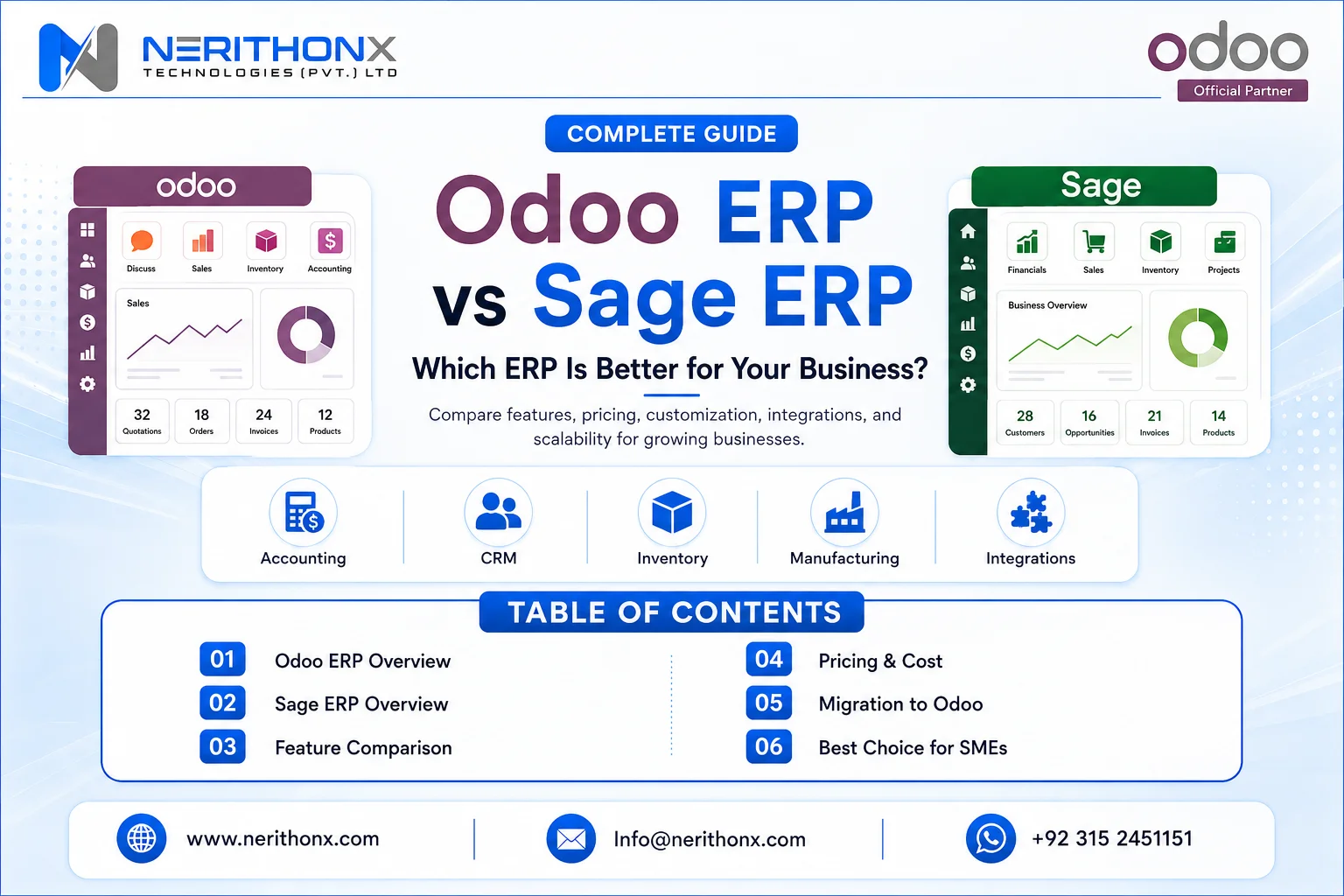
Many businesses compare Odoo ERP vs Sage ERP because both are well-known business software options.
But the right choice is not the same for every company. It depends on business size, industry, budget, accounting complexity, inventory needs, customization requirements, integrations, users, and long-term growth plans.
This guide compares Odoo and Sage in simple business language so you can understand which system may fit your business better.
Quick Overview: Odoo ERP vs Sage ERP
Odoo is an integrated suite of business apps. It covers areas such as CRM, eCommerce, accounting, inventory, point of sale, project management, and more. Odoo’s official website describes its value as being easy to use and fully integrated.
Sage is not only one ERP product. It is a family of business software products. Sage products include Sage X3, Sage Intacct, Sage 50, Sage Accounting, payroll products, HR products, and other finance or business management tools depending on country and market. Sage’s official product pages show different solutions for small and medium businesses, including Sage Intacct and Sage 50 Accounting.
This point is important.
When someone says “Sage ERP,” they may mean Sage X3, Sage 300, Sage Intacct, Sage 50, or another Sage product. These products are not the same. So businesses should compare Odoo with the exact Sage solution they are considering.

What Is Odoo ERP?
Odoo ERP is a modular business management system.
A company can use Odoo apps for CRM, sales, accounting, inventory, purchase, manufacturing, POS, eCommerce, HR, projects, website, marketing, and reporting.
The main idea is that different departments can work in one connected system. For example, a sales order can affect inventory, delivery, invoicing, accounting, and reporting without entering the same data again and again.
Odoo can be used by SMEs and growing businesses that want flexibility across many departments.
Odoo also provides deployment options such as Odoo Online, Odoo.sh, and on-premise depending on the selected plan and implementation needs. Odoo’s pricing page shows Standard and Custom plans, and the Custom plan mentions Odoo Online, Odoo.sh, on-premise, Odoo Studio, multi-company, and external API availability.
Odoo can be a strong fit for businesses that want one integrated ERP for operations, not only accounting.
What Is Sage ERP?
Sage is a business software company with multiple products.
Some Sage products focus on accounting and finance. Some support ERP, manufacturing, distribution, supply chain, and business management.
Common Sage products include:
Sage X3
Sage Intacct
Sage 300
Sage 50
Sage Accounting
Sage X3 is positioned as an ERP solution for areas such as financial management, supply chain management, production management, manufacturing, distribution, and business intelligence. Sage’s official Sage X3 Middle East page describes it as a complete and flexible ERP solution with financial management, supply chain management, production management, and business intelligence capabilities.
Sage Intacct is more finance-focused. Sage’s official Intacct page describes it as cloud accounting software for growing and mid-sized organizations, with financial management, planning, HR, and payroll capabilities.
Sage 50 is more focused on small business accounting. Sage describes Sage 50 as accounting software for small businesses with invoicing, expense tracking, payroll, financial reporting, and inventory management.
So Sage can be strong for businesses that are finance-led, accounting-heavy, or already invested in the Sage ecosystem.
Odoo ERP vs Sage ERP: Main Difference
The main difference between Odoo and Sage is the business approach.
Odoo is usually more all-in-one and modular across many business departments.
Sage is often stronger in finance and accounting-focused workflows, depending on the exact Sage product.
Odoo may be better for businesses that want CRM, sales, accounting, inventory, manufacturing, POS, eCommerce, HR, projects, website, and reports in one flexible ecosystem.
Sage may be better for companies that are mainly finance-led, need strong accounting workflows, or already use Sage products and want to stay within that ecosystem.
Neither platform is automatically best for every company.
The better choice depends on your actual business process.
Feature Comparison Table
Feature Area | Odoo ERP | Sage ERP |
Accounting | Integrated with sales, purchase, inventory, invoicing, and reporting | Strong accounting and finance options, depending on Sage product |
CRM | Available as part of Odoo apps | Depends on Sage product or integration |
Sales | Integrated with CRM, inventory, invoicing, and accounting | Available in some Sage products or through connected tools |
Inventory | Strong integrated inventory workflows | Available in products such as Sage X3 and Sage 50, depending on needs |
Purchase | Connected with inventory, vendors, and accounting | Available depending on Sage product |
Manufacturing | Odoo Manufacturing supports MRP workflows, planning, work orders, and reporting | Sage X3 supports manufacturing, distribution, supply chain, and finance |
POS | Integrated POS available in Odoo ecosystem | May require Sage-specific product or integration |
eCommerce | Odoo has website and eCommerce apps | May require integration or separate tools depending on Sage product |
HR | Odoo has HR-related apps | Sage has HR/payroll products depending on region and product |
Payroll | Depends on localization, configuration, and edition | Depends on Sage product, country, and payroll offering |
Projects | Available in Odoo | Depends on Sage product or integration |
Reporting | Integrated operational and financial reports | Strong financial reporting in finance-focused Sage products |
Customization | Odoo Studio, configuration, custom modules, and APIs | Customization depends on Sage product and partner ecosystem |
Third-Party Integrations | APIs and custom integrations available | Integration depends on Sage product and marketplace |
Mobile Access | Depends on deployment, apps, and configuration | Depends on Sage product |
Multi-Company | Available depending on plan/configuration | Available in certain Sage products |
Multi-Currency | Available depending on configuration/localization | Available depending on Sage product |
Deployment Options | Odoo Online, Odoo.sh, on-premise depending on plan | Depends on Sage product and region |
Scalability | Good for SMEs and growing businesses needing integrated workflows | Good for finance-led or Sage-specific business needs |
Best-Fit Business Type | SMEs, retailers, manufacturers, eCommerce, services, and businesses needing flexible workflows | Finance-heavy companies, accounting-led businesses, and companies already using Sage ecosystem |
Feature availability can vary by edition, region, localization, configuration, and implementation scope.

Accounting and Finance Comparison
Sage has a strong reputation in accounting and financial management.
Sage Intacct is especially finance-focused. Sage describes it as cloud accounting software for growing organizations and mid-sized companies, with automation and insights across financials, planning, HR, and payroll.
Sage X3 also includes financial management along with operations. Sage’s financial management page for Sage X3 mentions areas such as general ledger, accounts payable, accounts receivable, cash flow, bank management, cost and analytical accounting, budgets, and commitments.
Odoo Accounting is useful for businesses that want accounting connected with operations. Odoo’s official accounting page presents accounting as part of its wider business app ecosystem and mentions financial operations, reconciliation, expenses, tax returns, and reporting.
So the decision is practical.
If your main need is advanced financial management, Sage Intacct or Sage X3 may deserve serious consideration.
If your main need is accounting connected with sales, purchase, inventory, POS, eCommerce, manufacturing, and automation, Odoo may be a strong fit.
Inventory and Manufacturing Comparison
For inventory and manufacturing, both platforms can be useful, but the fit depends on business complexity.
Odoo supports inventory and manufacturing as part of its integrated app ecosystem. Odoo’s manufacturing page says the MRP app can help handle the production process, including planning and reporting.
Odoo Manufacturing features include manufacturing orders, work orders, barcode support, planning, and scheduling features, depending on configuration.
Sage X3 is also strong for product-centric businesses. Sage describes Sage X3 as supporting manufacturing, distribution, supply chain, financial management, production management, and business intelligence.
For manufacturing companies, the better choice depends on production complexity, costing needs, traceability, reports, approval workflows, user training, and implementation partner capability.
A simple manufacturer may prefer Odoo for flexible operations. A finance-heavy or Sage-aligned manufacturer may prefer Sage X3.
Sales, CRM, POS, and eCommerce Comparison
Odoo is attractive for businesses that want sales, CRM, POS, website, eCommerce, inventory, and accounting in one connected system.
Odoo’s official website presents Odoo as an integrated suite of apps covering CRM, eCommerce, accounting, inventory, point of sale, project management, and more.
For retail and eCommerce businesses, this integration can be useful. A POS sale can affect stock. An online order can create sales and delivery records. Accounting can receive invoice data. Reports can show sales and inventory together.
Sage may also support sales, inventory, and integrations depending on the selected Sage product. However, in many cases, Sage is chosen more for finance and accounting strength, while operational workflows may require a specific Sage ERP product or third-party integrations.
For businesses where POS, eCommerce, inventory, and sales workflows are central, Odoo is often easier to position as an integrated operational ERP.
Customization and Flexibility
Odoo is known for flexible customization.
Businesses can use Odoo configuration, Odoo Studio, custom modules, APIs, and integrations to adapt workflows. Odoo Studio is presented by Odoo as a tool for creating and customizing apps without coding.
Sage also supports customization and integrations, but the options depend heavily on the selected Sage product, partner ecosystem, region, and implementation scope.
Odoo may be easier to adapt when a business needs custom workflows across multiple departments, such as sales approvals, custom inventory movement, HR workflows, manufacturing validations, customer portals, or custom dashboards.
But customization must be controlled.
Over-customization can create upgrade, training, and support problems. A good ERP partner should first check whether standard features can solve the problem before building custom code.
Integration and Automation
Both Odoo and Sage can integrate with other systems.
Odoo integrations can connect with eCommerce platforms, payment gateways, shipping systems, WhatsApp or SMS tools, CRM tools, BI dashboards, barcode devices, biometric attendance devices, custom web apps, mobile apps, and APIs.
Sage integrations depend on the selected Sage product and available marketplace or partner tools.
For any ERP, integration should be planned carefully. A proper integration plan should include data mapping, security, access rights, error handling, testing, monitoring, and support.
Poor integration can create duplicate records, wrong reports, failed syncs, and user frustration.
Pricing and Total Cost Considerations
ERP cost should never be judged only by the software subscription.
The real cost usually includes:
Software subscription or license
Implementation
Configuration
Customization
Data migration
Integrations
Training
Hosting
Support
Future upgrades
Internal team time
Odoo has published pricing plans. Odoo’s pricing page shows plan direction, all-app pricing, hosting options, Odoo Studio, multi-company, and external API availability depending on the plan. It also notes items that may not be included, such as implementation services, custom code maintenance, and Odoo.sh hosting for custom developments.
Sage pricing depends on the selected Sage product, region, users, modules, implementation partner, support requirements, and business scope. Sage products are also positioned differently, from small business accounting options like Sage 50 to finance-focused products like Sage Intacct and ERP products like Sage X3.
The best approach is to compare total cost of ownership, not only monthly or annual subscription price.

Implementation and User Adoption
ERP success depends on implementation quality.
Even the best ERP system can fail if requirements are unclear, users are not trained, data is not cleaned, reports are not tested, or management does not support adoption.
Odoo implementation can be fast for standard workflows, but custom business processes need proper analysis, configuration, testing, and training.
Sage implementation also depends on the selected product, business complexity, data migration, integrations, and user training.
For both systems, user adoption is critical. Employees must understand why the ERP is being used and how it helps their daily work.
A good implementation partner should support requirement analysis, configuration, migration, testing, training, go-live, and post-go-live support.
Odoo ERP vs Sage ERP for Different Business Types
Small Businesses
Odoo may fit small businesses that want to start with core apps and grow into a wider ERP system. Sage 50 or Sage Accounting may fit small businesses focused mainly on accounting, invoicing, and basic inventory.
Growing SMEs
Odoo is often attractive for SMEs that need CRM, sales, inventory, accounting, HR, POS, eCommerce, and reporting in one system. Sage Intacct or Sage X3 may be suitable when finance or structured accounting workflows are the main priority.
Manufacturing Companies
Odoo can support manufacturing workflows with MRP, BOMs, work orders, inventory, purchase, and reporting. Sage X3 can also be a strong option for manufacturing and distribution businesses with finance and supply chain needs.
Retail Businesses
Odoo can be strong for retail businesses because POS, inventory, sales, accounting, and reporting can work together. Sage may fit retail businesses that mainly need accounting plus selected integrations.
Wholesale and Distribution Companies
Odoo can support sales, purchase, inventory, warehouses, deliveries, and accounting in one workflow. Sage X3 can also support distribution and supply chain operations.
Service Companies
Odoo can work well for service companies needing CRM, projects, timesheets, invoicing, helpdesk, and reporting. Sage may fit service companies with finance-first requirements.
eCommerce Businesses
Odoo can be attractive when website, eCommerce, inventory, sales, invoicing, and accounting need to be connected. Sage may require integrations depending on the eCommerce platform and Sage product.
Multi-Branch Companies
Odoo can support multi-company, multi-branch, multi-warehouse, and role-based workflows depending on setup. Sage can also support multi-entity or multi-location needs depending on product selection.
Finance-Heavy Organizations
Sage Intacct or Sage X3 may be a strong fit for businesses where finance management, accounting reporting, consolidation, or finance-led processes are the top priority.
Global Businesses
Both systems may support global operations, but the right choice depends on localization, tax rules, currencies, languages, reporting, and regional partner support.
Pros and Cons of Odoo ERP
Pros
Integrated apps for many departments
Flexible customization options
Good fit for SMEs and growing businesses
Useful for sales, CRM, inventory, manufacturing, POS, eCommerce, HR, and projects
Community and Enterprise directions
Can support custom modules and integrations
Good for workflow automation and reporting
Cons
Needs proper implementation
Customization must be controlled
User training is important
Some local accounting or payroll needs may require localization or customization
Partner quality matters
Poor data migration can create long-term problems
Pros and Cons of Sage ERP
Pros
Strong accounting and finance reputation
Multiple products for different business sizes
Sage Intacct is finance-focused
Sage X3 can support ERP, manufacturing, distribution, finance, and supply chain
Good option for companies already using Sage ecosystem
Useful for finance-led organizations
Cons
Comparison depends heavily on the selected Sage product
Some workflows may require integrations or separate tools
Customization and full-business integration vary by product
Costs and implementation scope can vary
May feel finance-first for businesses needing broad all-in-one operational ERP
When Should You Choose Odoo ERP?
Odoo may be a better fit when:
You need one connected system for multiple departments.
You want CRM, sales, accounting, inventory, manufacturing, POS, eCommerce, HR, and projects together.
You need flexible customization.
You want to automate workflows.
You need custom reports and dashboards.
You want integrations with websites, mobile apps, POS, payment gateways, or third-party systems.
You are an SME or growing business that wants scalable ERP.
You want your ERP configured around your real business process.
Odoo is especially practical when business operations are spread across many departments and the company wants to reduce duplicate work.
When Should You Choose Sage ERP?
Sage may be a better fit when:
Your business is mainly finance or accounting-led.
Your finance team already uses Sage and prefers Sage workflows.
You need Sage Intacct for cloud financial management.
You need Sage X3 for specific manufacturing, distribution, or supply chain needs.
Your region or industry has strong Sage partner support.
You want to stay inside the Sage ecosystem.
Sage is especially practical when accounting and finance management are the main decision drivers.
Migration From Sage to Odoo
Some businesses move from Sage to Odoo when they need broader ERP integration, custom workflows, inventory, manufacturing, POS, eCommerce, or business automation.
Migration should be planned carefully.
A Sage-to-Odoo migration may include:
Data audit
Chart of accounts mapping
Customer and vendor migration
Product and inventory migration
Opening balances
Historical data decision
Tax and accounting settings
Trial migration
Validation
User testing
Training
Go-live support
Migration is not only a copy-paste task. If data is not cleaned properly, the new ERP can start with wrong balances, duplicate products, missing customers, or incorrect reports.
A good migration plan protects business continuity.

Common Mistakes Businesses Should Avoid
Businesses should avoid these ERP selection mistakes:
Choosing ERP based only on price
Comparing Odoo with the wrong Sage product
Ignoring implementation cost
Ignoring data migration
Not defining business requirements
Over-customizing without planning
Ignoring user training
Not involving finance and operations teams
Skipping testing
Ignoring local accounting or tax rules
Not planning support after go-live
Choosing software without choosing the right implementation partner
ERP selection should be based on real workflows, not only brand name.
Odoo ERP vs Sage ERP: Decision Checklist
Before choosing between Odoo and Sage, review these points:
Business size
Industry
Accounting complexity
Inventory needs
Manufacturing needs
CRM needs
POS and eCommerce needs
Customization needs
Integration needs
Budget
Deployment preference
Reporting needs
User training needs
Local support
Future scalability
Partner expertise
Multi-company needs
Multi-currency needs
Localization requirements
This checklist helps businesses choose based on real requirements instead of assumptions.

Odoo ERP vs Sage ERP for Global Businesses
Businesses in Pakistan, UAE, Saudi Arabia, UK, USA, Canada, Europe, and other regions may have different tax rules, accounting standards, currencies, languages, branch structures, payroll rules, inventory workflows, and compliance needs.
ERP selection should consider:
Localization
Multi-company operations
Multi-currency support
User access rights
Regional reporting
Tax configuration
Payroll rules
Integration requirements
Local implementation support
Data security needs
No ERP should be selected only because it is popular in another country. The system must fit the business’s local operations and long-term plans.
Businesses should not assume legal or tax compliance without checking local requirements with qualified experts.
How NerithonX Technologies Can Help
NerithonX Technologies (Pvt.) Ltd. helps businesses evaluate, implement, customize, integrate, migrate, and support Odoo ERP systems.
The team can help analyze workflows, compare ERP needs, configure Odoo modules, develop custom features, integrate third-party tools, migrate business data, train users, and provide ongoing support.
NerithonX Technologies can support businesses with:
Odoo Implementation
Odoo Customization
Odoo Integration
Odoo Migration
Odoo Support and Maintenance
Odoo Training
ERP Consulting
Business Automation
Web Development
Mobile App Development
Digital Transformation
The goal is not only to install Odoo. The goal is to build a practical ERP system that supports real business operations and long-term growth.
Final Verdict: Odoo ERP vs Sage ERP
Odoo is a strong choice for businesses that want flexible, integrated, and customizable ERP across many departments.
Sage can be a strong choice for businesses with finance-led requirements, accounting-heavy processes, or existing investment in Sage products.
Odoo may be better for businesses that want sales, CRM, accounting, inventory, manufacturing, POS, eCommerce, HR, projects, and automation in one connected system.
Sage may be better for businesses that prioritize financial management, accounting workflows, or Sage-specific industry and regional support.
The best choice depends on business requirements, budget, users, integrations, industry, localization, and implementation partner.

Conclusion
Odoo and Sage are both capable business software options, but they serve different priorities.
Odoo is usually stronger when businesses need flexible, integrated workflows across many departments. Sage is often strong when accounting and finance are the main focus, especially with products such as Sage Intacct and Sage X3.
The best ERP choice should be based on your real workflows, not only the software name.
If your business is comparing Odoo ERP vs Sage ERP and needs practical guidance, NerithonX Technologies can help you review requirements, plan Odoo implementation, migrate data, customize workflows, integrate systems, and train users.
Need help choosing the right ERP? NerithonX guides businesses in selecting, implementing, and customizing ERP systems that match their operations, budget, and growth goals.
FAQ
Frequently Asked Questions
What is the difference between Odoo ERP and Sage ERP?
Odoo is an integrated ERP suite with apps for sales, CRM, accounting, inventory, manufacturing, POS, eCommerce, HR, projects, and more. Sage is a family of business software products, often known for accounting, finance, and ERP products such as Sage X3 and Sage Intacct.
Is Odoo better than Sage ERP?
Odoo may be better for businesses that need flexible, integrated workflows across many departments. Sage may be better for businesses focused mainly on finance, accounting, or Sage-specific workflows.
Is Sage ERP better for accounting?
Sage has a strong accounting and financial management reputation, especially with Sage Intacct and Sage X3. Odoo Accounting can also be useful when accounting needs to connect with sales, purchase, inventory, and operations.
Is Odoo good for small and medium businesses?
Yes. Odoo can be a good fit for SMEs and growing businesses that need modular ERP apps, customization, automation, and connected workflows.
Which is better for manufacturing, Odoo or Sage?
Both can support manufacturing depending on business needs. Odoo can support MRP, BOMs, work orders, inventory, and purchase workflows. Sage X3 can support manufacturing, distribution, supply chain, finance, and production management.
Can Odoo replace Sage?
Odoo can replace Sage in some businesses, especially where broader ERP integration, custom workflows, inventory, manufacturing, POS, eCommerce, or automation are needed. Migration should be planned carefully.
Can businesses migrate from Sage to Odoo?
Yes. Businesses can migrate from Sage to Odoo, but the process should include data audit, chart of accounts mapping, customer and vendor migration, product data, opening balances, testing, validation, and user training.
Which ERP is more customizable, Odoo or Sage?
Odoo is known for flexible customization through configuration, Odoo Studio, custom modules, and integrations. Sage customization depends on the selected Sage product and partner ecosystem.
How should a business choose between Odoo and Sage?
A business should compare accounting needs, inventory, manufacturing, CRM, POS, eCommerce, customization, integrations, budget, deployment, local support, reporting, and future scalability.
How can NerithonX Technologies help with Odoo ERP implementation?
NerithonX Technologies can help with Odoo implementation, customization, integration, migration, support, training, ERP consulting, and business automation.