
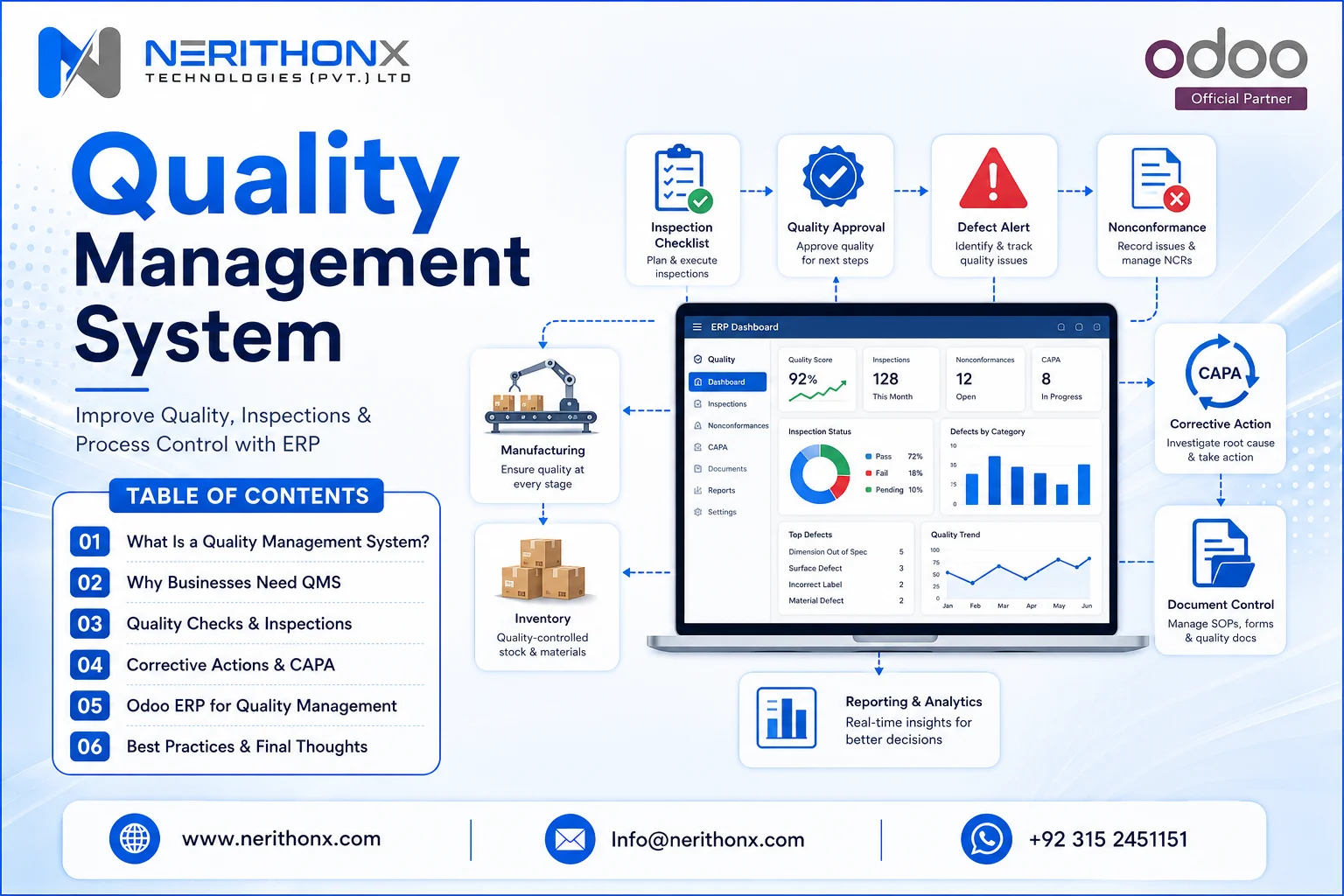
Many businesses face repeated defects, customer complaints, inconsistent processes, manual inspections, weak documentation, poor audit preparation, supplier quality issues, product returns, and disconnected quality records. A quality management system helps solve these problems by creating a structured way to manage quality across the business.
Quality is not only a manufacturing topic. It affects every business that wants to deliver consistent products, reliable services, better customer experience, and stronger internal control.
For manufacturers, retailers, wholesalers, service companies, and SMEs, quality management becomes even more important when the business grows. Manual quality checks, paper records, Excel files, and informal approvals may work at the start, but they become difficult to control as teams, products, suppliers, and customers increase.
A good quality management system connects quality with daily operations. It helps teams define standards, perform inspections, record defects, manage corrective actions, control documents, track supplier issues, and report quality performance to management.
When connected with ERP software like Odoo, quality becomes part of the full business workflow. Quality checks can connect with manufacturing orders, inventory receipts, purchase orders, delivery orders, returns, suppliers, products, and reports.
What Is a Quality Management System?
A quality management system is a structured way to define processes, responsibilities, procedures, documents, inspections, corrective actions, and improvement activities so a business can deliver consistent products or services.
In simple words, a QMS answers important questions such as:
- What quality standards should we follow?
- Who is responsible for quality checks?
- When should inspections happen?
- How should defects be recorded?
- What happens when a product fails inspection?
- How should corrective actions be tracked?
- Which documents and procedures are approved?
- How does management review quality performance?
A quality management system is not just a file or certificate. It is a working business system. It should guide employees on how quality is planned, checked, recorded, improved, and reported.
For example, a manufacturing company may use QMS processes for incoming material inspection, in-process production checks, finished goods inspection, supplier quality, customer complaints, and corrective actions.
A service company may use a QMS to define service standards, approval steps, customer complaint handling, employee responsibilities, and performance reviews.
Why Quality Management Matters for Modern Businesses
Quality management matters because customers expect consistent results. A business may get sales once with good marketing, but it earns trust through consistent quality.
A proper quality management system helps businesses improve:
- Product and service consistency
- Customer satisfaction
- Defect control
- Complaint handling
- Process discipline
- Employee accountability
- Supplier control
- Waste reduction
- Compliance readiness
- Management visibility
- Continuous improvement
Without quality management, the same problems can repeat again and again. One customer complaint may be solved manually, but if the root cause is not fixed, the same issue can return with another customer.
Quality management helps businesses move from reactive problem-solving to planned process control.
Common Problems Without a Quality Management System
Businesses without a proper quality management system often depend on people’s memory, informal communication, paper files, and manual follow-ups.
Common problems include:
- Repeated defects
- Manual quality checks
- Paper-based records
- Missing inspection history
- Unclear responsibility
- Poor document control
- Delayed corrective actions
- Supplier quality issues
- Customer complaints
- Weak audit preparation
- Disconnected quality, inventory, production, and purchase teams
- No real-time quality reporting
- Difficulty finding past inspection results
- No proper root cause tracking
- No clear approval workflow
These issues create confusion. Quality teams may know about defects, but production may not have full details. Purchasing may not know which supplier is causing quality problems. Management may only see the issue after customer complaints increase.
A QMS helps bring quality data into one structured system.
Quality Management System vs Quality Control vs Quality Assurance
Quality management system, quality control, and quality assurance are connected, but they are not the same.
A quality management system is the complete framework for managing quality. It includes policies, processes, responsibilities, documents, inspections, corrective actions, audits, supplier control, customer complaints, and improvement activities.
Quality control focuses on checking whether products or services meet requirements. It is usually inspection-based. For example, checking product dimensions, testing samples, inspecting incoming materials, or approving finished goods.
Quality assurance focuses on preventing quality problems through planned processes. It makes sure the right procedures, standards, and controls are in place before problems happen.
In simple terms:
- QMS is the full quality framework.
- QC checks the result.
- QA improves and protects the process.
All three should work together. A business should not only inspect defects after they happen. It should also improve processes so defects are reduced in the future.
Main Components of a Quality Management System
A strong quality management system includes several important components.
Quality Policy and Objectives
A quality policy explains the company’s commitment to quality. Quality objectives convert that commitment into measurable goals.
For example:
- Reduce product defects
- Improve inspection completion
- Reduce customer complaints
- Improve supplier quality
- Close corrective actions on time
Objectives should be realistic, measurable, and reviewed regularly.
Process Documentation
Processes should be documented clearly so employees know how work should be done.
This may include:
- Standard operating procedures
- Inspection instructions
- Approval workflows
- Product specifications
- Supplier evaluation steps
- Complaint handling process
- Corrective action process
Good documentation reduces confusion and supports consistent work.
Roles and Responsibilities
A QMS should clearly define who is responsible for each quality activity.
For example:
- Who performs inspections?
- Who approves quality checks?
- Who records defects?
- Who assigns corrective actions?
- Who reviews supplier issues?
- Who approves updated documents?
Clear responsibility improves accountability.
Document Control
Document control ensures that employees use the latest approved version of procedures, forms, drawings, checklists, and quality documents.
Poor document control can create serious problems. Employees may follow old instructions, use outdated product specifications, or miss important process changes.
Quality Inspections
Quality inspections help verify whether materials, products, services, or processes meet defined requirements.
Inspections may happen during:
- Supplier receiving
- Inventory movement
- Manufacturing
- Work orders
- Packaging
- Finished goods
- Delivery
- Returns
Quality Control Points
Quality control points define when and where inspections should happen.
For example:
- Check raw material when received
- Check product weight during production
- Check packaging before delivery
- Check returned goods before restocking
Control points help automate inspection discipline.
Nonconformance Management
A nonconformance means something does not meet the defined requirement.
Examples include:
- Wrong product size
- Damaged material
- Failed inspection
- Missing label
- Supplier defect
- Wrong packaging
- Service error
A QMS should record nonconformances properly so the business can understand what happened and why.
Corrective and Preventive Actions
Corrective actions fix the existing issue. Preventive actions reduce the chance of the issue happening again.
This is often called CAPA: Corrective and Preventive Action.
A good CAPA process includes:
- Issue description
- Root cause
- Responsible person
- Corrective action
- Preventive action
- Deadline
- Status tracking
- Verification of effectiveness
Audit Management
Audits help review whether processes are being followed correctly.
Audits may be internal or external. Internal audits help the business find process gaps before they become larger problems.
Supplier Quality Management
Suppliers affect product and service quality. If materials are late, damaged, inconsistent, or below specification, the final output may also suffer.
Supplier quality management may include:
- Supplier evaluation
- Incoming inspection
- Supplier defect tracking
- Supplier performance reports
- Vendor corrective actions
Training and Competence
Employees must understand quality procedures. Training records help show who has been trained and where more training is needed.
A process is only useful when employees know how to follow it.
Customer Complaint Management
Customer complaints should be recorded, investigated, and resolved properly.
A QMS should help track:
- Complaint source
- Product or service involved
- Issue description
- Responsible team
- Corrective action
- Customer response
- Final closure
Risk Management
Risk management helps identify where quality problems may happen and how to reduce them.
For example, a business may identify risk in supplier quality, manual inspection, machine breakdown, packaging errors, or delivery mistakes.
Reporting and Continuous Improvement
A QMS should provide reports that help management make better decisions.
Reports may include defect trends, inspection results, CAPA status, supplier issues, customer complaints, audit findings, and quality KPIs.

Quality Management System Process Step by Step
A practical quality management system process can follow these steps:
- Define quality objectives.
- Map business processes.
- Set quality standards and inspection points.
- Create quality documents and procedures.
- Train employees.
- Perform inspections and quality checks.
- Record defects and nonconformances.
- Create corrective and preventive actions.
- Track responsibility and deadlines.
- Review quality reports.
- Improve processes continuously.
This workflow helps businesses manage quality in a planned way instead of reacting only after customers complain.
What Is QMS Software?
QMS software is a digital system that helps businesses manage quality processes.
Instead of using paper files, spreadsheets, and disconnected records, QMS software helps digitize:
- Document control
- Quality checks
- Inspection records
- Audit records
- Nonconformance tracking
- CAPA management
- Supplier quality
- Customer complaints
- Quality reporting
QMS software gives teams better visibility and control. It also helps management see quality performance faster.
When QMS software is connected with ERP, quality becomes part of the full business workflow. This is useful because quality is connected with purchasing, inventory, production, sales, delivery, returns, and accounting.
Key Features of Quality Management System Software
Good quality management system software should include practical features that support daily quality work.
Important features include:
- Quality checks
- Quality control points
- Inspection forms
- Document control
- Audit management
- Nonconformance tracking
- CAPA management
- Quality alerts
- Supplier quality management
- Customer complaint tracking
- Training records
- Approval workflows
- Traceability
- Reporting dashboards
- Mobile or shop floor access
- ERP integration
- User access controls
The right features depend on business size, industry, process complexity, and reporting needs.
For a small business, basic inspection records, complaints, CAPA, and reporting may be enough at the start. For a manufacturing company, the system may need quality checks inside manufacturing orders, work orders, inventory receipts, and delivery operations.
Benefits of Quality Management System Software
QMS software helps businesses move from manual quality control to a structured digital quality process.
Key benefits include:
- Better visibility
- Faster inspections
- Fewer manual errors
- Improved accountability
- Stronger document control
- Better defect tracking
- Faster corrective actions
- Improved supplier quality
- Better audit readiness
- Improved customer satisfaction
- Better reporting for managers
- Scalable quality process
A digital system makes it easier to find past records, track responsibilities, review open issues, and understand quality trends.

ISO 9001 and Quality Management Systems
ISO 9001 is a globally recognized quality management standard. It provides requirements for establishing, maintaining, and improving a quality management system.
Certification is not mandatory for every business. However, ISO-style principles can help many organizations improve quality, even if they are not applying for certification immediately.
ISO-style quality management encourages businesses to:
- Understand customer requirements
- Define processes
- Assign responsibilities
- Control documents
- Monitor performance
- Manage risks
- Improve continuously
Important note: NerithonX Technologies should not be presented as an ISO certification body unless this is officially confirmed. Businesses that need official ISO certification should consult an accredited certification body.
However, ERP and business automation can support ISO-style quality workflows by improving documentation, inspections, records, traceability, reporting, and corrective action tracking.
How Odoo ERP Supports Quality Management
Odoo ERP can support quality management through connected business applications.
Odoo Quality can help businesses manage quality checks, quality control points, quality alerts, inspection workflows, and quality reporting. It can connect quality activities with manufacturing and inventory operations.
Relevant Odoo modules and areas include:
- Odoo Quality
- Odoo Manufacturing
- Odoo Inventory
- Odoo Purchase
- Odoo Sales
- Odoo PLM
- Odoo Maintenance
- Odoo Barcode
- Odoo Reporting
Practical Odoo quality workflows may include:
- Incoming material inspection during receipt
- Quality checks on manufacturing orders
- Quality control points for specific products or operations
- Work order inspections
- Defect alerts from manufacturing or inventory
- Corrective and preventive action tracking
- Supplier quality issue recording
- Inventory quality checks before delivery
- Lot and serial number traceability
- Quality dashboards and reports
For example, when materials are received from a supplier, Odoo can help trigger a quality check before the material is fully accepted into stock. During manufacturing, quality checks can be added to production or work order steps. If a defect is found, a quality alert can be created and assigned to the responsible quality team.
This makes quality part of the workflow instead of a separate manual activity.

Quality Management in Manufacturing
Manufacturing quality management needs strong control because defects can affect cost, production time, customer delivery, and brand trust.
A manufacturing QMS may include:
- Incoming material inspection
- In-process quality checks
- Finished product inspection
- Work order quality checks
- Batch or lot tracking where relevant
- Defect recording
- Scrap and rework tracking
- Root cause analysis
- Production quality reporting
- Supplier quality tracking
- Machine-related quality issue tracking
For example, if a product fails an in-process inspection, the team should record the issue, identify the root cause, decide whether rework or scrap is required, and assign corrective action.
Without a proper system, this information may stay in paper files or informal messages. With ERP quality management, the issue can be linked to the product, operation, work center, batch, supplier, or manufacturing order.
Quality Management in Retail, Wholesale, and Service Businesses
Quality management is not only for factories. Retailers, wholesalers, and service companies also need quality control.
For retail and wholesale businesses, quality management may include:
- Supplier quality checks
- Product receiving inspection
- Return inspection
- Damaged goods tracking
- Delivery quality
- Customer complaint tracking
- Internal process reviews
For service businesses, quality management may include:
- Service standards
- Customer feedback
- Complaint handling
- Employee accountability
- Documented procedures
- Approval workflows
- Performance reporting
A QMS helps these businesses deliver consistent service and reduce repeated mistakes.
When Should a Business Use QMS Software?
A business should consider QMS software when quality problems become difficult to track manually.
Common signs include:
- Quality problems are repeated
- Records are stored in paper files or spreadsheets
- Audit preparation takes too much time
- Customer complaints are not tracked properly
- Corrective actions are delayed
- Inspection results are difficult to find
- Supplier quality is inconsistent
- Production defects are increasing
- Management has no quality dashboard
- The business is growing and manual quality control is not enough
If quality information is spread across notebooks, Excel files, emails, and WhatsApp messages, it becomes difficult to control.
QMS software helps centralize quality records and improve accountability.
How to Choose the Right Quality Management System Software
Choosing the right quality management system software depends on your business needs.
Use this checklist:
- Business size
- Industry requirements
- Ease of use
- ERP integration
- Quality control features
- Document control
- CAPA and nonconformance tracking
- Audit management
- Supplier quality support
- Reporting dashboards
- Customization options
- Cloud or on-premise needs
- Training and support
- Scalability
- Implementation partner experience
- Total cost of ownership
A business should not choose QMS software only because it has many features. The system should match real workflows and be easy for users to adopt.
For ERP-based quality management, it is also important to check whether quality can connect with purchasing, inventory, manufacturing, sales, delivery, and reporting.
Common QMS Implementation Mistakes to Avoid
A quality management system can fail if it is implemented without proper planning.
Avoid these common mistakes:
- Starting without process mapping
- Ignoring employee training
- Poor document control
- Overcomplicating the system
- Not defining quality responsibilities
- Not connecting quality with production and inventory
- Ignoring supplier quality
- Not tracking CAPA properly
- Using dirty or incomplete data
- Skipping testing before go-live
- No post-go-live support
The best system is not always the most complex system. The best system is the one that supports real business processes and is used correctly by employees.
Important Quality Management KPIs
Quality KPIs help management understand whether quality is improving or getting worse.
Important quality management KPIs include:
- Defect rate
- First pass yield
- Customer complaint rate
- Return rate
- Audit findings
- CAPA closure time
- Supplier defect rate
- On-time inspection completion
- Rework rate
- Scrap rate
- Cost of poor quality
- Quality check pass rate
These KPIs should be reviewed regularly. They help identify repeated issues, weak processes, supplier problems, and training needs.
Quality Management System for Global Businesses
Businesses in Pakistan, UAE, Saudi Arabia, UK, USA, Canada, Europe, and other international markets face many similar quality challenges.
These include:
- Supplier consistency
- Customer expectations
- Documentation control
- Audit readiness
- Production defects
- Service quality
- Multi-location quality control
- Approval workflows
- Product traceability
- Management reporting
A flexible ERP system can be adapted to different countries, industries, warehouses, teams, approvals, documents, and reporting needs.
This makes ERP-based QMS useful for:
- quality management system in Pakistan
- quality management system in UAE
- quality management system in Saudi Arabia
- quality management system in UK
- quality management system in USA
- quality management system in Canada
- quality management system in Europe
- Odoo quality management system for global businesses
For global companies and SMEs, the goal is not only to record quality checks. The goal is to create a connected quality process that supports better decisions, fewer mistakes, and stronger customer trust.
How NerithonX Technologies Helps
NerithonX Technologies helps businesses plan, implement, customize, integrate, train, and support Odoo ERP and business automation workflows.
For quality management, NerithonX Technologies can support businesses with:
- Odoo implementation
- Odoo customization
- Odoo integration
- Odoo migration
- Odoo support and maintenance
- Odoo training
- ERP consulting
- Business automation
- Quality workflow planning
- Quality inspection setup
- Inventory and manufacturing quality process improvement
- Reporting and dashboard setup
- User training and post-go-live support
NerithonX Technologies does not need to make fake claims or ISO certification promises. The practical value is helping businesses design digital workflows that support quality checks, inspections, corrective actions, reporting, inventory control, production quality, and business automation.
Final Thoughts
A quality management system helps businesses improve consistency, reduce defects, manage inspections, track corrective actions, improve customer satisfaction, and make smarter quality decisions.
For modern businesses, quality should not stay hidden in paper files, spreadsheets, or disconnected records. It should be part of daily operations.
The right ERP-based quality system connects quality with purchasing, suppliers, inventory, manufacturing, sales, delivery, returns, customer complaints, and reporting.
For SMEs, manufacturers, retailers, wholesalers, and service companies, QMS software can improve visibility, accountability, and process control.
When implemented properly, Odoo ERP can support quality management through quality checks, quality control points, quality alerts, manufacturing integration, inventory workflows, supplier quality tracking, and reporting dashboards.
Need a better quality management system for your business?
NerithonX Technologies can help you plan, implement, customize, and support Odoo ERP workflows for quality checks, inspections, inventory, manufacturing, purchasing, reporting, and business automation.
FAQ
frequently Asked Questions
What is a quality management system?
A quality management system is a structured way to manage quality processes, responsibilities, documents, inspections, corrective actions, and continuous improvement so a business can deliver consistent products or services.
Why is a quality management system important?
A QMS is important because it helps reduce defects, improve customer satisfaction, control processes, improve employee accountability, manage supplier quality, and support better business decisions.
What is QMS software?
QMS software is a digital system that helps businesses manage quality checks, document control, inspections, audits, nonconformance, CAPA, supplier quality, customer complaints, and quality reporting.
What is the difference between quality control and quality assurance?
Quality control checks whether products or services meet requirements. Quality assurance focuses on preventing quality problems by creating planned processes, standards, and controls.
What is the difference between QMS and ISO 9001?
A QMS is the complete system a business uses to manage quality. ISO 9001 is an international standard that provides requirements for creating and improving a quality management system.
Can small businesses use a quality management system?
Yes. Small businesses can use a QMS to standardize processes, reduce mistakes, manage complaints, track inspections, and improve customer satisfaction.
What features should QMS software include?
QMS software should include quality checks, inspection forms, document control, audit management, nonconformance tracking, CAPA, quality alerts, supplier quality, complaint tracking, reporting, and ERP integration.
How does ERP help quality management?
ERP helps quality management by connecting quality checks with purchasing, inventory, manufacturing, sales, delivery, returns, suppliers, and reporting in one system.
Is Odoo good for quality management?
Yes. Odoo can support quality management through Odoo Quality, Manufacturing, Inventory, Purchase, Sales, Quality Checks, Quality Control Points, Quality Alerts, and reporting.
Can NerithonX Technologies help implement Odoo for quality management?
Yes. NerithonX Technologies can help businesses plan, implement, customize, integrate, train, and support Odoo ERP workflows for quality management, inspections, inventory, manufacturing, purchasing, and reporting.