Many companies still depend on manual data entry, Excel reports, delayed approvals, scattered customer information, and slow decision-making.
As the business grows, these manual processes create more errors, more delays, and less visibility. Sales teams miss follow-ups. Finance teams spend time preparing reports manually. Inventory teams struggle with stock updates. Managers wait for information instead of acting on time.
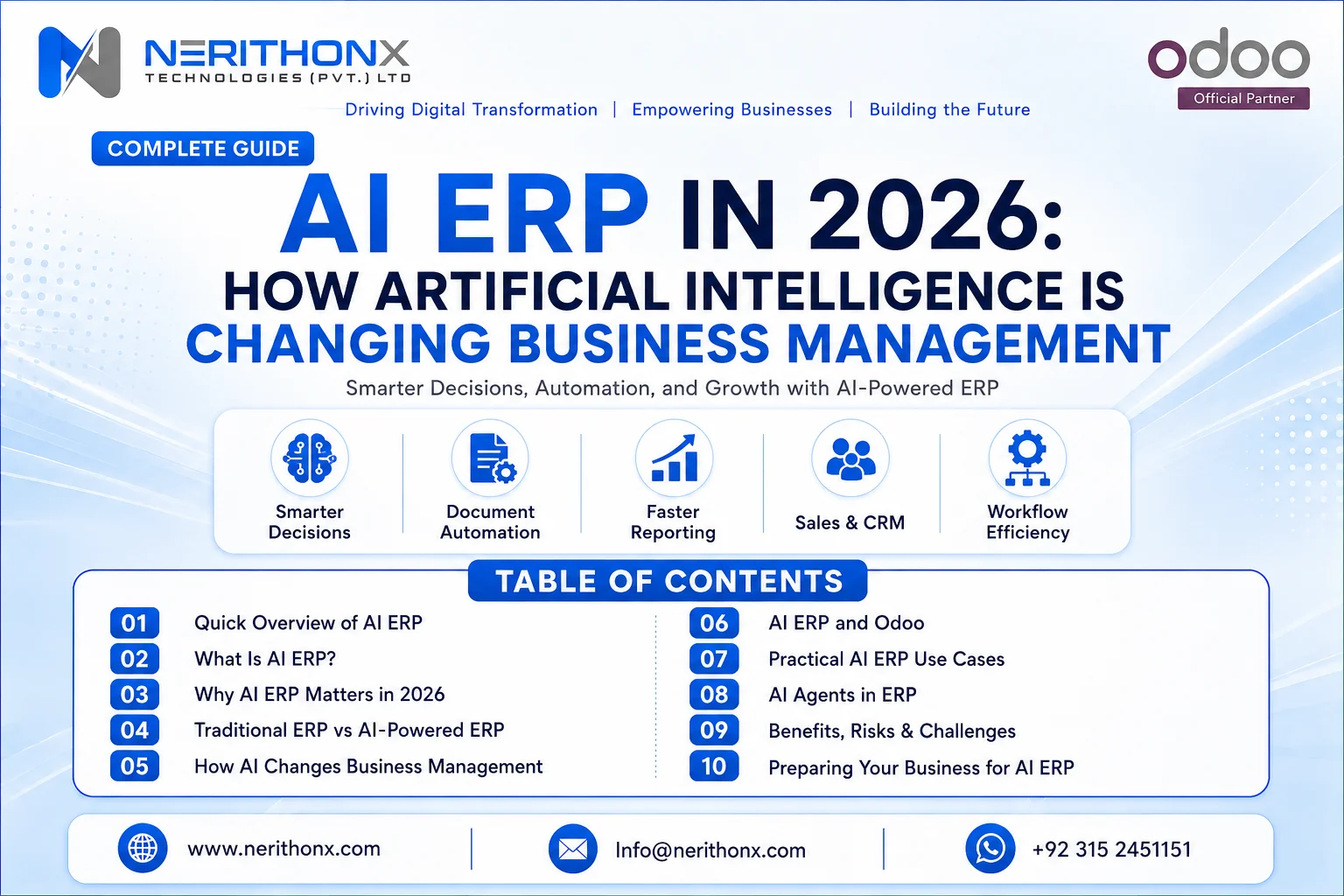
This is why AI ERP in 2026 is becoming important for growing businesses.
Artificial Intelligence is no longer only about chatbots or content generation. In ERP systems, AI can support reporting, document handling, workflow automation, data search, customer communication, and decision-making.
But AI ERP is not magic. It works best when the ERP system is properly implemented, business data is clean, users follow the right workflows, and AI features are configured according to real business needs.
Why AI ERP Matters in 2026
Businesses now need faster decisions, cleaner workflows, better customer response, and more automation.
Traditional ERP systems help companies store and manage data. AI-powered ERP goes one step further by helping users understand data, search faster, reduce repetitive work, and take action with better context.
Odoo’s official AI documentation explains that its Ask AI feature can help users inside an Odoo database by understanding natural language, answering questions, opening views, and improving content, depending on setup and availability.
AI ERP can help businesses with:
- Faster access to information
- Better reporting
- Less repetitive work
- Smarter follow-ups
- Improved forecasting
- Better customer communication
- More efficient operations
In 2026, AI ERP is important because businesses cannot depend only on delayed reports and manual approvals. They need systems that help teams work faster and managers make better decisions.

Traditional ERP vs AI-Powered ERP
|
Area |
Traditional ERP |
AI-Powered ERP |
|
Data Search |
Users search records manually |
Users can search or ask questions using natural language where configured |
|
Reporting |
Reports are generated from stored data |
AI can help summarize reports and highlight key points |
|
Document Handling |
Manual entry and document upload |
AI can support document reading and classification depending on setup |
|
Decision Support |
Managers analyze data manually |
AI can support insights, trends, and risk identification |
|
User Experience |
Menu-based system navigation |
AI assistants can help users find information faster |
|
Automation |
Rule-based workflows |
AI-supported workflows can reduce repetitive work |
|
Customer Communication |
Manual replies and follow-ups |
AI can support draft replies, summaries, and customer context |
|
Forecasting |
Based on standard reports |
AI can support trend analysis where data is clean |
|
Management Visibility |
Depends on reports and dashboards |
AI can support faster understanding of dashboard data |
Traditional ERP stores and processes business data.
AI-powered ERP helps users understand and act on that data faster.
How Artificial Intelligence Is Changing Business Management
Smarter Decision-Making
AI can help managers understand trends, risks, and opportunities faster.
For example, management may want to know why sales dropped in one branch, why expenses increased, or which customers have pending payments. AI can support faster analysis by summarizing available ERP data and pointing users toward useful records.
AI does not replace business judgment. It supports decision-makers with better visibility.
Faster Reporting and Data Search
In many companies, employees spend a lot of time searching records.
They open sales reports, invoice lists, customer records, stock reports, and Excel sheets. AI search can make this easier by helping users find information using natural language, depending on the ERP setup.
For example:
- “Show unpaid invoices for this customer.”
- “Summarize this month’s sales performance.”
- “Find purchase orders pending receipt.”
- “Show products with low stock.”
This saves time and improves productivity.
Automated Document Processing
Document handling is one of the most practical AI use cases in ERP.
Businesses receive vendor bills, customer documents, purchase documents, receipts, and invoices. Manual entry takes time and can create mistakes.
Odoo’s AI-powered invoice automation page explains that vendor bills can be scanned, sent by email, or processed in batch through Odoo Documents depending on the setup.
AI document automation can help with:
- Invoice reading
- Vendor bill digitization
- Document classification
- Customer document handling
- Reduced manual data entry
Human review is still important, especially for financial records.
Better Sales and CRM Management
Sales teams often lose leads because follow-ups are not properly tracked.
AI ERP can help sales teams with:
- Lead summaries
- Follow-up reminders
- Customer history summaries
- Sales pipeline insights
- Communication support
- Activity suggestions
For example
A salesperson can quickly understand customer history before a call. A manager can review pipeline activity and identify delayed follow-ups.
This improves sales discipline and customer communication.
Improved Accounting and Finance Workflows
Finance teams handle invoices, vendor bills, expenses, payments, and reporting.
AI can support finance workflows by helping with:
- Vendor bill processing
- Invoice data extraction
- Payment follow-up insights
- Expense analysis
- Financial report summaries
- Document matching support
This does not mean AI should approve financial data without review. Finance teams still need proper controls, access rights, and verification.
Smarter Inventory and Purchase Planning
Inventory mistakes can block cash, delay deliveries, and affect customers.
AI ERP can support inventory and purchase teams by helping identify patterns in stock movement, low-stock products, slow-moving items, and purchase planning needs.
Practical examples include:
- Low-stock warnings
- Demand pattern analysis
- Stock movement insights
- Reorder support
- Slow-moving product identification
- Purchase planning support
The quality of these insights depends on clean stock data and correct ERP usage.
Improved Customer Support
Customer support teams need fast access to customer history, open tickets, previous complaints, and pending issues.
Odoo’s AI live chat documentation explains that AI agents can be integrated with Live Chat to answer common questions, request information, qualify conversations, and escalate to a human operator when needed.
AI can support customer service through:
- Ticket summaries
- Suggested replies
- Customer history review
- Faster issue resolution
- Live chat support
- Escalation to human support when required
This helps support teams respond faster without removing human responsibility.
Better HR and Employee Management
HR teams manage attendance, leaves, payroll data, employee documents, and onboarding tasks.
AI ERP can support HR by helping summarize employee records, identify leave patterns, organize documents, and support HR reporting.
Examples include:
- Attendance insights
- Leave pattern summaries
- Employee document management
- Onboarding support
- HR reporting summaries
HR data is sensitive, so access rights and privacy controls are very important.

AI ERP and Odoo: What Businesses Should Know
Odoo is moving toward AI-supported business workflows. Odoo’s official AI application page describes Odoo AI as helping turn everyday data into smarter decisions, faster workflows, and fewer manual tasks.
Odoo AI features may include:
- Ask AI
- AI agents
- AI-assisted writing
- AI search
- AI-supported email or chatter summaries
- AI document automation
- AI-supported actions
- Integration possibilities with AI tools
Odoo’s official AI agents documentation explains that an AI agent is a smart assistant that can understand natural language, perform tasks, and assist users by interacting with Odoo tools.
But businesses should understand one important point:
Odoo AI features depend on Odoo version, edition, configuration, hosting setup, user permissions, and implementation approach.
Not every database will have every AI feature by default. AI must be planned and configured according to real business requirements.

Practical AI ERP Use Cases for Businesses
AI for Sales Teams
AI can help sales teams work with better customer context.
Useful examples include:
- Lead summaries
- Follow-up reminders
- Sales pipeline insights
- Customer communication support
- Draft email assistance
- Customer history review
This helps sales teams respond faster and reduce missed follow-ups.
AI for Finance Teams
Finance teams can use AI ERP for document and reporting support.
Useful examples include:
- Vendor bill digitization
- Invoice data extraction
- Payment follow-up insights
- Financial report summaries
- Expense analysis
- Document classification
This reduces repetitive work and helps finance teams focus more on review and control.
AI for Inventory Teams
Inventory teams need visibility.
AI ERP can support:
- Low-stock warnings
- Demand pattern analysis
- Stock movement insights
- Reorder support
- Slow-moving product review
- Warehouse reporting
This helps businesses reduce stock confusion and improve planning.
AI for Management
Management needs clear and fast information.
AI ERP can help with:
- Dashboard summaries
- Performance insights
- Risk alerts
- Faster decision support
- Department-wise reporting summaries
- Business trend review
This is useful for CEOs, directors, operations managers, and department heads.
AI for Customer Support
Customer support teams can use AI for faster response and better ticket handling.
Useful examples include:
- Ticket summaries
- Suggested replies
- Customer history review
- Faster issue resolution
- Live chat support
- Escalation support
AI can help support teams reply faster, but sensitive or complex issues should still be reviewed by humans.
AI Agents in ERP: The Next Step
An AI agent is a smart assistant that can understand instructions, use business data, and help users perform tasks inside the ERP system depending on setup.
In ERP, AI agents can support tasks such as:
- Create a follow-up task
- Summarize customer communication
- Search vendor bills
- Help answer customer questions
- Support live chat
- Prepare draft responses
- Find business records
Odoo’s AI agents documentation explains that agents work with defined purposes, prompts, topics, and tools that guide their behavior.
This is important because AI agents should not work without control. They should be configured with:
- Proper user permissions
- Trusted data sources
- Clear business rules
- Human review where needed
- Secure access controls
AI agents can support business teams, but they should not replace proper process planning or management decisions.
Benefits of AI ERP for Growing Businesses
AI ERP can help growing businesses improve daily operations and management control.
Key benefits include:
- Reduced manual work
- Faster decision-making
- Better reporting
- Improved customer response
- Stronger sales follow-up
- Better financial control
- Improved inventory visibility
- Faster document processing
- Better team productivity
- More scalable business operations
The real value of AI ERP is not only automation. The real value is helping teams work with better information and less delay.
Risks and Challenges of AI ERP
AI ERP is powerful, but it must be implemented carefully.
Common risks include:
- Poor data quality
- Wrong configuration
- Over-reliance on AI
- Privacy and access control risks
- Lack of user training
- Unclear business goals
- Weak ERP workflows
- Cost without clear value
- AI output needing human review
Gartner has also warned that many agentic AI projects can fail when costs are high, business value is unclear, or the implementation is driven more by hype than practical use.
This is why businesses should start with clear goals and practical use cases.
AI ERP works best when implemented with clean data, proper permissions, trained users, and clear business workflows.
How to Prepare Your Business for AI ERP
Before adding AI to ERP, businesses should prepare properly.
Use this checklist:
- Map your business processes.
- Clean your customer, product, vendor, and accounting data.
- Define clear AI use cases.
- Start with high-impact workflows.
- Set user access and data permissions.
- Train your team.
- Test AI results before full use.
- Monitor accuracy and performance.
- Improve workflows over time.
- Work with an experienced ERP implementation partner.
Do not add AI before fixing workflows. AI will not solve a broken process automatically.
AI ERP for Pakistani Businesses
Many Pakistani businesses still use Excel sheets, WhatsApp communication, manual approvals, and disconnected accounting or inventory records.
This slows decision-making and creates confusion.
For businesses in Pakistan, especially growing companies in Peshawar, Islamabad, Lahore, Karachi, and other markets, AI ERP can support better control across departments.
AI ERP can help Pakistani businesses improve:
- Sales follow-ups
- Accounting workflows
- Inventory control
- Customer support
- Management reporting
- Document handling
- Team productivity
For example, a trading company can use ERP to manage sales, inventory, invoicing, and receivables. With AI support, managers can understand reports faster, sales teams can follow up better, and finance teams can reduce repetitive document work.
The key is proper implementation.

Common Mistakes Companies Make with AI ERP
Many companies make the mistake of adding AI before fixing the basics.
Common mistakes include:
- Adding AI before fixing workflows
- Using poor-quality data
- Not defining business goals
- Not training users
- Giving too much access without permissions
- Expecting AI to solve every problem
- Ignoring human review
- Not testing AI outputs
- Choosing tools without implementation support
AI ERP should be part of a clear business automation plan.
Is AI ERP Suitable for SMEs?
Yes, AI ERP can be useful for SMEs when implemented step by step.
Small and medium businesses do not need to automate everything on day one. They can start with practical use cases that solve real problems.
Good starting points include:
- Sales follow-ups
- Invoice processing
- Customer support
- Dashboard summaries
- Document handling
- Inventory alerts
For SMEs, the best approach is simple: start small, test properly, train users, and improve over time.
Why Choose NerithonX Technologies for AI ERP and Odoo Implementation?
NerithonX Technologies (Pvt.) Ltd. helps businesses in Pakistan implement, customize, migrate, integrate, and support Odoo ERP systems.
The team focuses on real business workflows, not just software installation.
NerithonX Technologies provides:
- Odoo ERP Implementation
- Odoo Customization
- Odoo Integration
- Odoo Migration
- Odoo Support and Maintenance
- Odoo Training
- Business Automation
- ERP Reporting and Dashboard Setup
- AI-Powered ERP Workflow Consulting
As mentioned in your company brief, NerithonX Technologies is positioned as an Official Odoo Partner with 7+ years of experience, 20+ Odoo experts, 19+ businesses transformed, and practical ERP implementation support for Pakistani businesses.
For businesses in Peshawar, Islamabad, and across Pakistan, NerithonX Technologies can help plan AI-ready ERP workflows, configure Odoo according to real business needs, train users, and support the system after go-live.
Final Thoughts
AI ERP in 2026 is not about replacing people. It is about helping teams work smarter, reduce manual tasks, understand data faster, and make better business decisions.
ERP systems collect business data. AI helps businesses use that data more effectively.
With the right ERP setup, clean data, trained users, and practical implementation, AI ERP can improve sales follow-ups, finance workflows, inventory visibility, customer support, reporting, and management control.
If your business wants to explore AI-powered Odoo ERP, improve workflows, or build smarter business automation, NerithonX Technologies can help you plan and implement the right ERP solution for long-term growth.
FAQ
Frequently Asked Questions
What is AI ERP?
AI ERP is an Enterprise Resource Planning system that uses artificial intelligence to support automation, reporting, document handling, decision-making, and business workflows.
How is AI changing ERP systems in 2026?
AI is helping ERP users search data faster, summarize reports, automate repetitive tasks, process documents, improve customer communication, and support better decisions.
Can Odoo ERP use AI?
Yes, Odoo includes AI-related capabilities such as Ask AI, AI agents, AI-assisted writing, AI search, document automation, and AI-supported workflows depending on version, edition, configuration, and hosting setup.
What are AI agents in ERP?
AI agents are smart assistants that can understand instructions,
use business data, and help users perform tasks inside the ERP system depending on setup and permissions.
Is AI ERP useful for small businesses?
Yes, AI ERP can be useful for small businesses when implemented step by step with practical use cases such as sales follow-ups, invoice processing, customer support, and reporting.
What business areas can AI ERP improve?
AI ERP can improve sales, finance, inventory, purchase, HR, customer support, reporting, document handling, and management visibility.
What are the risks of AI ERP?
The main risks include poor data quality, wrong configuration, weak workflows, lack of training, privacy issues, over-reliance on AI, and AI outputs needing human review.
Why choose NerithonX Technologies for AI ERP and Odoo implementation?
Odoo can support pharma manufacturing workflows through Manufacturing, Inventory, Quality, Purchase, Sales, Accounting, lot tracking, expiration dates, quality checks, quality alerts, reporting, access rights, and customization.
Does ERP software guarantee GMP or FDA compliance?
No. ERP software does not automatically guarantee GMP, FDA, ISO, or 21 CFR Part 11 compliance. Compliance depends on correct configuration, validation where required, SOPs, documentation, training, internal controls, and qualified review.
Can NerithonX Technologies help implement Odoo for pharma manufacturing?
NerithonX Technologies helps Pakistani businesses implement, customize, integrate, migrate, train, and support Odoo ERP systems with practical AI-ready workflow planning.