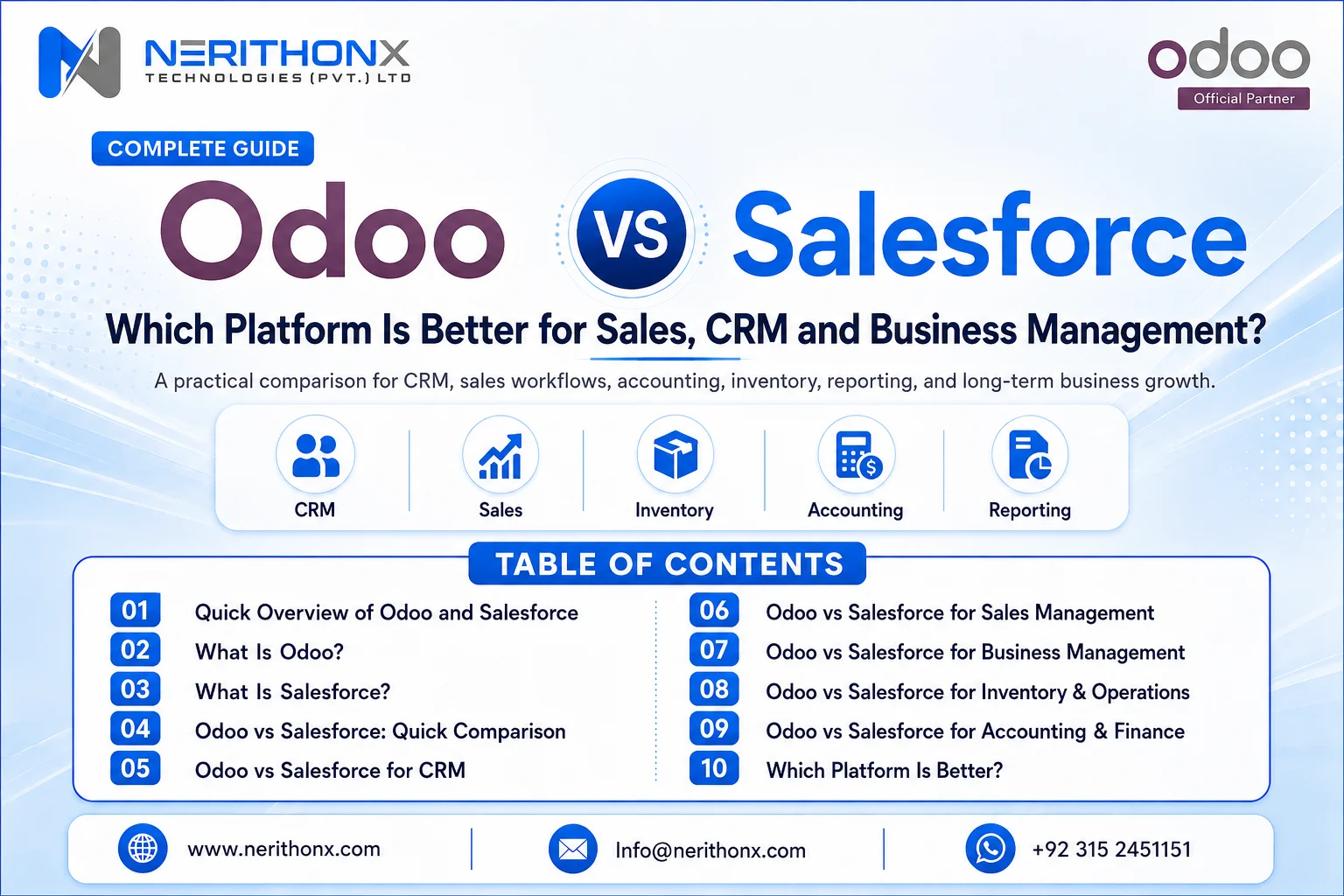
Many businesses struggle with scattered customer records, missed follow-ups, slow sales reporting, manual quotations, disconnected accounting, poor inventory visibility, and weak management control.
At first, a simple CRM may look enough.
Sales teams need to manage leads. Managers need pipeline reports. Customers need faster responses. But as the business grows, sales, finance, inventory, operations, and customer service need to work together.
This is where many companies start comparing Odoo vs Salesforce.
Both platforms are popular, powerful, and useful, but they solve business problems in different ways.
Salesforce is mainly known for CRM and customer relationship management. Salesforce describes Customer 360 as a platform that brings together apps for sales, service, marketing, commerce, IT, industries, partners, and more. (Salesforce)
Odoo is a complete ERP and business management platform that helps companies manage connected workflows through Odoo ERP implementation. Odoo describes itself as a suite of business apps covering CRM, eCommerce, accounting, inventory, point of sale, project management, and more. (Odoo)
The better choice depends on business needs, budget, workflow complexity, implementation quality, and long-term growth plans.
Quick Answer: Odoo vs Salesforce
Odoo is usually a better choice for businesses that need CRM combined with ERP operations such as accounting, inventory, sales, purchase, manufacturing, POS, and reporting.
Salesforce is usually a better choice for businesses that mainly need advanced CRM capabilities, customer engagement workflows, sales automation, and enterprise-level pipeline management.
The right choice depends on whether your business needs a CRM-first platform or an ERP-first business management system.
What Is Odoo?
Odoo is an ERP and business management platform that helps companies manage different departments from one connected system.
Odoo includes business apps such as:
- CRM
- Sales
- Accounting
- Inventory
- Purchase
- Manufacturing
- POS
- Website
- eCommerce
- HR
- Projects
- Helpdesk
- Reporting dashboards
Odoo is useful for businesses that want to connect customer management with backend operations like quotations, invoices, stock, purchases, deliveries, accounting, and reporting.
For example, a sales opportunity in Odoo can move toward quotation creation, sales order confirmation, delivery, invoicing, payment tracking, and reporting depending on setup.
This makes Odoo practical for businesses that do not only need CRM, but also need complete business workflow management.
What Is Salesforce?
Salesforce is a CRM-focused platform widely used for sales management, customer relationship management, marketing, service, automation, analytics, and customer data management.
Salesforce Sales Cloud is built around sales force automation, sales processes, reporting, dashboards, lead tracking, activities, and pipeline visibility. Salesforce’s official Sales Cloud page describes reporting tools for dashboards, lead volume, activity conversion rates, and sales pipeline tracking. (Salesforce)
Salesforce strengths can include:
- Lead management
- Opportunity tracking
- Sales pipeline
- Customer communication
- Sales automation
- Marketing and service tools
- Analytics and reporting
- Enterprise CRM customization
- Strong app ecosystem depending on edition and setup
Salesforce can be a strong option for companies that need advanced CRM, large sales teams, customer engagement workflows, and enterprise-level sales operations.
It is not fair to say Salesforce is only useful for large companies or that it is not suitable for SMEs. The real question is whether the business needs a CRM-first platform or a connected ERP system with CRM included.
Odoo vs Salesforce: Quick Comparison
Area | Odoo | Salesforce |
Main Focus | ERP-first business management platform with CRM included | CRM-first platform focused on customer relationships and sales |
CRM | Leads, opportunities, pipeline, activities, quotations, sales reporting | Strong CRM pipeline, lead management, sales automation, customer engagement |
Sales Management | Sales orders, quotations, invoicing, deliveries, reporting | Lead, account, contact, opportunity, pipeline, sales activity management |
ERP Modules | Strong ERP apps including accounting, inventory, purchase, manufacturing, POS, HR | ERP needs usually depend on integrations or external systems |
Accounting | Available inside Odoo depending on configuration | Usually needs integration with accounting or ERP systems |
Inventory | Built-in inventory and warehouse workflows | Usually handled through integrations or external systems |
Purchase | Purchase workflows available inside Odoo | Usually handled through integration or another platform |
Manufacturing | Manufacturing workflows available inside Odoo | Usually handled through integration or another ERP |
POS | Odoo POS available | POS usually needs integration or third-party solution |
eCommerce | Website and eCommerce apps available | Commerce tools available depending on Salesforce products and setup |
Customization | Flexible ERP and workflow customization | Strong CRM customization and enterprise workflow flexibility |
Integration | Apps inside one ecosystem plus integration options | Strong ecosystem and integration options |
Reporting | ERP-wide reporting depending on apps and setup | Strong CRM analytics and dashboard capabilities |
User Training | Needed for CRM, ERP, operations, finance, and users | Needed for CRM, sales processes, reporting, and automation |
Cost Consideration | Depends on users, apps, hosting, customization, support | Depends on edition, users, products, implementation, integrations, support |
Best For | Businesses needing CRM plus ERP in one system | Businesses needing advanced CRM and customer engagement workflows |
Salesforce is strong for CRM-focused sales and customer management.
Odoo is strong for businesses that need CRM plus complete ERP operations in one connected platform.
Odoo vs Salesforce for CRM
Both platforms offer CRM features, but their approach is different.
Odoo CRM helps businesses manage leads, opportunities, sales activities, and customer workflows through a structured Odoo CRM implementation approach. Odoo’s CRM documentation says it helps users organize sales activities, track leads, close opportunities, and get forecasts. (Odoo)
Salesforce CRM is deeply focused on customer relationship management, pipeline control, sales automation, customer engagement, and enterprise CRM workflows. Salesforce’s official sales help documentation mentions lead generation, opportunity management, account relationships, forecasts, territories, and selling teams. (Salesforce)
The practical difference is simple.
If a business mainly needs advanced CRM, Salesforce can be suitable.
If a business needs CRM connected with inventory, accounting, sales orders, invoices, purchases, deliveries, and operations, Odoo can be more practical depending on implementation.

Odoo vs Salesforce for Sales Management
Sales teams need lead tracking, follow-ups, quotations, approvals, sales orders, customer history, and reporting.
In Odoo, sales can continue from CRM to quotation, sales order, delivery, invoice, and payment workflow depending on configuration. Odoo documentation also explains that quotations can be created from CRM opportunities. (Odoo)
Salesforce is strong when the business needs structured pipeline control, sales activities, opportunity tracking, sales dashboards, and enterprise sales engagement workflows.
A practical example:
If a trading company wants the sales team to check stock availability, create quotations, confirm sales orders, process delivery, generate invoices, and connect with accounting, Odoo may be easier to manage in one system.
If a company has a large sales team and needs advanced pipeline control, customer engagement, forecasting, and CRM automation, Salesforce can be a strong choice.
Odoo vs Salesforce for Business Management
This is where the difference becomes clear.
Salesforce is CRM-first.
Odoo is ERP-first with CRM included.
Odoo can connect sales with:
- Inventory
- Accounting
- Purchase
- Manufacturing
- POS
- eCommerce
- Projects
- Helpdesk
- HR
- Reporting
For businesses that want one system for multiple departments, Odoo can reduce disconnected tools and duplicate data entry.
For businesses already using multiple enterprise systems and needing a powerful CRM layer, Salesforce can fit well depending on integration strategy.
The better choice depends on what the business wants to manage.
If the main problem is customer relationship management, sales pipeline, and customer engagement, Salesforce is strong.
If the main problem is connected business operations, Odoo is often more practical.

Odoo vs Salesforce for Inventory and Operations
Inventory and operations are important for retail, distribution, manufacturing, and trading businesses.
Odoo can directly connect CRM and sales with stock availability, delivery orders, purchase planning, warehouses, manufacturing, and inventory reporting.
Salesforce can support operations through integrations, add-ons, or external ERP systems depending on business setup.
For example, if a business sells physical products, the sales team often needs to know:
- Is the product available?
- Which warehouse has stock?
- Can delivery be processed?
- Is purchase planning required?
- Has the invoice been generated?
- Has the customer paid?
Odoo can manage these workflows inside one ERP ecosystem depending on configuration.
If inventory and operations are core business needs, Odoo may be easier to manage as a connected ERP system.

Odoo vs Salesforce for Accounting and Finance
Sales and CRM data eventually affect invoices, payments, receivables, revenue reports, and financial control.
Odoo can connect sales, invoices, payments, accounting, expenses, vendor bills, and financial reports depending on configuration.
Salesforce may require integration with accounting or ERP systems for complete finance workflows depending on business requirements.
This does not mean Salesforce is weak. It means Salesforce is usually used as a CRM and customer platform, while finance and accounting may be managed through another integrated system.
Accounting workflows should always be reviewed by the finance team and configured according to the business process.
No CRM or ERP system should replace proper finance review.
Odoo vs Salesforce for Customization and Flexibility
For businesses with unique workflows, Odoo customization can help adapt modules, reports, automation, and processes according to operational requirements.
Customization may include:
- Workflow customization
- Fields and forms
- Reports and dashboards
- Integrations
- Automation rules
- Approval flows
- User roles and permissions
Salesforce offers strong CRM customization and enterprise ecosystem capabilities depending on edition and setup.
Odoo offers flexibility across ERP workflows, including CRM, sales, inventory, accounting, purchase, manufacturing, POS, and reporting.
The important point is this: customization should be based on real business needs, not unnecessary complexity.
Poor customization can make any system difficult to maintain.
Odoo vs Salesforce for Integration
Most growing businesses need integration with websites, eCommerce platforms, payment gateways, accounting tools, marketing tools, WhatsApp, email, and reporting systems.
Odoo can integrate with many systems through APIs and Odoo integration solutions.
Salesforce has a strong ecosystem and many integration options, especially for customer-facing and enterprise workflows. Salesforce’s products page presents Salesforce as a unified platform with AI, data, and Customer 360 applications. (Salesforce)
The right integration approach depends on:
- Existing business systems
- Budget
- Data flow
- API requirements
- Reporting requirements
- Long-term support plan
Before choosing any platform, businesses should map what data needs to move between systems and which department owns each workflow.
Odoo vs Salesforce for Reporting and Dashboards
Managers need clear reports, not just stored data.
Odoo can show reports across sales, inventory, accounting, purchase, POS, manufacturing, and CRM depending on installed apps and configuration.
Salesforce can provide strong CRM analytics, sales dashboards, pipeline reports, and customer insights depending on edition and configuration. Salesforce Sales Cloud highlights dashboard and reporting tools for sales performance and pipeline visibility. (Salesforce)
The best reporting depends on:
- Clean data
- Correct configuration
- Useful dashboard design
- Proper user entry
- Clear management KPIs
A dashboard is only useful when the data behind it is accurate.
Odoo vs Salesforce for Cost and Implementation
It is better not to compare Odoo and Salesforce only by license price.
The real cost depends on:
- Number of users
- Selected edition
- Apps or modules
- Hosting
- Customization
- Integration
- Data migration
- Training
- Support
- Implementation partner
Odoo may be more suitable for SMEs that want ERP and CRM together in one system.
Salesforce may be more suitable for companies that need advanced CRM capabilities and have budget for enterprise CRM implementation.
For Pakistani SMEs, the practical question is not only “Which software is famous?”
The better question is:
Which platform fits our workflow, budget, team skill level, reporting needs, and long-term growth plan?
Odoo vs Salesforce Decision Matrix
| Business Requirement | Better Fit |
|---|---|
| Advanced CRM only | Salesforce |
| CRM + Accounting | Odoo |
| CRM + Inventory | Odoo |
| Enterprise sales automation | Salesforce |
| Manufacturing workflows | Odoo |
| Retail + POS operations | Odoo |
| Large customer engagement teams | Salesforce |
| SMEs needing one connected system | Odoo |
Which Platform Is Better?
There is no single answer for every business.
Choose Salesforce if:
- Your main need is advanced CRM
- You have a large sales or customer engagement team
- You need deep customer pipeline management
- You already have ERP/accounting/inventory systems
- You have budget for enterprise CRM implementation
- You need strong CRM customization and customer engagement workflows
Choose Odoo if:
- You need CRM plus ERP in one platform
- You want sales connected with inventory and accounting
- You want quotations, invoices, purchases, stock, and reporting together
- You run retail, distribution, manufacturing, trading, or service operations
- You want to reduce disconnected tools
- You need a scalable ERP system for multiple departments
Both platforms can be powerful when implemented correctly.
The better choice depends on company size, budget, business process, reporting requirements, integration needs, and user training.
Odoo vs Salesforce by Industry
| Industry | Recommended Approach |
|---|---|
| Manufacturing | Odoo because sales, inventory, production, and accounting can connect |
| Retail | Odoo because CRM, POS, inventory, and sales can work together |
| Distribution | Odoo because warehouse and sales workflows are connected |
| Enterprise Sales Organizations | Salesforce because of advanced CRM capabilities |
| Service Businesses | Depends on whether CRM or operations are the main priority |
Odoo vs Salesforce for Pakistani Businesses
Many Pakistani businesses still use Excel sheets, WhatsApp follow-ups, manual sales records, separate accounting software, disconnected inventory systems, and delayed reporting.
According to Pakistan’s SME ecosystem reports, small and medium businesses represent a significant part of the country’s private sector. As these businesses grow, the need for connected systems covering sales, finance, inventory, and reporting becomes more important.
This creates problems between sales, finance, inventory, operations, and management.
For businesses in Pakistan, especially in Peshawar and Islamabad, Odoo may be practical when the goal is to connect CRM with ERP workflows such as sales, inventory, purchase, accounting, POS, and reporting.
Salesforce can be a strong option for businesses that need advanced CRM, structured sales teams, customer engagement, and enterprise-level pipeline management.
The decision should be based on real workflow needs, not only brand popularity.
Common Mistakes Businesses Make When Choosing CRM or ERP
Many companies choose software too quickly and face problems later.
Common mistakes include:
- Choosing software without mapping workflows
- Looking only at license cost
- Ignoring implementation cost
- Ignoring user training
- Not cleaning customer data
- Not defining sales stages
- Not involving finance and operations teams
- Adding too much customization at the start
- Ignoring integration needs
- Not planning reports and dashboards
- Choosing a tool without long-term support
- Expecting software to fix weak business processes automatically
Odoo and Salesforce can both fail if implementation is weak.
From practical ERP implementation experience, many software selection problems are not caused by the platform itself. They usually happen because businesses do not define workflows, data requirements, reporting needs, and user responsibilities before implementation.
Software selection should always start with business process mapping.
How to Choose Between Odoo and Salesforce
Use this checklist before making a decision:
- Define your main business problem
- Decide whether you need CRM only or CRM plus ERP
- Review your sales process
- Review your inventory and accounting needs
- Check reporting requirements
- Identify required integrations
- Review number of users and departments
- Check budget for license, implementation, customization, and support
- Plan data migration
- Train users before go-live
- Test workflows before full implementation
- Work with an experienced implementation partner
This approach helps businesses choose a system based on practical needs, not assumptions.
Why Choose NerithonX Technologies for Odoo CRM and ERP Implementation?
NerithonX Technologies (Pvt.) Ltd. helps businesses in Pakistan implement, customize, integrate, migrate, and support Odoo ERP systems.
The team focuses on real business workflows, not just software installation.
As an Official Odoo Partner, NerithonX Technologies supports businesses with:
- Odoo ERP implementation in Pakistan
- Odoo migration and data transfer
- Odoo customization
- Odoo integration
- Odoo CRM implementation
- Odoo sales automation
- Odoo customization and integration
- ERP reporting and dashboard setup
- CRM and sales workflow consulting
- User training and post-go-live support
- Practical support for businesses in Peshawar, Islamabad, and across Pakistan
With 7+ years of experience, 20+ Odoo experts, and 19+ businesses transformed, NerithonX Technologies helps companies build connected sales, CRM, and ERP workflows.
Final Thoughts
Odoo vs Salesforce is not about saying one platform is perfect and the other is wrong.
Both platforms can be powerful when implemented correctly.
Salesforce is strong for advanced CRM, sales pipeline management, customer engagement, and enterprise customer operations.
Odoo is strong for businesses that need CRM plus complete ERP operations such as sales, inventory, accounting, purchase, manufacturing, POS, eCommerce, helpdesk, and reporting.
For many Pakistani SMEs and growing companies, Odoo can be a practical choice when the goal is to connect multiple departments in one system.
If your business is comparing Odoo vs Salesforce and wants to build better sales, CRM, reporting, and ERP workflows, NerithonX Technologies can help you review your needs and implement the right Odoo ERP solution for long-term growth.
Confused between Odoo and Salesforce? Contact NerithonX Technologies for expert Odoo
FAQ
Frequently Asked Questions
What is the main difference between Odoo and Salesforce?
Odoo is an ERP platform with CRM included, while Salesforce is mainly a CRM-focused platform for sales, customer management, marketing, service, and customer engagement.
Is Odoo better than Salesforce?
Odoo can be better for businesses that need CRM plus inventory, accounting, purchase, sales, POS, and operations in one system. Salesforce can be better for advanced CRM and customer engagement workflows.
Is Salesforce better than Odoo CRM?
Salesforce can be stronger for advanced CRM, large sales teams, pipeline automation, and enterprise customer engagement. Odoo CRM is useful when CRM needs to connect with ERP workflows.
Can Odoo manage sales and CRM?
Yes, Odoo can manage leads, opportunities, activities, quotations, customers, sales orders, invoices, reporting, and sales teams depending on configuration.
Can Salesforce manage ERP operations?
Salesforce can support many business workflows, but complete ERP operations such as accounting, inventory, purchase, manufacturing, and POS may require integrations or additional systems.
Which platform is better for Pakistani SMEs?
For Pakistani SMEs that need CRM, sales, inventory, accounting, purchase, and reporting in one system, Odoo can be practical. For advanced CRM-focused teams, Salesforce can also be suitable.
What should businesses consider before choosing Odoo or Salesforce?
Businesses should review their budget, company size, sales process, reporting needs, integration requirements, ERP needs, user training, customization, and implementation support.
Why choose NerithonX Technologies for Odoo implementation?
Odoo can support pharma manufacturing workflows through Manufacturing, Inventory, Quality, Purchase, Sales, Accounting, lot tracking, expiration dates, quality checks, quality alerts, reporting, access rights, and customization.
Does ERP software guarantee GMP or FDA compliance?
No. ERP software does not automatically guarantee GMP, FDA, ISO, or 21 CFR Part 11 compliance. Compliance depends on correct configuration, validation where required, SOPs, documentation, training, internal controls, and qualified review.
Can NerithonX Technologies help implement Odoo for pharma manufacturing?
NerithonX Technologies helps Pakistani businesses implement, customize, integrate, migrate, and support Odoo ERP with practical CRM, sales, reporting, automation, training, and long-term support.
Is Odoo a CRM or ERP?
Odoo is an ERP and business management platform that includes CRM functionality. It connects customer management with sales, accounting, inventory, operations, and other business processes.
Can Odoo replace Salesforce?
Odoo can replace Salesforce for businesses that need CRM combined with ERP operations. However, companies requiring highly specialized enterprise CRM workflows may still prefer Salesforce.