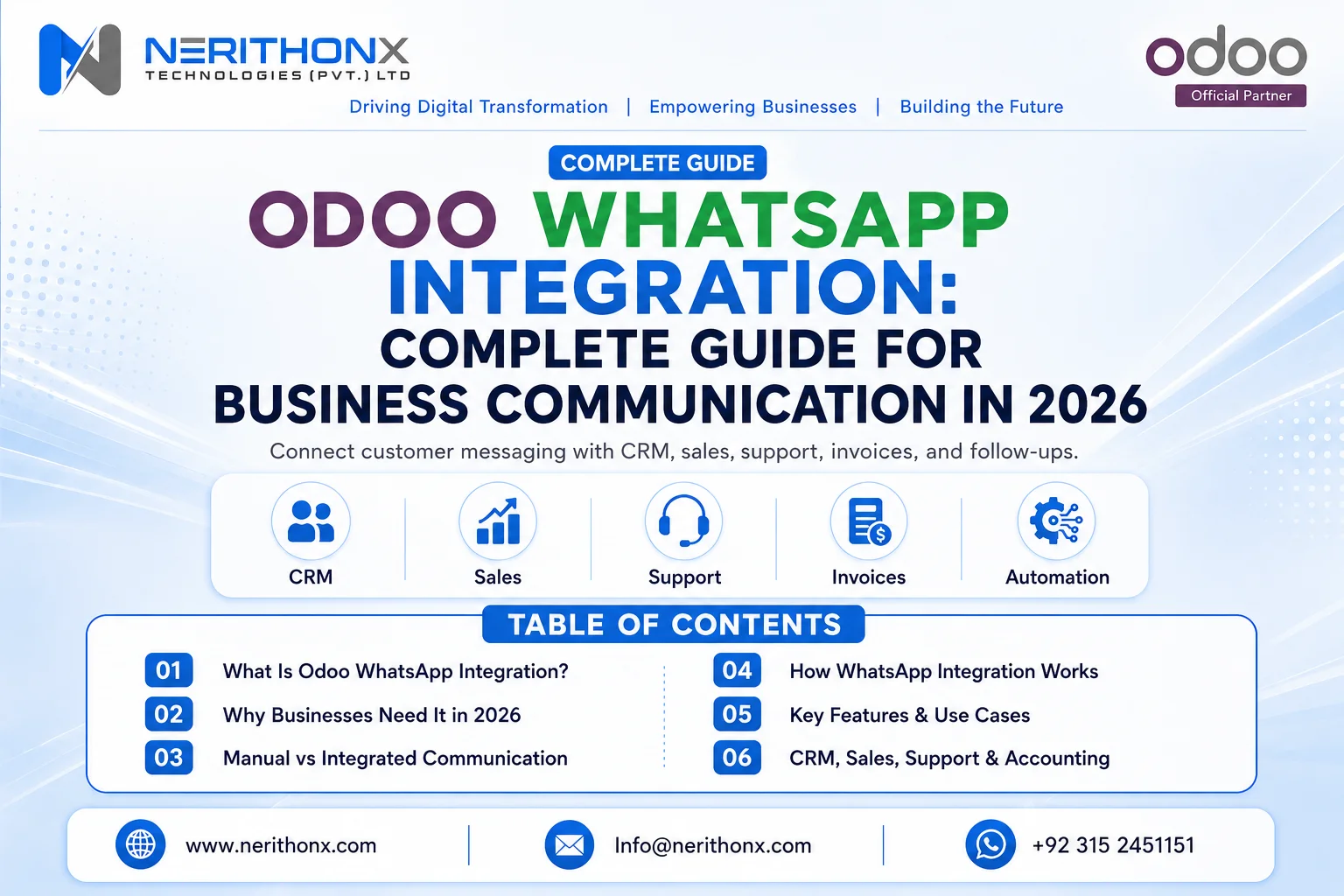
Many businesses use WhatsApp every day for sales inquiries, customer support, order updates, payment reminders, and follow-ups.
It is fast, familiar, and easy for customers.
But when WhatsApp communication is separate from CRM, sales, inventory, accounting, and helpdesk systems, teams face serious problems.
Sales teams miss follow-ups. Support teams repeat the same questions. Customer history stays inside individual employee phones. Managers cannot track communication properly. Finance reminders are sent manually. Order updates depend on personal follow-up.
As the business grows, this creates confusion, delayed replies, missed messages, and poor customer tracking.
This is where Odoo WhatsApp Integration becomes important.
In 2026, businesses need connected communication. Odoo WhatsApp Integration helps connect WhatsApp conversations with Odoo ERP workflows so teams can communicate faster, track customers better, and manage business follow-ups more professionally.
But integration is most useful when workflows are properly planned, customer data is clean, message templates are approved where required, and the connector is configured according to business needs.
What Is Odoo WhatsApp Integration?
Odoo WhatsApp Integration means connecting WhatsApp Business communication with Odoo ERP so businesses can manage customer messages, sales follow-ups, support updates, reminders, and business records from a connected system.
Instead of sending every message manually from personal WhatsApp accounts, businesses can connect communication with Odoo records such as leads, customers, quotations, sales orders, invoices, delivery orders, and support tickets.
Depending on the connector, Odoo version, WhatsApp Business API setup, Meta/WhatsApp rules, hosting setup, configuration, and implementation approach, Odoo WhatsApp Integration can support workflows such as:
- Customer inquiries
- CRM lead communication
- Sales quotation sharing
- Order confirmation messages
- Invoice or payment reminders
- Delivery updates
- Helpdesk ticket updates
- Appointment reminders
- Follow-up messages
- Customer support conversations
- Message templates
- Communication history
Odoo’s official WhatsApp documentation explains that Odoo can integrate a WhatsApp Business Account with Odoo using the WhatsApp Business API, and Odoo’s WhatsApp app is available for Enterprise users. (Odoo)
The exact workflow should always be reviewed before implementation because every business has different communication needs.

Why Businesses Need Odoo WhatsApp Integration in 2026
Customers now expect faster replies, clear updates, and organized communication.
For many Pakistani businesses, WhatsApp is already the main channel for inquiries, quotations, payment follow-ups, delivery updates, and support messages.
The problem is not WhatsApp itself.
The problem is disconnected communication.
When messages are not connected with CRM, sales, invoices, tickets, or customer history, the business depends too much on individual employees. If one employee is absent, leaves the company, or forgets a follow-up, the customer experience suffers.
Odoo WhatsApp Integration can help businesses improve:
- Faster customer communication
- Better sales follow-ups
- Improved CRM tracking
- Organized customer history
- Less manual message sending
- Better support response
- Reduced missed follow-ups
- Faster quotation and order updates
- Improved team coordination
- Better communication visibility for management
Results depend on business process, configuration, connector capability, user training, and proper communication control.
Manual WhatsApp Communication vs Odoo WhatsApp Integration
Area | Manual WhatsApp Communication | Odoo WhatsApp Integration |
Customer Inquiry Handling | Messages stay scattered in chats | Inquiries can connect with CRM or customer records |
Sales Follow-ups | Follow-ups depend on individual memory | Follow-up activities can be managed in Odoo |
CRM Updates | CRM may not be updated properly | WhatsApp communication can support CRM visibility |
Quotation Sharing | Quotations are sent manually | Quotations may be shared from Odoo records |
Order Updates | Updates depend on manual messages | Order updates can follow configured workflows |
Payment Reminders | Finance sends reminders manually | Reminders can be managed through controlled workflows |
Support Tickets | Support history may be missing | WhatsApp can support helpdesk ticket communication |
Communication History | Often stored on employee phones | Customer communication can be more organized |
Team Coordination | Teams may not know the latest update | Sales, support, and management can work with better visibility |
Management Visibility | Hard to monitor follow-ups | Managers can review communication and activities |
Manual WhatsApp communication is fast but often unorganized.
Odoo WhatsApp Integration helps businesses connect communication with proper CRM, sales, support, and ERP workflows.
How Odoo WhatsApp Integration Works
The general workflow is simple.
- Customer sends an inquiry or needs an update
- The message or customer record is connected with Odoo
- Sales or support team can view customer details
- Quotation, order, invoice, or ticket information can be used for communication
- Approved messages or templates can be sent where required
- Follow-up activities can be created in Odoo
- Communication history can support sales and support teams
- Managers can track customer communication and follow-up performance
This workflow may vary depending on connector, WhatsApp Business API setup, configuration, message type, user permissions, and business requirements.
For example, one business may want WhatsApp messages only for sales quotations. Another business may need invoice reminders. A service company may need appointment reminders. An eCommerce business may need order and delivery updates.
That is why proper workflow planning is important before starting integration.
Key Features of Odoo WhatsApp Integration
WhatsApp Messages from Odoo
Businesses may send WhatsApp messages from Odoo records such as leads, customers, quotations, sales orders, invoices, delivery orders, or tickets depending on configuration.
Odoo’s Chatter documentation notes that after WhatsApp is configured and enabled, a WhatsApp button can appear on applicable records, and approved WhatsApp templates are required before use. (Odoo)
This helps teams communicate from business records instead of switching between different systems.
CRM Lead Communication
CRM is one of the strongest areas for Odoo WhatsApp Integration.
Sales teams can use WhatsApp communication for lead follow-ups, inquiry responses, quotation discussions, and customer updates.
Odoo CRM is designed to help businesses track leads, manage opportunities, organize pipelines, and handle daily activities. (Odoo)
When WhatsApp communication is connected with CRM workflows, sales teams can reduce missed follow-ups and improve customer tracking.
Quotation and Sales Order Sharing
Sales teams often use WhatsApp to share quotations, product details, order confirmations, and sales updates.
With the right setup, businesses can share quotations or order-related information through WhatsApp from Odoo.
Odoo Sales is used to manage the sales process from quotation to sales order, delivery, and invoicing. (Odoo)
This helps sales teams keep communication closer to real sales records.
Invoice and Payment Reminders
Finance teams can use WhatsApp integration for invoice notifications, payment reminders, and customer balance follow-ups where appropriate.
This should be done carefully.
Businesses should avoid spam, use controlled templates where required, and make sure finance communication is reviewed by the finance team.
Payment reminders should support finance workflows, not replace proper accounting review.
Delivery and Order Updates
Sales, inventory, or delivery teams can send order status, dispatch, or delivery-related updates through WhatsApp where workflows are configured.
This is useful for businesses that regularly update customers about order confirmation, delivery timing, dispatch status, or service completion.
The workflow should be connected with real Odoo records to avoid wrong updates.
Helpdesk and Customer Support
WhatsApp can support customer service when connected with helpdesk workflows.
Odoo Helpdesk is a ticket-based customer support application where multiple support teams can be configured and managed with their own pipelines. (Odoo)
With WhatsApp integration, support teams can manage ticket updates, customer replies, issue follow-ups, and support history more professionally.
Message Templates and Automation
WhatsApp Business API may require approved message templates for certain outbound messages.
Meta’s WhatsApp Business Messaging Policy states that businesses may initiate conversations using approved message templates, and templates can be reviewed, approved, paused, or rejected. (WhatsApp for Business)
This means message templates should be planned carefully according to business use cases.
Good examples include:
- Quotation shared
- Order confirmed
- Invoice reminder
- Payment follow-up
- Appointment reminder
- Ticket update
- Delivery update
Automation should be useful, controlled, and respectful to the customer.
Communication History and Follow-ups
Connected communication can help teams review past customer interactions, reduce repeated questions, and plan better follow-ups.
For example, if a customer asks about a previous quotation, the sales team can view the customer record and related activity instead of searching old chats manually.
This improves team coordination and customer experience.

Benefits of Odoo WhatsApp Integration for Businesses
Odoo WhatsApp Integration can help businesses with:
- Faster customer response
- Better sales follow-up
- More organized communication
- Improved CRM visibility
- Reduced manual work
- Better quotation sharing
- Easier invoice and payment reminders
- Improved support workflows
- Better customer history
- Stronger team coordination
- Better management tracking
- More scalable customer communication
These benefits depend on correct implementation, clean customer data, proper templates, user permissions, and trained teams.
Odoo WhatsApp Integration Use Cases
For Sales Teams
Sales teams can use WhatsApp integration for:
- Lead follow-up messages
- Quotation sharing
- Customer inquiry responses
- Sales activity reminders
- Deal stage communication
For example, if a lead asks for a quotation, the sales team can create or update the lead in Odoo and send communication through a controlled workflow.
For Customer Support Teams
Support teams can use WhatsApp integration for:
- Ticket update messages
- Issue follow-ups
- Customer reply tracking
- Support history review
- Faster response coordination
This is helpful when customers prefer WhatsApp over email or phone calls.
For Finance Teams
Finance teams can use WhatsApp integration for:
- Invoice notifications
- Payment reminders
- Payment confirmation communication
- Customer account follow-ups
- Finance-related message templates
These workflows should be reviewed and controlled to avoid unnecessary or repeated messages.
For eCommerce and Online Stores
Online stores can use WhatsApp integration for:
- Order confirmation messages
- Delivery updates
- Return or exchange communication
- Customer support responses
- Product availability messages
This helps customers stay informed and reduces manual follow-up pressure on the team.
For Service-Based Businesses
Service companies can use WhatsApp integration for:
- Appointment reminders
- Service updates
- Customer feedback requests
- Follow-up communication
- Support and maintenance reminders
This is useful for clinics, agencies, maintenance companies, consultants, and service providers.
For Management
Management can benefit from:
- Communication visibility
- Follow-up performance tracking
- Customer response monitoring
- Sales team activity insights
- Support workflow control
Instead of depending only on verbal updates, managers can review business communication in a more organized way.
Odoo WhatsApp Integration and CRM
CRM is one of the most important areas for WhatsApp integration.
When WhatsApp communication is connected with Odoo CRM, sales teams can manage leads, opportunities, follow-ups, quotations, and customer conversations more professionally.
A proper CRM workflow may include:
- Lead creation
- Opportunity tracking
- Customer communication history
- Follow-up activities
- Quotation sharing
- Sales pipeline visibility
- Team assignment
- Manager review
Before starting WhatsApp automation, businesses should define CRM stages, lead ownership, follow-up rules, and team responsibilities.
Without a proper CRM structure, WhatsApp automation can become another scattered communication channel.

Odoo WhatsApp Integration and Sales
Sales teams often use WhatsApp for quotations, product details, order confirmations, and customer follow-ups.
Integration can reduce scattered communication and help sales teams connect conversations with real sales records.
Important sales areas include:
- Quotations
- Sales orders
- Product information
- Customer records
- Follow-up reminders
- Order confirmation
- Sales reporting
- Approval workflow if required
For example, if a customer requests a quotation, the sales team should not only send a WhatsApp message. The opportunity, quotation, expected closing date, and follow-up activity should also be tracked in Odoo.
This creates better sales visibility.

Odoo WhatsApp Integration and Helpdesk
For support teams, WhatsApp can be a strong customer communication channel when properly connected with helpdesk workflows.
Support-related workflows may include:
- Ticket updates
- Customer issue tracking
- Response history
- Escalation reminders
- Support team assignment
- SLA monitoring where configured
- Customer satisfaction follow-up
This helps support teams reduce missed replies and improve customer handling.
However, WhatsApp should support helpdesk discipline, not replace ticket management.

Odoo WhatsApp Integration and Accounting
Finance teams can use WhatsApp integration for invoice notifications, payment reminders, and account-related communication where appropriate.
This may include:
- Invoice sharing
- Payment reminders
- Customer balance follow-up
- Payment confirmation messages
- Finance team review
- Message control and approval
Accounting communication should be configured according to business process and reviewed by the finance team.
Do not send finance-related messages without proper control, customer consent, and internal approval rules.
WhatsApp Business API, Templates, and Permissions
WhatsApp Business API is commonly used for structured business messaging.
It may involve Meta/WhatsApp rules, phone number setup, business verification, templates, permissions, and messaging policies.
Meta’s WhatsApp Cloud API documentation explains that Cloud API enables businesses to programmatically send and receive WhatsApp messages using a business phone number. (Facebook Developers)
Businesses should plan these areas carefully:
- Customer consent is important
- Template messages may need approval
- User access should be controlled
- Message history should be handled carefully
- Businesses should avoid spam
- Privacy and permissions must be planned properly
- Connector limitations should be reviewed before implementation
Meta’s documentation also states that businesses are required to obtain opt-in before messaging people on WhatsApp. (Facebook Developers)
This section is not about making the process complicated. It is about using WhatsApp communication professionally and responsibly.
Common Challenges in Odoo WhatsApp Integration
Odoo WhatsApp Integration can bring strong business value, but poor planning can create problems.
Common challenges include:
- Wrong connector selection
- WhatsApp Business API setup confusion
- Message template approval issues
- Duplicate customer records
- Poor CRM data
- Unclear sales workflow
- Weak helpdesk process
- Too many manual workarounds
- No user access control
- No customer consent process
- Poor testing before go-live
- Lack of user training
- Sync or delivery failure handling not planned
- Expecting WhatsApp to replace full CRM or ERP discipline
Most integration problems happen because communication workflows are not mapped properly before implementation.
A connector can send messages, but it cannot fix weak CRM, poor customer data, or unclear sales ownership by itself.
How to Prepare Your Business for Odoo WhatsApp Integration
Before starting integration, businesses should prepare properly.
Use this practical checklist:
- Define your WhatsApp communication goals
- Map your sales, CRM, support, and finance workflows
- Clean customer and contact data
- Decide which Odoo records need WhatsApp communication
- Select the right connector or integration approach
- Plan WhatsApp Business API setup if required
- Prepare message templates where needed
- Define user access and permissions
- Set rules for customer consent and message control
- Test with sample customers and records
- Train sales, support, finance, and management users
- Go live step by step
- Monitor errors, replies, and team usage
- Improve workflows after feedback
This preparation helps reduce mistakes and makes the integration more useful for daily business operations.
Odoo WhatsApp Integration for Pakistani Businesses
Many Pakistani businesses use WhatsApp as a primary customer communication channel.
Sales inquiries, quotations, payment follow-ups, order updates, and support messages often happen through WhatsApp.
But when this communication is not connected with ERP or CRM, teams may lose customer history, miss follow-ups, or depend too much on individual employees.
For businesses in Pakistan, especially in Peshawar and Islamabad, Odoo WhatsApp Integration can help improve:
- Sales follow-ups
- Customer communication
- CRM tracking
- Quotation sharing
- Payment reminders
- Helpdesk support
- Order updates
- Team coordination
- Management visibility
- Business communication control
Pakistani SMEs do not need to automate everything on day one.
They can start with lead follow-ups, quotation sharing, invoice reminders, support updates, and basic CRM communication history. After that, they can expand into more advanced workflows.

Is Odoo WhatsApp Integration Suitable for SMEs?
Yes, Odoo WhatsApp Integration can be useful for SMEs when implemented step by step.
Small and medium businesses do not need to automate every message on day one.
They can start with:
- Lead follow-ups
- Quotation sharing
- Invoice reminders
- Order updates
- Helpdesk communication
- Appointment reminders
- Customer feedback messages
- Basic CRM communication history
This allows SMEs to improve communication without making the system too complex.
The best approach is to start with the workflows that create the most manual effort or missed follow-ups.
Why Choose NerithonX Technologies for Odoo WhatsApp Integration?
NerithonX Technologies (Pvt.) Ltd. helps businesses in Pakistan implement, customize, integrate, migrate, and support Odoo ERP systems.
The team focuses on real business workflows, not just software installation.
As an Official Odoo Partner, NerithonX Technologies supports businesses with:
- Odoo ERP implementation in Pakistan
- Odoo WhatsApp Integration
- Odoo CRM and sales automation
- Odoo helpdesk and customer support workflows
- Odoo customization and integration
- ERP reporting and dashboard setup
- User training and post-go-live support
- Practical support for businesses in Peshawar, Islamabad, and across Pakistan
With 7+ years of experience, 20+ Odoo experts, and 19+ businesses transformed, NerithonX Technologies helps businesses build more organized customer communication workflows using Odoo ERP and smart automation.
Final Thoughts
Odoo WhatsApp Integration in 2026 is not only about sending messages from an ERP system.
It is about helping businesses organize communication, improve sales follow-ups, support customers faster, reduce missed updates, and connect WhatsApp conversations with real business workflows.
WhatsApp is already part of daily business communication. Odoo helps organize business operations. When both are connected properly, businesses can improve customer handling, team coordination, and management visibility.
If your business wants to connect WhatsApp with Odoo ERP, improve customer communication, automate follow-ups, or build a more organized CRM and support workflow, NerithonX Technologies can help you plan and implement the right integration for long-term growth.
Want to connect WhatsApp with Odoo ERP? Contact NerithonX Technologies for Odoo WhatsApp Integration, CRM automation, sales follow-ups, helpdesk workflows, and long-term ERP support.
FAQ
Frequently Asked Questions
What is Odoo WhatsApp Integration?
Odoo WhatsApp Integration means connecting WhatsApp Business communication with Odoo ERP so businesses can manage messages, follow-ups, customer records, sales updates, and support workflows from a connected system.
Why do businesses need WhatsApp Odoo integration?
Businesses need WhatsApp Odoo integration to organize customer communication, reduce missed follow-ups, improve CRM tracking, support sales teams, and manage customer updates more professionally
Can Odoo send WhatsApp messages to customers?
Yes, Odoo can send WhatsApp messages to customers depending on the Odoo version, connector, WhatsApp Business API setup, approved templates, permissions, and configuration.
Can WhatsApp be connected with Odoo CRM?
Yes, it can help support teams send ticket updates, manage customer replies, review support history, and coordinate issue follow-ups depending on the configured workflow.
Is Odoo WhatsApp Integration useful for small businesses?
Yes, small businesses can start with simple workflows such as lead follow-ups, quotation sharing, invoice reminders, order updates, and customer support messages.
What are the common challenges in WhatsApp Odoo integration?
Common challenges include wrong connector selection, template approval issues, duplicate customer records, weak CRM workflows, poor testing, lack of user training, and unclear message permissions.
What are the common challenges in WhatsApp Odoo integration?
Electronic batch records are digital records of batch production activities, including formula, materials used, production steps, quality checks, operators, timings, deviations, approvals, and final output.
Why choose NerithonX Technologies for Odoo WhatsApp Integration?
NerithonX Technologies helps Pakistani businesses implement, customize, integrate, and support Odoo ERP with practical CRM, sales, helpdesk, reporting, automation, and training support.