Many businesses reach a stage where normal software tools are no longer enough.
Sales may be managed in spreadsheets. Inventory may be updated manually. Accounting may be delayed. Approvals may happen through WhatsApp. Reports may take hours to prepare. Different departments may use different systems, which creates duplicate data entry and confusion.
This is where Odoo ERP development services become important.
Odoo ERP development services help businesses customize, extend, and integrate Odoo so it can support real business workflows. The goal is not only to install software. The goal is to build a reliable ERP system that connects departments, automates daily work, improves reporting, and supports business growth.
Odoo describes itself as a suite of open-source business apps that covers needs such as CRM, eCommerce, accounting, inventory, point of sale, and project management. Odoo is available in Community and Enterprise editions, with Enterprise adding extra apps, infrastructure, and professional services.
For growing businesses, this flexibility is useful. But to get the best result, Odoo must be configured, customized, integrated, tested, and supported properly.
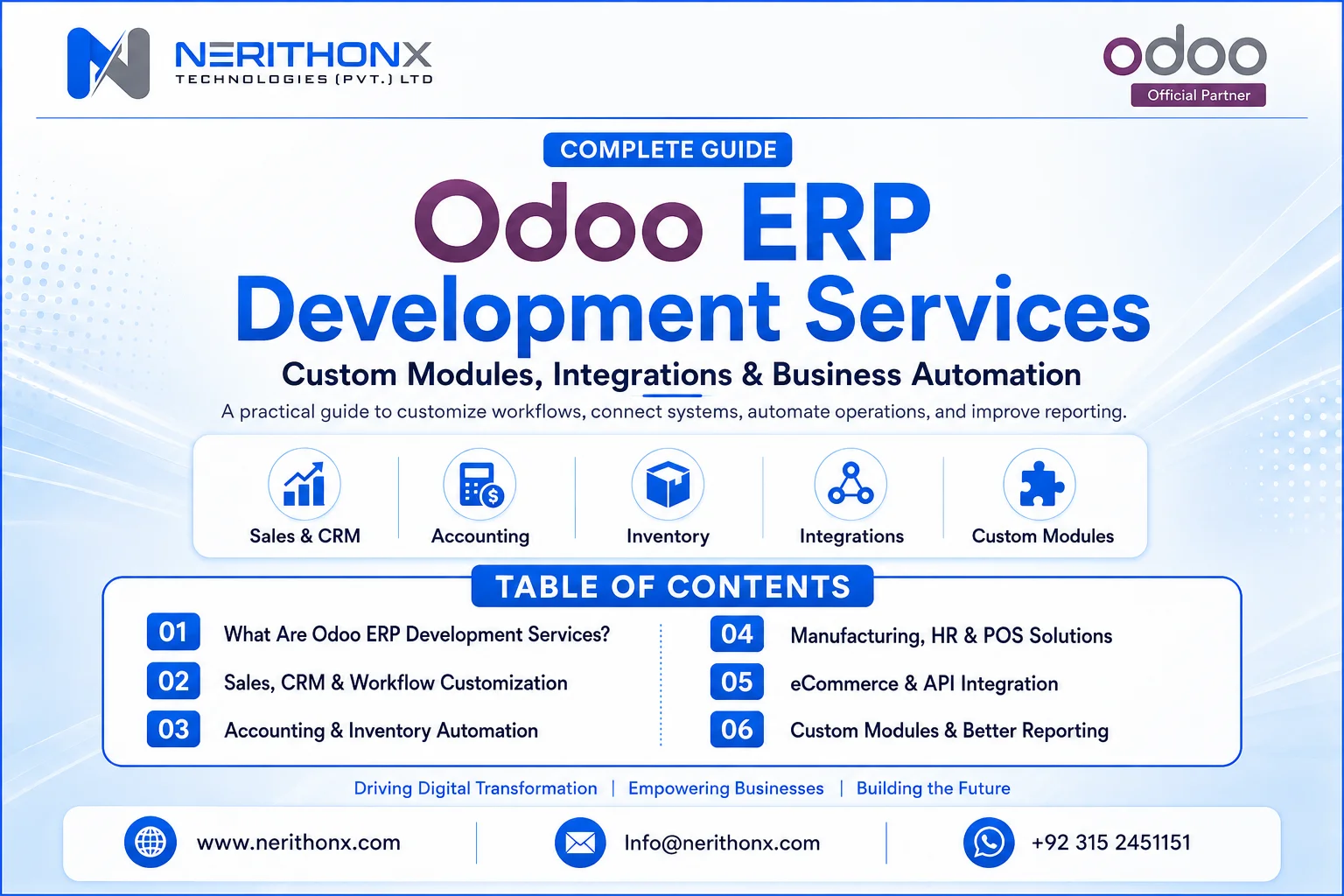
What Are Odoo ERP Development Services?
Odoo ERP development services are professional services that help businesses build, customize, improve, and maintain Odoo ERP according to their operations.
These services can include:
Odoo implementation
Odoo configuration
Odoo customization
Custom module development
Odoo integration
Odoo migration
Reports and dashboards
Workflow automation
Website and eCommerce development
POS customization
Mobile app and portal development
Security rules and access rights
Testing and deployment
Odoo support and maintenance
Odoo user training
In simple words, Odoo ERP development helps businesses adapt Odoo to their actual process instead of forcing users to work manually outside the system.
For example, a manufacturing company may need a custom production approval workflow. A retailer may need POS receipt customization. A school may need a student attendance workflow. A trading company may need a special sales commission report.
Odoo development makes these workflows possible when standard configuration is not enough.
Why Businesses Need Odoo ERP Development Services
Businesses usually need Odoo ERP development services when their current software setup creates operational problems.
Common problems include:
Disconnected systems
Manual approvals
Duplicate data entry
Excel-based reporting
Inventory and accounting mismatch
Slow sales and purchase workflows
Poor department coordination
No real-time dashboards
Limited user access control
No proper integration with third-party tools
Industry-specific requirements
Difficult data migration
Low user adoption
For example, if sales orders are created in one system, stock is managed in Excel, and invoices are created separately, the business will struggle with accuracy. Odoo can connect sales, inventory, accounting, purchase, CRM, POS, manufacturing, HR, and reporting in one system, but each business still needs proper setup and sometimes custom development.
This is why development is not only technical work. It is also business process improvement.
What Makes Odoo a Flexible ERP Platform?
Odoo is flexible because it is modular, integrated, customizable, and open-source.
A business can start with the modules it needs, such as CRM, Sales, Purchase, Inventory, Accounting, Manufacturing, HR, POS, Website, or eCommerce. Later, the business can add more modules as operations grow.
Odoo’s official website explains that Odoo is designed as an integrated suite of business apps covering many company needs, and its value proposition is being easy to use and fully integrated.
Odoo also provides different customization options.
For simple no-code changes, businesses can use Odoo Studio. Odoo Studio is described in official documentation as a toolbox used to customize Odoo without coding knowledge, including fields, views, models, automation rules, webhooks, PDF reports, approval rules, and security rules.
For advanced workflows, complex integrations, performance-sensitive logic, or industry-specific modules, custom Odoo development is usually a better option.
This flexibility allows businesses to start simple and grow step by step.

Core Odoo ERP Development Services
Odoo ERP development services cover many areas. Each service has a different purpose.
Odoo Implementation Services
Odoo implementation means setting up Odoo for real business use.
This includes requirement analysis, module selection, company setup, users, access rights, workflows, configuration, testing, training, and go-live.
A good implementation starts with understanding the business process. It should not begin by randomly installing modules.
For example, before implementing Inventory, the team should understand warehouses, locations, product categories, units of measure, purchase flow, sales flow, delivery process, and stock valuation needs.
Odoo Customization Services
Odoo customization means adjusting existing Odoo apps according to business requirements.
This may include custom fields, forms, menus, workflows, approval rules, access rights, dashboards, reports, and business validations.
For example, a company may want a sales order to require manager approval if discount is above a certain limit. Another company may want a custom invoice report format.
Customization should be practical and upgrade-safe. Businesses should avoid unnecessary customization when standard Odoo features can solve the problem.
Custom Odoo Module Development
Custom Odoo module development is used when a business needs a feature that is not available in standard Odoo or cannot be handled properly through simple configuration.
Examples include:
Custom approval workflows
Industry-specific operations
Custom manufacturing logic
HR and payroll workflows
Sales commission systems
Special pricing rules
Custom reports
Customer portals
Vendor portals
Branch-specific workflows
Advanced dashboards
Odoo’s developer tutorial explains that building a new Odoo application starts by creating a module, but it also notes that before developing a new module, it is good practice to verify whether Odoo already provides a way to answer the specific business case.
That is an important point. Custom development should solve a real business gap, not duplicate something standard Odoo already does.
Odoo Integration Services
Odoo integration connects Odoo with other systems.
This can include:
Shopify
WooCommerce
Payment gateways
Shipping providers
WhatsApp
SMS gateways
Email tools
CRM tools
Accounting systems
POS devices
Biometric attendance devices
Barcode systems
Third-party APIs
Custom web apps
Mobile apps
BI dashboards
Odoo’s JSON-2 API documentation states that API operations use Odoo’s standard security models and are validated against access rights, record rules, and field access of the user. It also recommends dedicated bot users for extended automated integrations so permissions can be limited.
This is why integration should be planned carefully. It needs data mapping, security, error handling, access rights, testing, and monitoring.
Odoo Migration Services
Odoo migration means moving data and workflows from an old system to Odoo or from an older Odoo version to a newer one.
Migration may involve:
Old ERP systems
Excel files
QuickBooks
Tally
ERPNext
SAP Business One
Legacy software
Older Odoo versions
A proper migration includes data audit, data cleaning, field mapping, import templates, trial migration, validation, opening balances, and user testing.
Bad data migration can create long-term ERP problems. Businesses should never treat migration as a simple copy-paste task.
Odoo Website and eCommerce Development
Odoo can be used for website and eCommerce workflows.
Odoo website and eCommerce development may include product catalog setup, online orders, customer portal, payment integration, shipping integration, quotation forms, landing pages, and backend ERP connection.
This is useful because online orders can connect with sales, inventory, invoicing, delivery, and customer records.
Odoo POS Development
Odoo POS development is useful for retail shops, supermarkets, restaurants, showrooms, and multi-branch businesses.
It may include barcode flow, payment methods, receipt customization, discounts, loyalty, cashier access, branch-wise sales, product sync, and inventory connection.
For retail businesses, POS should not work separately from inventory and accounting. It should be part of the complete ERP workflow.
Odoo Reports and Dashboard Development
Reports are one of the biggest reasons businesses invest in ERP.
Odoo report development can include:
Sales reports
Inventory reports
Accounting reports
Purchase reports
Manufacturing reports
HR reports
Payroll reports
POS reports
Customer reports
Management dashboards
PDF reports
Excel exports
Good reports help management see what is happening in the business without waiting for manual Excel files.
Odoo Mobile App and Portal Development
Some businesses need mobile-friendly workflows or portals.
Examples include customer portals, vendor portals, employee portals, delivery portals, field staff apps, approval apps, and mobile dashboards.
A mobile app is not always required. Sometimes a responsive portal or mobile-friendly Odoo workflow is enough. The right choice depends on the business need.
Odoo Support and Maintenance
ERP does not end after go-live.
Odoo support and maintenance may include bug fixing, user support, performance checks, module improvements, backups, upgrades, security review, report changes, and workflow improvements.
Post-go-live support is important because users often discover practical improvements after they start using the system daily.

Odoo Studio vs Custom Odoo Development
Odoo Studio and custom Odoo development both help businesses customize Odoo, but they are not the same.
Odoo Studio is useful for simple no-code customization. Official documentation also explains that Studio customizations are stored in a module named studio_customization, which can be exported as a ZIP and imported into another Odoo database.
Custom Odoo development is better for advanced workflows, complex logic, integrations, performance-sensitive changes, and industry-specific modules.
Area | Odoo Studio | Custom Odoo Development |
Best Use | Simple changes | Advanced requirements |
Technical Skill Needed | Low | Higher |
Speed | Faster for basic work | Depends on requirement |
Flexibility | Good for simple customization | Higher flexibility |
Complex Workflows | Limited | Stronger |
Reports | Basic to moderate | Advanced reports possible |
Integrations | Limited/simple cases | Better for API integrations |
Upgrade Planning | Needs review | Can be designed upgrade-safe |
Cost Level | Usually lower for simple needs | Higher for complex work |
Long-Term Scalability | Good for light changes | Better for large custom workflows |
A good Odoo partner should choose the simplest safe solution.
Not every requirement needs custom code. But not every requirement should be forced into Studio either.

Odoo ERP Development for Different Business Departments
Odoo ERP development can improve many departments.
Sales
Custom quotation formats, discount approvals, sales commission reports, customer follow-up workflows, and automated sales dashboards.
CRM
Lead assignment rules, sales pipeline customization, activity reminders, source tracking, and conversion reports.
Accounting
Custom invoice reports, payment tracking, branch-wise accounting reports, tax configuration support, and accounting dashboards.
Inventory
Warehouse rules, barcode flows, product movement reports, stock alerts, batch tracking, and multi-warehouse workflows.
Purchase
Vendor approval workflows, RFQ customization, purchase comparison reports, and automated reordering rules.
Manufacturing
Custom Bill of Materials logic, production approvals, work order reports, raw material tracking, and manufacturing dashboards.
HR and Payroll
Employee records, attendance workflows, leave management, payslip reports, approvals, and employee self-service.
POS and Retail
Receipt customization, loyalty, discounts, branch-wise sales, barcode workflows, and POS reporting.
eCommerce
Product catalog, online orders, customer portal, payment integration, shipping integration, and backend ERP sync.
Projects and Services
Task workflows, timesheets, project cost reports, customer billing, and service dashboards.
Customer Support
Ticket workflows, SLA tracking, support dashboards, and customer communication history.
Industry Use Cases for Odoo ERP Development
Odoo ERP development can support many industries.
Manufacturing
Production planning, raw material control, work orders, quality checks, costing, and manufacturing reports.
Retail and POS
Branch-wise POS, inventory sync, barcode scanning, customer loyalty, receipts, and sales reports.
Wholesale and Distribution
Purchase, sales, inventory, warehouse operations, credit limits, delivery tracking, and customer statements.
eCommerce
Odoo integration with online stores, payment gateways, shipping providers, and inventory updates.
Service Companies
Project tracking, timesheets, invoicing, customer communication, and service reports.
Construction
Project costing, material requests, approvals, equipment tracking, and site-wise reports.
Education
Student records, fee workflows, attendance, exams, communication, and dashboards.
Healthcare Clinics
Appointment workflows, billing, inventory, patient communication, and internal reporting. This should be configured according to local healthcare and privacy requirements.
Logistics
Shipment tracking, delivery workflows, fleet-related records, billing, and customer updates.
Real Estate
Lead management, property listings, customer follow-ups, booking workflows, and payment schedules.
Trading Companies
Purchase, sales, inventory, accounting, customer statements, and product-wise profitability.
Multi-Branch Companies
Branch-wise users, warehouses, approvals, accounting, sales, inventory, and reporting.
Odoo Integration: Connecting ERP With Other Systems
Integration matters because many businesses already use different tools.
A company may use Shopify for online sales, WhatsApp for customer communication, a biometric device for attendance, a payment gateway for online payments, and a third-party shipping service for deliveries.
Odoo integration helps connect these tools with ERP.
Common integrations include:
Third-party APIs
Payment gateways
Shipping systems
Shopify or WooCommerce
WhatsApp, SMS, and email tools
Accounting tools
BI dashboards
Barcode and IoT devices
Biometric attendance devices
Custom web and mobile apps
Integration should not be done without planning. The team must define which data moves, when it moves, what happens if an error occurs, who has access, and how security will be managed.
Odoo’s JSON-2 API documentation is also clear that API calls are validated using Odoo access rights, record rules, and field access. This makes permission planning important in every integration project.

Odoo Migration: Moving From Old Systems to Odoo
Migration is one of the most sensitive parts of an ERP project.
A business may have years of data in Excel, QuickBooks, Tally, ERPNext, SAP Business One, legacy systems, or an older Odoo version.
A proper migration process includes:
Data audit
Data cleaning
Field mapping
Import templates
Trial migration
Validation
Opening balances
Product records
Customer records
Vendor records
Historical data decision
User testing
Final migration before go-live
For example, if product names are duplicated or customer balances are wrong, the new ERP system will start with problems. Clean data is necessary for clean ERP operations.
Businesses should decide which historical data is truly needed in Odoo and which data can be kept as archive records.

Upgrade-Safe Odoo Customization
Upgrade-safe customization means developing Odoo changes in a way that is easier to maintain during future version upgrades.
This matters because ERP systems are long-term business systems.
Businesses should avoid changing Odoo core code directly. Instead, custom features should be developed in proper custom modules.
A practical upgrade-safe approach includes:
Use proper custom modules
Avoid direct core code changes
Document custom changes
Avoid unnecessary customization
Use standard Odoo features where possible
Test custom modules before upgrades
Use staging environments before production changes
Keep integration logic documented
Review custom reports before version upgrades
Odoo.sh documentation explains that Odoo.sh uses a GitHub repository, an Odoo.sh project, and an Odoo database as part of a pipeline from code development to live business use. It also includes tools such as automated backups, staging environments, and continuous integration pipelines.
For business owners, the simple meaning is this: test before changing the live system.
Security, Access Rights, and Data Control in Odoo Development
Security is a major part of Odoo ERP development.
A business system contains sensitive information such as invoices, payments, salaries, customer data, vendor data, inventory value, and company reports.
Odoo development should include:
User roles
Access groups
Record rules
Approval permissions
Audit trail
Sensitive data protection
Backup planning
Secure API use
Testing access before go-live
User training
For example, a sales user may need access to quotations but not accounting reports. A warehouse user may need stock operation access but not salary data. A branch manager may need branch data but not all company records.
API integrations also need secure access. Odoo’s JSON-2 API documentation recommends using dedicated bot users for extended automated usage so minimum required permissions can be granted and risk can be limited.
This article is not legal advice. Businesses should also follow local data protection and compliance rules according to their country and industry.
How the Odoo ERP Development Process Works
A successful Odoo ERP development project should follow a clear process.
Step 1: Business Process Analysis
Understand how the business works today, including sales, purchase, inventory, accounting, HR, manufacturing, POS, or service workflows.
Step 2: Requirement Documentation
Write clear requirements so the development team and business users understand the same scope.
Step 3: Gap Analysis
Compare business needs with standard Odoo features. Decide what can be configured, what needs Studio, and what needs custom development.
Step 4: Module Selection
Choose the right Odoo modules. Avoid installing unnecessary apps.
Step 5: Configuration
Set up companies, users, access rights, warehouses, journals, products, taxes, workflows, and settings.
Step 6: Custom Development
Build custom modules, reports, dashboards, workflows, validations, or integrations where needed.
Step 7: Integration Setup
Connect Odoo with third-party tools such as eCommerce, payment gateways, shipping providers, WhatsApp, biometric devices, or external APIs.
Step 8: Data Migration
Clean, map, import, and validate data before go-live.
Step 9: Testing and User Acceptance
Test workflows with real business scenarios. Users should confirm that the system supports their daily work.
Step 10: User Training
Train employees according to their roles. Sales users, accountants, warehouse staff, managers, and admins need different training.
Step 11: Go-Live
Move the system to live usage carefully. Monitor the first days closely.
Step 12: Support, Optimization, and Improvement
Fix issues, improve reports, train users again, and optimize workflows after real usage.

Common Mistakes Businesses Should Avoid
Businesses should avoid these mistakes during Odoo ERP development:
Starting development without clear requirements
Over-customizing Odoo
Ignoring standard Odoo features
Changing core code directly
Skipping user training
Ignoring data cleaning before migration
Not testing reports
Not planning integrations properly
Not setting access rights correctly
Ignoring post-go-live support
Not documenting customizations
Choosing a developer without functional ERP understanding
Thinking ERP development is only technical work
ERP development is both functional and technical. The development team must understand business operations, not only code.
How to Choose the Right Odoo ERP Development Company
Choosing the right Odoo development company is important because ERP affects daily business operations.
Use this checklist:
Understands business processes
Has Odoo functional and technical knowledge
Provides requirement analysis
Can handle implementation, customization, integration, migration, support, and training
Explains solutions in simple language
Avoids unnecessary customization
Builds upgrade-safe modules
Provides documentation
Tests before go-live
Offers user training
Supports after deployment
Understands global and local business needs
Can work with SMEs and growing companies
A good Odoo ERP development company should not only say “yes” to every customization. It should guide the business toward the safest, simplest, and most maintainable solution.
Odoo ERP Development Services for Global Businesses
Businesses in Pakistan, UAE, Saudi Arabia, UK, USA, Canada, Europe, and other regions may have different accounting rules, tax requirements, inventory workflows, approval structures, languages, currencies, warehouses, branch structures, and compliance needs.
A flexible ERP system should support local business rules while staying scalable for global growth.
Global and multi-branch businesses may need:
Multi-company setup
Multi-currency transactions
Multi-warehouse inventory
Multi-language support
Branch-wise reporting
Role-based access
Localized accounting configuration
Custom approval structures
Centralized dashboards
Businesses should avoid unsupported legal or tax compliance assumptions. Country-specific accounting, tax, payroll, and compliance requirements should always be reviewed by qualified local experts.
How NerithonX Technologies Can Help
NerithonX Technologies (Pvt.) Ltd. helps businesses implement, customize, integrate, migrate, and support Odoo ERP systems.
The team can help analyze workflows, configure Odoo modules, develop custom features, integrate third-party tools, migrate business data, train users, and provide ongoing support.
NerithonX Technologies can support businesses with:
Odoo Implementation
Odoo Customization
Odoo Integration
Odoo Migration
Odoo Support and Maintenance
Odoo Training
ERP Consulting
Business Automation
Web Development
Mobile App Development
Digital Transformation
The goal is not only to install Odoo. The goal is to create a practical ERP system that users can manage, departments can trust, and management can use for better decisions.
Conclusion
Odoo ERP development services help businesses move from disconnected tools, manual processes, and scattered data to a connected ERP system.
With the right development approach, Odoo can support workflow automation, custom modules, third-party integrations, data migration, reports, dashboards, access control, and long-term business growth.
The best Odoo development is practical, upgrade-safe, well-tested, and aligned with real business needs.
If your business wants to customize Odoo, build custom modules, integrate systems, migrate data, or improve ERP workflows, NerithonX Technologies can help you plan, develop, train, and support the right solution.
Ready to build a smarter ERP system for your business?
NerithonX provides professional Odoo ERP development services to customize modules, automate workflows, integrate business processes, and create scalable solutions for growing companies.
FAQ
Frequently Asked Questions
What are Odoo ERP development services?
Odoo ERP development services help businesses customize, extend, integrate, migrate, and support Odoo ERP according to their business workflows.
Why does a business need Odoo ERP development?
A business may need Odoo ERP development when standard features are not enough, workflows are manual, systems are disconnected, reports are missing, or third-party integrations are required.
What is the difference between Odoo implementation and Odoo development?
Odoo implementation focuses on setting up and configuring Odoo for business use. Odoo development focuses on building custom modules, workflows, reports, integrations, and advanced features.
Can Odoo be customized for my business?
Yes. Odoo can be customized through configuration, Odoo Studio, or custom module development, depending on the complexity of the business requirement.
What is custom Odoo module development?
Custom Odoo module development means building a new Odoo feature or app for a specific business need, such as custom approvals, reports, industry workflows, or integrations.
Can Odoo integrate with third-party systems?
Yes. Odoo can integrate with third-party systems such as eCommerce platforms, payment gateways, shipping tools, WhatsApp, biometric devices, accounting tools, and custom APIs.
Is Odoo Studio enough or do I need custom development?
Odoo Studio is useful for simple changes like fields, views, basic automation, reports, and approval rules. Custom development is better for complex workflows, integrations, performance-sensitive logic, and industry-specific modules.
How long does Odoo ERP development take?
The timeline depends on the project scope, number of modules, data migration, integrations, custom features, testing, and training needs. Businesses should define requirements first before estimating timelines.
How can businesses avoid over-customization in Odoo?
Businesses can avoid over-customization by using standard Odoo features where possible, documenting requirements clearly, testing workflows, and choosing custom development only when it solves a real business gap.
How can NerithonX Technologies help with Odoo ERP development services?
NerithonX Technologies can help businesses with Odoo implementation, customization, integration, migration, custom module development, reports, dashboards, training, and ongoing support.