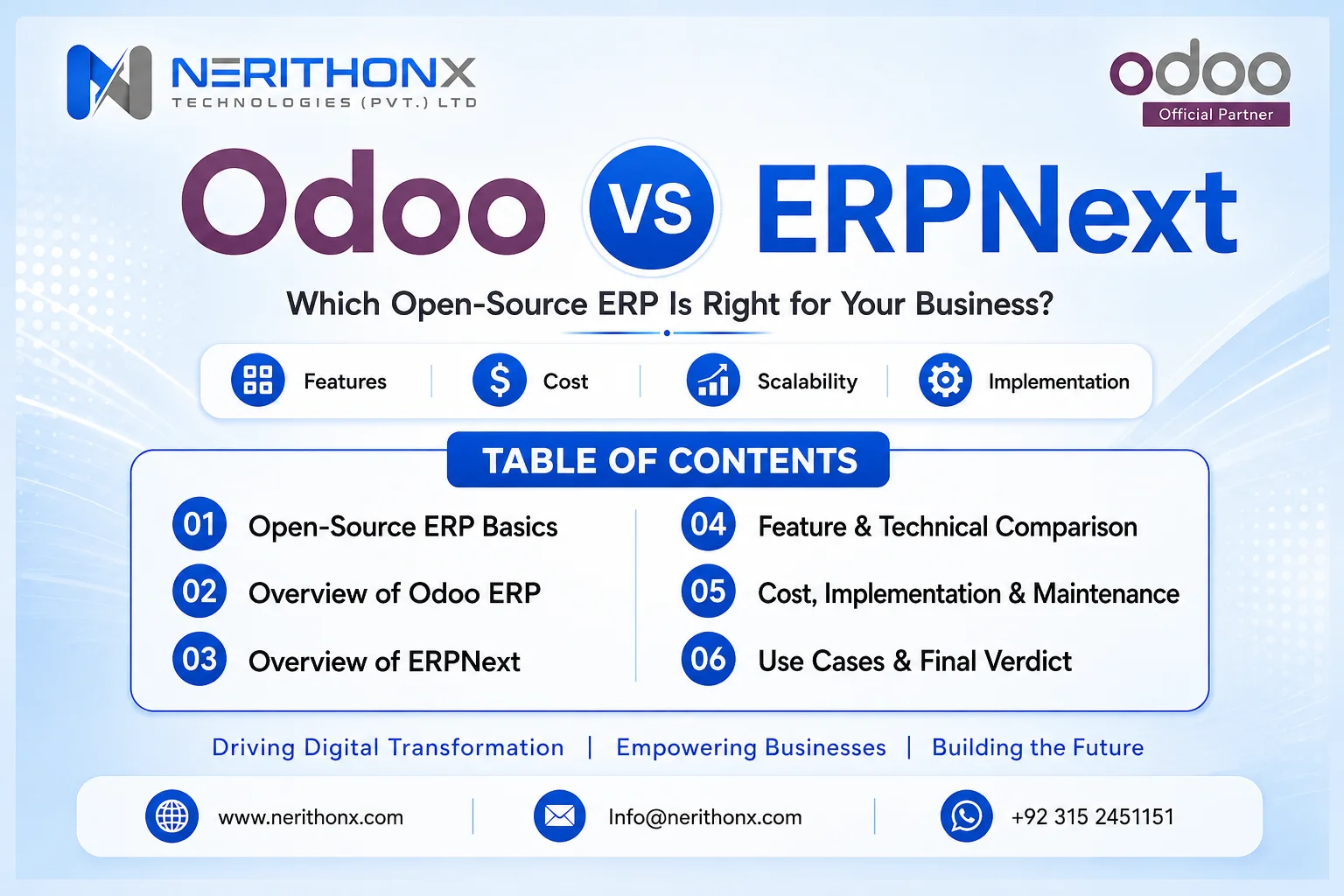
Odoo vs ERPNext is a common comparison for businesses looking for open-source ERP software. Both platforms help companies manage accounting, CRM, inventory, sales, manufacturing, and daily operations, but they differ in features, customization, pricing, scalability, and implementation complexity.
In this guide by NerithonX Technologies (Pvt.) Ltd, we break down how Odoo’s modular ecosystem compares with ERPNext’s tightly integrated framework, where each platform performs best, and the trade-offs businesses often overlook during selection. From implementation complexity to scalability and real-world use cases, this comparison is designed to help decision-makers move beyond surface-level features and evaluate what truly fits their operational needs.
Understanding Open-Source ERP Systems
Modern businesses rely on integrated systems to manage operations efficiently, and Enterprise Resource Planning (ERP) software plays a central role in this transformation. Open-source ERP systems, in particular, have gained traction among organizations seeking flexibility, cost control, and customization without the constraints of proprietary software.
This section explains the foundational concepts behind ERP systems and what differentiates open-source solutions like Odoo and ERPNext from traditional enterprise software.
What Is an ERP System?
An Enterprise Resource Planning (ERP) system is a centralized software platform designed to integrate and manage core business processes within a single unified environment. Instead of operating separate tools for accounting, sales, inventory, and human resources, an ERP system connects these functions through a shared database.
This integration enables real-time data flow across departments, improving visibility, reducing duplication, and supporting more informed decision-making. For example, a sales transaction can automatically update inventory levels, trigger invoicing in the accounting module, and reflect in financial reports without manual intervention.
ERP systems are commonly used to streamline operations, standardize workflows, and improve overall organizational efficiency—especially as businesses scale and processes become more complex.
What Makes an ERP “Open Source”?
An ERP system is considered open source when its source code is publicly accessible and can be modified, extended, or redistributed by users. Unlike proprietary ERP solutions that restrict access and customization, open-source platforms provide greater control over how the software is configured and deployed.
This openness allows businesses and developers to:
- Customize features based on specific operational needs
- Integrate with third-party tools using APIs
- Deploy the system on their own infrastructure (on-premise or cloud)
- Avoid mandatory licensing fees associated with closed systems
However, open-source ERP also requires a certain level of technical capability, as customization, maintenance, and updates often depend on internal teams or external developers.
Why Businesses Consider Open-Source ERP Solutions
Businesses—particularly SMEs, startups, and cost-conscious organizations—are increasingly exploring open-source ERP systems as an alternative to traditional enterprise software.
Several factors drive this shift:
- Cost Efficiency: Open-source ERP eliminates or reduces licensing costs, making it more accessible for growing businesses.
- Flexibility and Customization: Organizations can tailor the system to match unique workflows rather than adapting processes to rigid software structures.
- Scalability: Open-source platforms can evolve with the business, supporting additional modules and integrations over time.
- Vendor Independence: Businesses are not locked into a single provider, allowing greater control over upgrades and development decisions.
- Community and Ecosystem: Active developer communities contribute to continuous improvements, plugins, and shared knowledge.
At the same time, these advantages come with trade-offs, such as the need for technical expertise, careful implementation planning, and ongoing system maintenance.
Overview of Odoo ERP
Odoo ERP is a modular, open-source business management platform designed to integrate multiple business functions into a single, unified system. It enables organizations to manage operations such as sales, accounting, inventory, human resources, and manufacturing through interconnected applications. Unlike traditional ERP systems that often require full-scale implementation from the start, Odoo follows an app-based approach, allowing businesses to begin with essential modules and expand as their needs evolve. This flexibility makes it particularly suitable for small to mid-sized businesses as well as companies undergoing digital transformation.
Core Architecture and Technology Stack
Odoo is built on a three-tier architecture that separates the presentation layer, application logic, and database, ensuring scalability and efficient system performance. The platform is primarily developed using Python and uses PostgreSQL as its database, which is known for reliability and data integrity. Its internal framework relies on an object-relational mapping (ORM) system that simplifies database interactions and accelerates development. On the frontend, Odoo utilizes JavaScript, XML, and its QWeb templating engine to deliver a responsive web-based interface. Because it operates entirely through a web browser, users can access the system without installing heavy client software, making deployment and accessibility more streamlined across different environments.
Key Modules and Features
Odoo provides a wide range of integrated modules that collectively support end-to-end business operations. These modules are designed to work both independently and as part of a connected ecosystem, allowing seamless data flow across departments. For example, the CRM module manages customer interactions and sales pipelines, while the sales module handles quotations, orders, and invoicing. The accounting module supports financial reporting, tax management, and transaction tracking, whereas the inventory module manages stock levels, warehouses, and procurement processes. Additionally, Odoo includes manufacturing capabilities for production planning and bill of materials, as well as human resource tools for employee management and payroll. One of its distinguishing features is the extensive app marketplace, which offers both official and third-party extensions that further enhance functionality and customization options.
Odoo Editions (Community vs Enterprise)
Odoo is available in two main editions, Community vs Enterprise, each offering different levels of functionality and support. The Community edition is free and open-source, providing access to essential modules such as CRM, sales, and inventory. It is generally suitable for organizations with technical expertise that can manage customization and maintenance internally. However, it has limitations in terms of advanced features and official support. In contrast, the Enterprise edition operates on a subscription model and includes additional capabilities such as advanced accounting tools, low-code customization features, mobile accessibility, and integrated support services. It also offers a more refined user experience and can be deployed either in the cloud or on-premise. The choice between these editions significantly impacts both functionality and long-term costs.
Strengths and Limitations
Odoo offers several advantages that contribute to its widespread adoption. Its modular structure allows businesses to scale the system gradually, while its modern and user-friendly interface makes it more accessible compared to many traditional ERP platforms. The availability of a large ecosystem of applications and integrations further enhances its flexibility, enabling organizations to tailor the system according to their operational needs. Additionally, its global user base and active community provide a strong foundation for ongoing development and support.
However, Odoo also presents certain limitations that businesses need to consider. Some important features are only available in the Enterprise edition, which can create dependency on paid subscriptions over time. Customization, while flexible, often requires skilled developers, especially for complex workflows or integrations. As the system expands, costs related to hosting, development, and premium modules can increase. In larger implementations, performance optimization and infrastructure planning may also become necessary to maintain efficiency.
Overview of ERPNext
ERPNext is an open-source enterprise resource planning system designed to provide a fully integrated suite of business applications within a single platform. Unlike highly modular ERP systems, ERPNext follows a more unified and tightly integrated approach, where most core business functions are available out of the box. This makes it particularly appealing to organizations seeking a complete ERP solution without relying heavily on additional modules or third-party extensions. Built with a focus on simplicity and usability, ERPNext is commonly adopted by small to mid-sized businesses, startups, and organizations looking for a cost-effective system with strong built-in capabilities.
Frappe Framework and System Architecture
ERPNext is built on the Frappe Framework, a full-stack web application framework that provides the underlying architecture for development, customization, and deployment. The system uses Python as its primary programming language and MariaDB as its database, ensuring reliable data handling and performance. Its architecture is web-based and follows a model-view-controller (MVC) pattern, allowing developers to manage business logic, data, and user interfaces efficiently. One of the defining characteristics of ERPNext’s architecture is its metadata-driven design, which simplifies customization by enabling changes through configuration rather than extensive code modifications. This approach allows developers and technical teams to create custom fields, workflows, and applications while maintaining system consistency and upgrade compatibility.
Core Modules and Capabilities
ERPNext includes a comprehensive set of built-in modules that cover essential business operations without requiring separate installations. These modules are deeply integrated, ensuring seamless data flow across different functions. The accounting module supports general ledger management, invoicing, taxation, and financial reporting with a strong focus on compliance standards. Its human resources module handles employee records, payroll, attendance, and performance management, while the inventory and stock modules manage warehouses, procurement, and stock movements in real time. ERPNext also offers manufacturing capabilities, including bill of materials, production planning, and shop floor management. Additionally, it includes modules for project management, asset tracking, customer relationship management, and sales operations, making it a well-rounded solution for businesses seeking a unified system.
Built-in Features vs Modular Extensions
One of ERPNext’s distinguishing characteristics is its emphasis on built-in functionality rather than an extensive app marketplace. Most features required for standard business operations are included by default, reducing the need for external plugins or additional installations. This integrated approach simplifies implementation and ensures consistency across modules. However, ERPNext still supports customization and extension through custom apps built on the Frappe Framework. Developers can modify existing workflows, create new features, or integrate third-party systems using APIs. While it may not offer as large an ecosystem of ready-made applications as some other ERP platforms, its built-in completeness reduces dependency on external tools and helps maintain a more stable system environment.
Strengths and Limitations
ERPNext offers several strengths that make it a compelling choice for many organizations. Its fully integrated design ensures that all modules work cohesively, reducing data silos and improving operational efficiency. The platform is relatively easier to implement compared to more complex ERP systems, especially for businesses with standard processes. It also provides strong accounting capabilities with built-in compliance features, which is particularly beneficial for organizations operating in regulated environments. Additionally, being fully open-source, ERPNext allows complete access to its codebase, enabling deep customization without licensing restrictions.
Despite these advantages, ERPNext also has certain limitations. Its smaller ecosystem means fewer pre-built integrations and third-party extensions compared to larger platforms. While customization is possible, it often requires technical expertise in the Frappe Framework, which may not be as widely available as other development environments. In highly complex or large-scale enterprise scenarios, the platform may require additional development effort to meet advanced requirements. Furthermore, while the user interface is functional and clean, it may not be as refined or feature-rich as some competing ERP systems.
Odoo vs ERPNext: Feature-by-Feature Comparison
When comparing Odoo and ERPNext, the differences become more apparent at the feature level, where each platform reflects a distinct design philosophy. Odoo emphasizes modular flexibility and a polished user experience, while ERPNext focuses on built-in completeness and tightly integrated functionality. Understanding how each system performs across key operational areas helps businesses evaluate which platform aligns better with their workflows, technical capabilities, and long-term scalability requirements.
User Interface and User Experience
Odoo is widely recognized for its modern and visually refined user interface, designed to deliver a smooth and intuitive user experience. Its dashboard-driven layout, drag-and-drop features, and clean navigation make it easier for non-technical users to adopt the system with minimal training. The interface is consistent across modules, which contributes to usability and faster onboarding.
ERPNext, while functional and structured, follows a more utility-focused design. Its interface prioritizes clarity and accessibility of information rather than visual sophistication. While it may not appear as polished as Odoo, it offers a straightforward workflow that can be efficient for users familiar with ERP systems. However, new users may require some initial training to fully understand navigation and system behavior.
Customization and Flexibility
Odoo offers a highly modular architecture that allows businesses to install, configure, and extend features based on their needs. Customization can be performed through its low-code tools in the Enterprise edition or through development using Python. Its large marketplace of third-party applications further enhances flexibility, enabling businesses to adapt the system to diverse use cases.
ERPNext, on the other hand, provides customization through the Frappe Framework, which supports configuration-based changes as well as custom app development. Its metadata-driven approach simplifies modifications such as adding fields or altering workflows without extensive coding. While ERPNext may not offer as many pre-built extensions as Odoo, it allows deeper structural control for organizations with development expertise.
Accounting and Financial Management
ERPNext is often regarded as strong in accounting due to its comprehensive, built-in financial features. It includes general ledger management, invoicing, taxation, payroll integration, and multi-currency support, with a focus on compliance and standard accounting practices. Most of these features are available out of the box without requiring additional modules.
Odoo also provides robust accounting capabilities, particularly in its Enterprise edition. It supports invoicing, bank reconciliation, financial reporting, and tax management, but some advanced features are restricted to paid versions. While Odoo’s accounting module is powerful, businesses using the Community edition may need additional customization or third-party tools to match ERPNext’s out-of-the-box completeness.
Inventory and Supply Chain
Odoo offers advanced inventory management features, including multi-warehouse support, automated procurement, barcode scanning, and route optimization. Its modular approach allows businesses to extend supply chain functionality with additional apps, making it suitable for complex logistics environments.
ERPNext provides a well-integrated inventory system that covers stock tracking, warehouse management, batch and serial number tracking, and procurement processes. While it may not have as many advanced extensions as Odoo, its built-in capabilities are sufficient for most small to mid-sized businesses and are tightly connected with accounting and manufacturing modules.
CRM and Sales Management
Odoo has a strong advantage in CRM and sales management, offering a feature-rich system with pipeline visualization, lead scoring, automated follow-ups, and marketing integrations. Its user-friendly interface enhances sales team productivity and visibility into customer interactions.
ERPNext includes CRM and sales functionalities such as lead management, opportunity tracking, quotations, and order processing. While effective for standard sales workflows, it is generally more basic compared to Odoo’s advanced CRM features and automation capabilities.
Manufacturing Capabilities
Both Odoo and ERPNext provide manufacturing modules, but their approaches differ. Odoo offers a flexible manufacturing system with support for work orders, bill of materials, production planning, and integration with inventory. Additional capabilities can be added through modules, making it adaptable for various manufacturing environments.
ERPNext provides a comprehensive manufacturing module built into the core system, including bill of materials, production planning, job cards, and shop floor management. Its tightly integrated design ensures smooth coordination between manufacturing, inventory, and accounting, making it a strong option for businesses with standardized production workflows.
Reporting and Analytics
Odoo delivers dynamic reporting and dashboard capabilities with visually appealing charts and real-time insights. Users can generate customizable reports across different modules, and the system supports advanced analytics through integrations and additional tools.
ERPNext offers a solid reporting framework with built-in reports for accounting, inventory, HR, and other modules. It allows users to create custom reports and queries, though its visualization capabilities are more functional than visually advanced. For organizations focused on data accuracy and operational reporting, ERPNext provides reliable insights, even if the presentation is less sophisticated than Odoo.
Comparison Summary Table Odoo vs ERPNext
| Feature Area | Odoo ERP | ERPNext |
| User Interface | Modern, intuitive, visually polished | Functional, structured, less visually refined |
| Customization | Highly modular, large app ecosystem | Deep customization via Frappe Framework |
| Accounting | Advanced (best in Enterprise edition) | Strong, fully built-in and compliance-focused |
| Inventory Management | Advanced, scalable with extensions | Integrated and sufficient for most SMEs |
| CRM & Sales | Feature-rich, automation-driven | Basic to moderate functionality |
| Manufacturing | Flexible, modular approach | Fully integrated, strong out-of-the-box |
| Reporting & Analytics | Visual dashboards, advanced analytics | Reliable reports, less visual sophistication |
| Ecosystem | Large marketplace and global adoption | Smaller ecosystem, but tightly integrated |
Technical Comparison of Odoo vs ERPNext: Architecture, Deployment, and Scalability
A technical evaluation of Odoo and ERPNext highlights how each platform differs in underlying architecture, deployment flexibility, integration capabilities, and performance scalability. These factors are critical for IT teams and decision-makers assessing long-term system reliability and adaptability.
Technology Stack and Framework
Odoo is built using Python with PostgreSQL as its database and relies on its own ORM framework to manage data and business logic. Its architecture supports modular extensions, making it adaptable for a wide range of use cases. ERPNext, in contrast, is built on the Frappe Framework, also using Python but with MariaDB as its database. Its metadata-driven design allows easier configuration and customization at the framework level, particularly for structured business processes.
Deployment Options (Cloud vs On-Premise)
Both Odoo and ERPNext support flexible deployment options, including cloud-hosted, on-premise, and hybrid environments. Odoo offers a fully managed SaaS version in its Enterprise edition, simplifying setup and maintenance for non-technical users. ERPNext also provides cloud hosting options, but it is more commonly self-hosted, giving businesses greater control over infrastructure and data management.
API and Integration Capabilities
Odoo provides extensive API support, enabling integration with third-party applications such as payment gateways, eCommerce platforms, and external business tools. Its large ecosystem further enhances integration possibilities. ERPNext also offers RESTful APIs and supports custom integrations through the Frappe Framework, allowing developers to connect external systems, although its integration ecosystem is comparatively smaller.
Scalability and Performance
Odoo is designed to scale across growing business environments, especially when supported by optimized infrastructure and modular expansion. It performs well in complex and multi-user scenarios but may require tuning in large deployments. ERPNext is efficient for small to mid-sized implementations, offering stable performance with tightly integrated modules; however, scaling to highly complex enterprise-level operations may require additional architectural planning and customization.
Cost and Licensing Structure of Odoo vs ERPNext
Cost is a critical factor when evaluating open-source ERP systems, but it extends beyond initial pricing. While both Odoo and ERPNext offer open-source access, their licensing models, feature availability, and long-term expenses differ significantly. Understanding these differences helps businesses assess the true financial impact of each platform over time.
Open-Source vs Paid Features
ERPNext is fully open-source, meaning most of its core features—including accounting, HR, inventory, and manufacturing—are available without licensing fees. This makes it an attractive option for businesses seeking a complete ERP solution with minimal upfront cost.
Odoo, while also open-source in its Community edition, follows a hybrid model. Many advanced features, such as enhanced accounting, automation tools, and customization capabilities, are only available in the Enterprise edition, which requires a subscription. As a result, businesses may start with the free version but transition to paid features as their requirements grow.
Total Cost of Ownership (TCO)
The total cost of ownership includes not only licensing but also implementation, hosting, customization, training, and ongoing maintenance. ERPNext generally offers lower TCO for businesses with standard requirements due to its built-in features and lack of mandatory licensing fees.
Odoo’s TCO can vary depending on the edition and level of customization. While its modular approach allows gradual scaling, costs may increase with additional apps, enterprise subscriptions, and development work. For businesses requiring advanced functionality or extensive integrations, these costs can accumulate over time.
Hidden Costs in Implementation
Both platforms may involve hidden costs that are not immediately apparent during initial evaluation. These can include expenses related to data migration, system configuration, user training, and performance optimization. In Odoo, reliance on paid modules or third-party apps can further increase costs. In ERPNext, while licensing costs are minimal, customization and developer involvement may contribute to implementation expenses.
Careful planning, clear requirement analysis, and realistic budgeting are essential to avoid unexpected financial burdens, regardless of the platform chosen.
Odoo vs ERPNext Implementation and Maintenance: Setup, Support, and Long-Term Management
Implementation and ongoing maintenance play a critical role in the success of any ERP system. While both Odoo and ERPNext offer flexible deployment and customization, they differ in setup complexity, learning requirements, support models, and upgrade processes. Evaluating these factors helps businesses prepare for both initial adoption and long-term system sustainability.
Ease of Setup
ERPNext is generally considered easier to set up, particularly for businesses with standard workflows, as many features are available out of the box. Its integrated structure reduces the need for additional modules during initial deployment. Odoo, on the other hand, may require more configuration due to its modular approach, where businesses need to select, install, and configure multiple apps based on their requirements.
Learning Curve
Odoo offers a more intuitive and user-friendly interface, which can reduce the learning curve for non-technical users and business teams. Its modern design and consistent navigation contribute to quicker adoption. ERPNext, while structured and efficient, may require more initial training, especially for users unfamiliar with ERP systems, due to its workflow-oriented interface and terminology.
Community Support vs Vendor Support
Odoo provides both community-based support and official vendor support through its Enterprise edition, including documentation, updates, and professional services. Its large global ecosystem also contributes to a wide range of third-party resources. ERPNext relies primarily on its open-source community and official support channels from its core developers. While its community is active, it is smaller compared to Odoo’s broader ecosystem.
Upgrade and Maintenance Considerations
Odoo releases regular updates, particularly for its Enterprise users, but upgrading customized systems can require careful planning to avoid compatibility issues with custom modules. ERPNext follows a more structured upgrade path through the Frappe Framework, and its tightly integrated system can simplify version transitions. However, both platforms require ongoing maintenance, including performance monitoring, security updates, and periodic system optimization to ensure long-term reliability.
Odoo ERP Use Case Suitability: Where It Fits Best Compared to ERPNext
Selecting the right ERP depends heavily on how well the system aligns with specific business models, operational complexity, and technical capabilities. While both Odoo and ERPNext serve a wide range of industries, Odoo’s modular design and broader ecosystem make it particularly adaptable across diverse use cases. The following scenarios highlight where Odoo stands out, while also noting where ERPNext may be more suitable.
Best for SMEs
Odoo is well-suited for small to mid-sized enterprises that require flexibility as they scale. Its modular approach allows businesses to start with essential applications—such as CRM, sales, and accounting—and expand gradually without overhauling the system. This makes it ideal for SMEs experiencing growth or operational changes. ERPNext can also support SMEs effectively, particularly those with standard processes, but Odoo offers more room for expansion through its extensive app ecosystem.
Best for Startups
For startups, Odoo provides a balance between usability and scalability. Its user-friendly interface and wide range of ready-to-use applications enable faster onboarding and quicker implementation of business processes. Startups can begin with minimal modules and add advanced features as they grow. ERPNext may appeal to startups with limited budgets due to its fully open-source nature, but Odoo offers more flexibility in adapting to evolving business models over time.
Best for Manufacturing Businesses
Odoo offers strong manufacturing capabilities, especially when extended with additional modules for production planning, quality control, and supply chain optimization. Its flexibility allows manufacturers to tailor workflows based on specific operational needs. ERPNext, however, provides a highly integrated manufacturing module out of the box, which can be advantageous for businesses with standardized production processes. In more complex or evolving manufacturing environments, Odoo’s modular extensibility often provides a strategic advantage.
Best for Developers and Custom Projects
Odoo is a powerful platform for custom development, supported by a large developer community and a wide range of third-party applications. Its architecture allows businesses to build tailored solutions, integrate external systems, and extend functionality at scale. ERPNext also supports deep customization through the Frappe Framework and may be preferred by developers seeking full control within a tightly integrated system. However, Odoo’s larger ecosystem and flexibility make it a more versatile choice for complex or highly customized projects.
Odoo ERP Pros and Cons Summary Compared to ERPNext
Evaluating the strengths and limitations of each platform provides a clearer understanding of how Odoo and ERPNext perform in real-world scenarios. While both systems offer open-source flexibility, their differences in modularity, usability, and ecosystem size influence how well they fit specific business needs. The following summary highlights the key advantages and trade-offs of each platform.
Odoo Advantages and Disadvantages
Odoo offers a highly flexible and scalable ERP environment, making it a strong choice for businesses that expect growth or require customization. One of its main advantages is its modular architecture, which allows organizations to start with core functionalities and expand as needed. Its modern and intuitive user interface also improves usability, particularly for non-technical users, reducing onboarding time. Additionally, Odoo benefits from a large global ecosystem, including a wide range of third-party applications and developer support, which enhances its adaptability across industries.
However, Odoo also has certain limitations that businesses should consider. Many advanced features are only available in the Enterprise edition, which introduces ongoing subscription costs. As businesses scale and require more modules or integrations, the total cost can increase significantly. Customization, while powerful, often requires experienced developers, especially for complex implementations. In larger deployments, performance optimization and infrastructure planning may also become necessary.
ERPNext Advantages and Disadvantages
ERPNext stands out for its fully integrated and open-source nature, offering a comprehensive set of features without requiring additional licensing fees. Its built-in modules cover accounting, HR, manufacturing, and inventory, making it a cost-effective option for businesses with standard operational needs. The platform is relatively easier to implement in straightforward environments, and its strong accounting capabilities with compliance-focused features make it particularly useful for finance-driven organizations.
On the other hand, ERPNext has a smaller ecosystem compared to Odoo, which means fewer ready-made integrations and third-party extensions. While customization is possible, it often depends on familiarity with the Frappe Framework, which may limit developer availability. Its user interface, although functional, is less refined than Odoo’s, which can impact user experience. For businesses with highly complex or rapidly evolving requirements, ERPNext may require additional development effort to match the flexibility offered by Odoo.
How to Choose Between Odoo and ERPNext: A Practical Decision Framework
Choosing between Odoo and ERPNext requires more than a feature comparison—it involves aligning the ERP system with your business processes, technical capabilities, and long-term growth strategy. While both platforms offer open-source flexibility, Odoo’s modular ecosystem often provides greater adaptability for evolving requirements, whereas ERPNext may suit organizations seeking a more standardized, all-in-one solution. The following framework helps structure this decision logically.
Business Requirements Checklist
Start by clearly defining your operational needs, including core processes such as accounting, sales, inventory, and manufacturing. Odoo is often a better fit for businesses that require flexibility across multiple departments or plan to expand functionality over time, as its modular approach allows selective adoption of features. ERPNext, with its built-in modules, is more suitable for organizations with standardized workflows that do not require extensive customization. Evaluating how closely each system aligns with your day-to-day operations is essential to avoid unnecessary complexity.
Technical Readiness Assessment
Assess your internal technical capabilities or access to development resources. Odoo offers both low-code tools (in its Enterprise edition) and advanced customization options, making it accessible to a broader range of users while still supporting complex development. ERPNext, while also customizable, relies more heavily on the Frappe Framework, which may require specialized technical expertise. Businesses with limited technical resources may find Odoo’s ecosystem and support options easier to manage, whereas technically proficient teams may leverage ERPNext’s framework for deeper control.
Long-Term Scalability Considerations
Consider how the ERP system will support your business as it grows. Odoo’s scalability is driven by its extensive app marketplace, integration capabilities, and ability to handle complex, multi-department operations. This makes it well-suited for businesses anticipating expansion, diversification, or increased system complexity. ERPNext can scale effectively for small to mid-sized environments, particularly where processes remain consistent, but scaling to highly complex or customized enterprise scenarios may require additional development effort. Aligning the ERP choice with long-term strategic goals helps prevent costly system transitions in the future.
Final Comparison Summary: Odoo vs ERPNext
When comparing Odoo and ERPNext, both platforms offer strong open-source ERP capabilities, but they differ in how they approach flexibility, usability, and long-term scalability. Odoo stands out with its modular architecture, modern user interface, and extensive ecosystem, making it a highly adaptable solution for businesses that anticipate growth, require customization, or operate across multiple departments. Its ability to expand through additional apps and integrations gives it a strategic advantage in dynamic business environments.
ERPNext, on the other hand, provides a more tightly integrated system with a comprehensive set of built-in features available without licensing costs. This makes it a practical choice for organizations with standardized processes and limited budgets, particularly those that prefer an all-in-one system without relying heavily on external modules or extensions.
In practical terms, Odoo is often better suited for businesses that prioritize scalability, flexibility, and a refined user experience, especially when future expansion or complex workflows are expected. ERPNext is more aligned with organizations seeking simplicity, cost efficiency, and strong out-of-the-box functionality for stable operational needs.
Ultimately, the decision depends on how well each platform aligns with your business structure, technical readiness, and long-term strategy. Rather than focusing solely on features, evaluating how the system will perform over time—across growth, customization, and maintenance—provides a more reliable basis for selecting the right ERP solution.
For businesses that decide to move forward with Odoo, NerithonX Technologies (Pvt.) Ltd provides insights, guidance, and implementation support tailored to different operational needs, helping organizations better understand how to effectively adopt and scale ERP systems.
FAQS :
1. How long does it typically take to implement Odoo or ERPNext?
Implementation time varies based on business complexity. Smaller setups can take a few weeks, while larger or highly customized deployments may take several months, depending on data migration, integrations, and workflow configuration.
2. Can Odoo and ERPNext support multi-company operations?
Yes, both platforms support multi-company management, allowing businesses to manage multiple entities, financial records, and operations within a single system while maintaining data separation.
3. Which ERP system is better for remote or distributed teams?
Both Odoo and ERPNext support web-based access, making them suitable for remote teams. Odoo’s user interface and cloud options may offer a slightly smoother experience for distributed collaboration.
4. Do Odoo and ERPNext support mobile access?
Yes, both platforms can be accessed via mobile devices through browsers. Odoo also provides dedicated mobile applications in its Enterprise edition, while ERPNext offers responsive web access and community-supported mobile solutions.
5. How do updates affect customized ERP systems?
Updates can impact customized features in both systems. Odoo upgrades, especially in customized environments, may require testing and adjustments, while ERPNext’s structured framework helps maintain compatibility but still requires validation during updates.
6. Which ERP is better for integrating with eCommerce platforms?
Odoo has stronger native and third-party integrations with eCommerce platforms, along with its own built-in website and online store capabilities. ERPNext can integrate with eCommerce systems but may require more customization.
7. Can both systems handle multi-currency and international operations?
Yes, both Odoo and ERPNext support multi-currency transactions and can be configured for international business operations, including tax rules and regional settings.
8. What level of technical expertise is required to manage these systems?
Basic usage can be handled by non-technical users, but customization, integrations, and maintenance typically require technical knowledge. Odoo offers more low-code tools, while ERPNext often relies more on developer involvement.
9. Are Odoo and ERPNext suitable for service-based businesses?
Yes, both platforms support service-based operations, including project management, invoicing, and customer management. Odoo may offer more flexibility for service customization, while ERPNext provides structured workflows.
10. Where can businesses get guidance for choosing or implementing Odoo?
Businesses exploring Odoo can benefit from structured guidance and expert insights to align the system with their operations. NerithonX provides resources and support to help organizations understand, evaluate, and implement Odoo effectively based on their specific requirements.
11. Does NerithonX Technologies (Pvt.) Ltd provide Odoo ERP services in Islamabad?
Yes, NerithonX Technologies (Pvt.) Ltd provides Odoo ERP services across Pakistan, including Islamabad. The company offers end-to-end Odoo solutions such as implementation, customization, integration, and support for businesses of different sizes. In addition to its established presence in Peshawar, NerithonX has also expanded its operations by opening a branch in Islamabad, further extending its ERP services to businesses in the region.