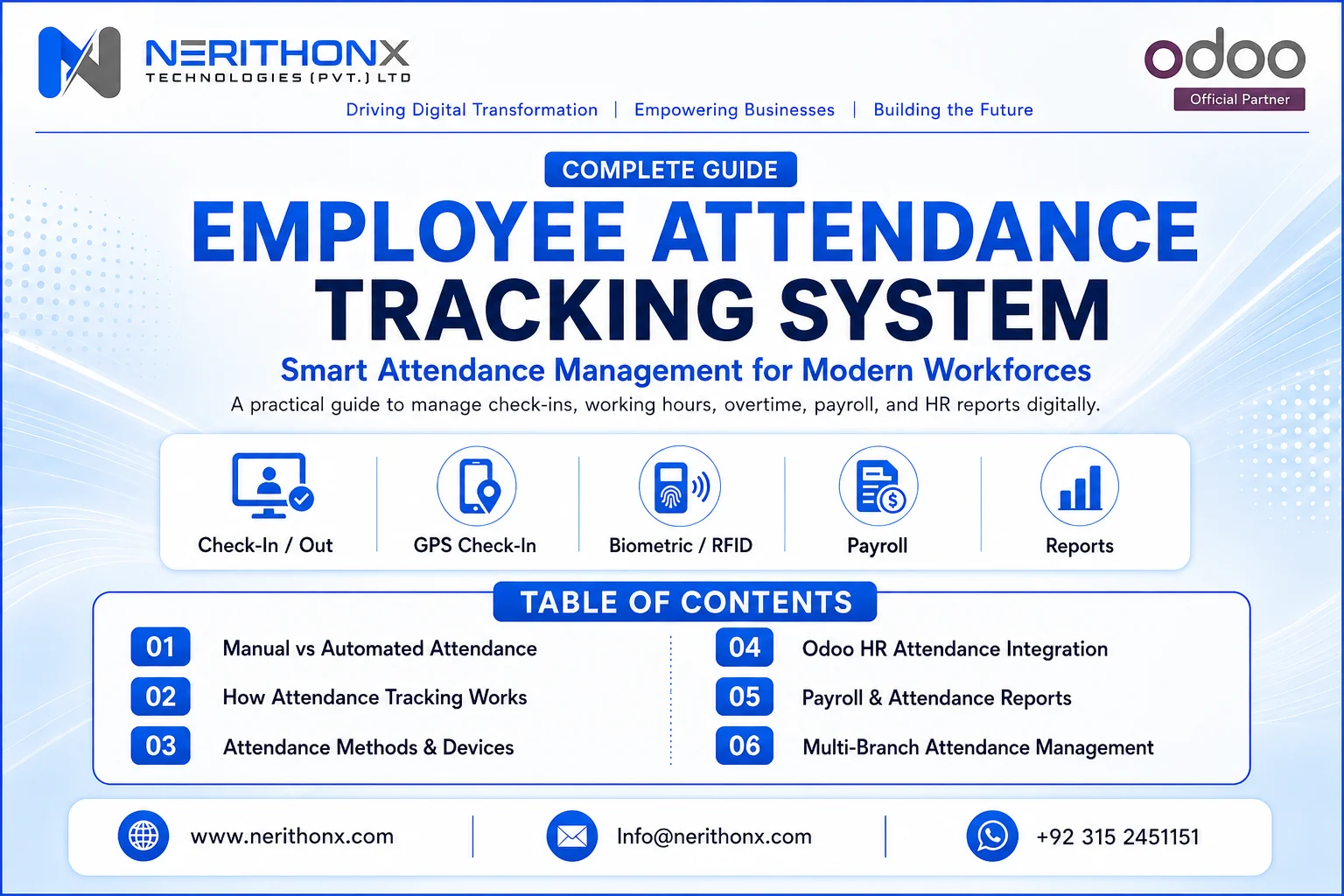
Managing employee attendance sounds simple, but it becomes difficult when a business grows.
Many companies still use paper registers, Excel sheets, manual timesheets, WhatsApp messages, and disconnected biometric machines. These methods may work for a small team, but they can create problems when the company has multiple departments, branches, shifts, field staff, overtime, and payroll rules.
Manual attendance can lead to late reports, payroll mistakes, missing records, disputes, and poor visibility for HR and management.
An employee attendance tracking system helps businesses manage attendance in a better way. It records check-ins, check-outs, working hours, late arrivals, absences, overtime, breaks, leave records, and attendance reports.
When connected with HR and payroll, it becomes even more useful because attendance data can support salary calculation, overtime review, leave management, and workforce planning.
For modern businesses, attendance tracking is not only about marking present or absent. It is about improving HR control, payroll accuracy, employee accountability, and business operations.
What Is an Employee Attendance Tracking System?
An employee attendance tracking system is software that helps companies record, manage, and report employee attendance digitally.
It tracks when employees start work, when they leave, how many hours they worked, whether they were late, whether they left early, and whether they were absent.
A good attendance tracking system can manage:
Employee check-in
Employee check-out
Working hours
Break time
Late arrivals
Early check-outs
Absences
Leaves
Overtime
Shift schedules
Attendance corrections
Manager approvals
Attendance reports
It can be used by many types of businesses, including offices, factories, warehouses, retail stores, service companies, construction companies, field-service teams, remote teams, hybrid teams, and multi-branch organizations.
The main purpose is to replace scattered manual records with one clean, reliable, and trackable attendance process.
Why Businesses Need a Digital Attendance System
Manual attendance creates many problems for HR, finance, operations, and management.
A paper register can be damaged or edited. Excel sheets can have mistakes. WhatsApp attendance is difficult to verify. A biometric machine may record data, but if it is not connected with HR or payroll, the team still has to do manual work.
Businesses need a digital attendance system because it helps solve problems such as:
Manual attendance errors
Payroll mistakes
Buddy punching
Time theft
Late attendance reporting
Difficulty managing overtime
Multi-location workforce challenges
Remote and field staff tracking
High HR workload
Lack of real-time visibility
Weak audit trail
For example, if a factory runs multiple shifts, HR needs to know who came on time, who worked extra hours, who missed a shift, and who needs approval for overtime.
If this data is handled manually, payroll can become slow and inaccurate. But when attendance is tracked digitally and connected with HR and payroll, the process becomes faster and more reliable.
How an Employee Attendance Tracking System Works
An employee attendance tracking system follows a clear workflow.
First, employee records are created in the system. These records may include employee name, department, job role, branch, manager, working schedule, and attendance method.
Next, the company configures working hours, shifts, break rules, overtime rules, late arrival rules, leave rules, and approval flows.
Then employees check in and check out using the selected method. This can be through a web portal, mobile app, kiosk, badge, RFID card, biometric device, QR code, GPS check-in, or geofencing.
After check-in and check-out, the system calculates attendance data. It can show worked hours, expected hours, late time, absence, overtime, and attendance differences.
Managers can review attendance records, approve corrections, and check reports. HR can use attendance data for payroll, leave, overtime, and compliance records.
In an ERP system, attendance can also connect with employees, time off, payroll, planning, and reporting workflows, depending on the system configuration.

Key Features of an Employee Attendance Tracking System
A strong attendance management system should support daily business operations, not only basic check-in and check-out.
Employee Check-In and Check-Out
The system should allow employees to check in and check out easily.
This can be done through a computer, mobile app, kiosk, RFID card, badge, PIN, QR code, biometric device, or GPS-based method.
The process should be simple because employees use it every day. If the check-in process is confusing, staff may make mistakes and HR will receive more correction requests.
Biometric, RFID, Kiosk, Mobile, and GPS Attendance
Different businesses need different attendance methods.
Factories may prefer kiosks, badges, or biometric devices.
Offices may use web-based check-in or kiosk mode.
Field teams may need mobile attendance with GPS or geofencing.
Retail stores may use shift-based attendance with manager approval.
Odoo’s Attendances app supports employee check-in and check-out directly from the database or through kiosk mode. Odoo explains that kiosks are useful for employees who do not have direct database access, and badge/RFID check-in requires an accessible device in kiosk mode.
Leave, Overtime, Shifts, and Payroll Integration
Attendance becomes more powerful when it connects with leave, overtime, shifts, and payroll.
For example, if an employee is absent but has approved leave, payroll should treat it differently from an unapproved absence.
If an employee works extra hours, the manager may need to approve overtime before payroll uses that data.
Odoo Payroll documentation explains that work entries can be generated from Attendances, Planning, and Time Off, and work entries provide worked-hour data used for payroll calculations when pay is based on work entries.
Reports, Dashboards, and Role-Based Access
A good attendance system should provide useful reports and dashboards.
HR may need daily attendance reports. Managers may need department-wise reports. Finance may need payroll attendance reports. Operations may need branch-wise attendance summaries.
Odoo attendance reporting includes worked hours, expected hours, difference, and balance, and the reporting view can be adjusted with filters and groups.
Role-based access is also important. Employees should see their own attendance. Managers should see their teams. HR should manage attendance rules and reports. Management should see dashboards.
Benefits of Employee Attendance Tracking Software
Employee attendance tracking software gives practical benefits to the whole business.
It saves HR time because attendance records are captured digitally.
It reduces manual mistakes because HR does not need to enter everything again in Excel.
It improves payroll accuracy because attendance, overtime, absence, and leave data can be reviewed before salary processing.
It improves employee accountability because check-in and check-out records are visible.
It reduces attendance disputes because records are easier to track.
It helps managers identify attendance problems early.
It improves workforce planning because management can see patterns in late arrivals, absences, overtime, and shift coverage.
It supports multi-branch operations because head office can view attendance data from different locations.
It reduces paperwork and helps the company build stronger HR operations.
Manual Attendance vs Automated Attendance System
Area | Manual Attendance | Automated Attendance System |
Speed | Slow and time-consuming | Faster check-in and check-out |
Accuracy | Higher chance of human error | More accurate digital records |
Payroll Connection | Manual calculation needed | Can connect with payroll workflows |
Reports | Prepared manually | Generated quickly |
Employee Accountability | Harder to verify | Clear attendance records |
Multi-Branch Control | Difficult to manage | Branch-wise visibility possible |
Remote Staff Tracking | Very limited | Mobile/GPS options available |
Audit Trail | Weak or missing | Better tracking and logs |
HR Workload | High | Reduced through automation |
Data Security | Paper or scattered files | Role-based access and secure storage |
Manual attendance is not always wrong, but it becomes risky when the business grows. An automated attendance system gives better control, cleaner data, and faster reporting.

Types of Employee Attendance Tracking Methods
There is no single attendance method that is perfect for every company. The right method depends on the business type, workforce size, privacy rules, internet availability, budget, and local labor laws.
Manual Web Attendance
Employees check in and check out through a web portal. This works well for offices and teams that already use computers.
Kiosk Attendance
Employees use a shared device such as a tablet, computer, or mobile phone at the workplace. This is useful for factories, warehouses, retail stores, and staff without personal system access.
RFID or Badge Attendance
Employees scan a badge or RFID card. It is fast and simple, but badges can be lost or shared.
Biometric Attendance
Employees use fingerprints, face recognition, or another biometric method. It can reduce proxy attendance, but it needs a careful privacy review.
Face Recognition Attendance
This can automate attendance, but it processes sensitive biometric information and should be used only after checking legal and privacy requirements.
Mobile App Attendance
Employees check in through a mobile app. This is useful for field staff, sales teams, remote employees, and hybrid teams.
GPS Attendance
The system captures location when an employee checks in. This is helpful for field teams, but companies should use it transparently and only when needed.
Geofencing Attendance
Employees can check in only when they are inside an approved location area. This can work for field sites, warehouses, branches, and construction locations.
QR Code Attendance
Employees scan a QR code to check in. It is simple and affordable, but it needs controls to avoid misuse.
Hybrid Attendance System
Many businesses use a mixed model. For example, office staff use web attendance, factory workers use kiosks, and field staff use mobile GPS attendance.

Employee Attendance Tracking for Different Business Types
Different businesses have different attendance needs.
Offices
Office teams usually need simple check-in, check-out, breaks, late arrival tracking, and monthly attendance reports.
Factories and Manufacturing Companies
Factories need shift management, overtime tracking, worker attendance, supervisor approvals, and payroll integration.
Retail Stores
Retail businesses need branch-wise attendance, shift rosters, late arrival reports, and manager approvals.
Warehouses
Warehouses need attendance by shift, department, location, and operational team.
Field Service Teams
Field teams may need mobile attendance, GPS check-in, geofencing, job-site attendance, and manager review.
Construction Companies
Construction businesses often need site-wise attendance, contractor attendance, daily workforce reports, and location-based check-ins.
Remote and Hybrid Teams
Remote teams may need web or mobile check-in, clear policies, and transparent reporting.
Multi-Branch Businesses
Multi-branch companies need centralized dashboards, branch-wise reports, and role-based access.
Service Companies
Service companies need attendance connected with job assignments, field visits, timesheets, and payroll.
Employee Attendance System and Payroll Integration
Attendance and payroll should work together.
If attendance stays separate, HR and finance teams must manually calculate working hours, overtime, absences, late deductions, unpaid leaves, paid leaves, and shift allowances.
This increases the risk of mistakes.
When attendance connects with payroll, the company can review attendance data before salary processing. HR can check approved leaves, overtime, late arrivals, missed check-outs, and attendance corrections.
Payroll integration can support:
Working hours
Overtime
Late deductions
Unpaid leave
Paid leave
Shift allowance
Public holidays
Attendance approval
Payslip accuracy
Reduced manual payroll work
In an ERP system like Odoo, attendance can connect with Employees, Time Off, Payroll, Planning, and reporting, depending on the company’s configuration, edition, localization, and implementation scope. Odoo Payroll documentation explains that contracts can use Attendances as a work entry source, and work entries can be used by Payroll to compute pay when applicable.

Odoo Employee Attendance Tracking System
Odoo can support employee attendance tracking through its Attendances application.
In simple business terms, Odoo Attendances works like a time clock. Employees can check in and check out, managers can see attendance visibility, and reports can help review worked hours, overtime, and attendance differences.
Odoo also supports kiosk mode for employees who do not use the database directly. A kiosk can be a dedicated PC, tablet, or mobile phone used for employee check-in and check-out.
Odoo attendance reporting helps managers review worked hours, expected hours, differences, balances, overtime, and absenteeism trends.
Odoo is also an integrated ERP platform with apps covering areas such as CRM, eCommerce, accounting, inventory, point of sale, project management, and more.
However, businesses should not assume that every attendance, payroll, biometric, GPS, or country-specific rule is available out of the box for every company. Attendance workflows often need configuration, customization, integration, localization review, and training.
NerithonX Technologies can help businesses implement, customize, integrate, and train users for Odoo-based attendance workflows.

Privacy and Employee Monitoring Considerations
Employee attendance tracking should be transparent.
If attendance tracking is handled poorly, employees may feel that they are being watched instead of managed fairly.
Companies should define a clear purpose for attendance tracking. They should explain what data is collected, why it is collected, who can access it, and how long it will be kept.
The UK ICO notes that staff monitoring can be intrusive even when done with good intentions, and organizations should think carefully about their reasons for monitoring and ensure they can justify it with a lawful basis.
Businesses should be especially careful with biometric and location data.
ICO biometric guidance explains that biometric recognition involves concepts such as biometric capture, comparison, lawful processing, fairness, transparency, rights requests, security, data minimization, and storage limitation.
A responsible attendance tracking process should include:
Clear attendance policy
Employee communication
Role-based access
Secure storage
Audit logs
Limited data collection
Approval workflow for corrections
Privacy review for biometric data
Privacy review for GPS/geofencing
Training for HR and managers
Regular access review
This article is not legal advice. Companies should consult local legal, labor, or privacy experts for country-specific requirements.
Reports Every Business Should Have
Attendance reports help HR, finance, operations, and management make better decisions.
Every business should consider these reports:
Daily attendance report
Employee-wise attendance report
Department-wise attendance report
Branch-wise attendance report
Late arrival report
Early checkout report
Absence report
Overtime report
Shift report
Leave vs attendance report
Monthly attendance summary
Payroll attendance report
Manager approval report
Attendance correction log
Remote or field staff location report, where legally allowed
Management attendance dashboard
For example, a factory manager may need overtime by shift. A retail head office may need branch-wise attendance. HR may need monthly attendance before payroll. A CEO may need a dashboard showing absence trends across departments.
Good reports turn attendance data into business visibility.
Common Mistakes Businesses Should Avoid
Many attendance system projects fail because companies focus only on software and ignore the actual process.
Common mistakes include:
Buying software without understanding attendance rules
Ignoring HR and payroll requirements
Not defining shifts properly
Not training employees
Not training HR users
Not cleaning employee data first
Using biometric tracking without privacy review
Using GPS tracking without clear policy
Not setting role-based access
Not connecting attendance with payroll
Ignoring manual correction approval flow
Not testing reports before go-live
Implementing everything at once without pilot testing
Not maintaining kiosks or devices
Not creating a clear attendance policy
The best approach is to design the attendance process first, then configure the system around that process.
How to Choose the Right Employee Attendance Tracking System
Before selecting employee attendance software, businesses should use a practical checklist.
The system should be easy to use.
It should work for office teams, field teams, and branch teams.
It should support mobile, kiosk, biometric, RFID, or web attendance as needed.
It should manage shifts, overtime, late arrivals, absences, leaves, and approvals.
It should integrate with HR and payroll.
It should support multi-branch operations.
It should provide strong reports and dashboards.
It should use role-based access.
It should protect employee data.
It should allow customization.
It should provide training and support.
It should fit current and future business needs.
It should support local attendance and payroll rules.
It should work with ERP if the business is growing.
A good attendance tracking system should not only solve today’s attendance problem. It should support future growth, new branches, new teams, and better HR automation.
Implementation Roadmap for Businesses
A successful employee attendance tracking system needs a proper implementation plan.
Step 1: Review Current Attendance Process
Check how attendance is currently recorded, corrected, approved, and used in payroll.
Step 2: Identify Attendance Problems
List current issues such as late reports, missing data, overtime confusion, payroll errors, or branch-wise control problems.
Step 3: Clean Employee Data
Fix employee names, departments, job roles, managers, branches, contracts, and schedules.
Step 4: Define Departments, Shifts, and Working Schedules
Set clear working hours, shift rules, weekly offs, break times, and overtime rules.
Step 5: Choose Attendance Method
Select web, kiosk, RFID, biometric, mobile, GPS, geofencing, QR, or hybrid attendance.
Step 6: Configure Attendance Rules
Set rules for late arrivals, early exits, missed check-outs, overtime, and attendance corrections.
Step 7: Connect with HR, Leave, and Payroll
Connect attendance with employees, time off, payroll, and reporting where needed.
Step 8: Train HR, Managers, and Employees
Train every user group. HR needs system control. Managers need approvals. Employees need simple check-in instructions.
Step 9: Run Pilot Testing
Start with one department, branch, or shift before full go-live.
Step 10: Go Live Branch-Wise or Department-Wise
Roll out step by step to reduce confusion.
Step 11: Monitor Reports
Check missing check-outs, wrong shifts, overtime issues, and correction requests.
Step 12: Improve Workflow Based on Feedback
Adjust the process after real user feedback.
Employee Attendance Tracking System for Global Businesses
Companies in Pakistan, UAE, Saudi Arabia, UK, USA, Canada, Europe, and other regions may have different labor laws, payroll rules, overtime policies, privacy requirements, working schedules, public holidays, and record-keeping requirements.
A flexible employee attendance tracking system should be configurable for local business rules.
Global and multi-branch companies should choose a system that supports localization, multi-company operations, multi-branch reporting, role-based access, and scalable workflows.
Businesses should avoid making unsupported compliance assumptions. Attendance and payroll rules should always be reviewed according to the specific country, industry, and company policy.

How NerithonX Technologies Can Help
NerithonX Technologies (Pvt.) Ltd. helps businesses implement and customize Odoo ERP, automate HR workflows, integrate attendance with payroll, design employee dashboards, configure approval flows, support multi-branch attendance, train users, and provide ongoing support.
For employee attendance automation, NerithonX Technologies can support:
Odoo Implementation
Odoo Customization
Odoo Integration
Odoo Migration
Odoo Support and Maintenance
Odoo Training
ERP Consulting
Business Automation
HR and Payroll ERP workflows
Mobile App Development
Digital Transformation
The team can help analyze your current attendance process, define the right workflow, connect attendance with HR and payroll, configure dashboards, train users, and support your business after go-live.
The goal is not only to install attendance software. The goal is to create a practical attendance process that HR can manage, employees can understand, and management can trust.
Conclusion
An employee attendance tracking system helps businesses move from manual records to a digital, automated, and controlled attendance process.
It saves HR time, improves payroll accuracy, reduces attendance disputes, increases transparency, and gives management better visibility.
For growing businesses, attendance should not stay separate from HR and payroll. It should connect with employees, shifts, leave, overtime, payroll, branches, and reports.
If your business wants to improve attendance tracking, automate HR workflows, or implement Odoo-based attendance management, NerithonX Technologies can help you plan, customize, integrate, and support the right solution.
Automate attendance tracking, leave management, shift scheduling, and payroll integration with a smart attendance solution tailored to your business needs. Improve accuracy, compliance, and productivity.
FAQ
Frequently Asked Questions
What is an employee attendance tracking system?
An employee attendance tracking system is software that records and manages employee check-ins, check-outs, working hours, overtime, absences, leaves, and attendance reports.
How does an employee attendance tracking system work?
It stores employee records, schedules, shifts, and attendance rules. Employees check in and check out through a selected method, and the system generates reports for HR, managers, and payroll.
What are the benefits of employee attendance software?
Employee attendance software saves HR time, reduces manual errors, improves payroll accuracy, supports accountability, and gives management better workforce visibility.
Can attendance tracking software integrate with payroll?
Yes. Attendance software can integrate with payroll to support working hours, overtime, late deductions, unpaid leave, paid leave, and payroll reports.
Can Odoo manage employee attendance?
Yes. Odoo Attendances can support employee check-in and check-out, kiosk mode, attendance reporting, and HR workflows, depending on configuration and business needs.
What is the best attendance method for employees?
There is no single best method for every company. The best option depends on workforce size, office setup, field staff, privacy rules, internet availability, budget, and local labor laws.
Is biometric attendance safe for businesses?
Biometric attendance can be useful, but businesses must handle it carefully. They should review privacy rules, collect only necessary data, secure the data, and inform employees clearly.
Can GPS attendance tracking be used for field staff?
Yes, GPS attendance tracking can be used for field staff where appropriate and legally allowed. Businesses should use it transparently and only for a clear work-related purpose.
Can attendance software manage overtime and shifts?
Yes. A good attendance system can manage shifts, overtime, late arrivals, early check-outs, absences, leaves, and manager approvals.
How can NerithonX Technologies help with employee attendance automation?
NerithonX Technologies can help businesses implement Odoo ERP, customize attendance workflows, integrate attendance with payroll, create reports and dashboards, train users, and provide ongoing support.