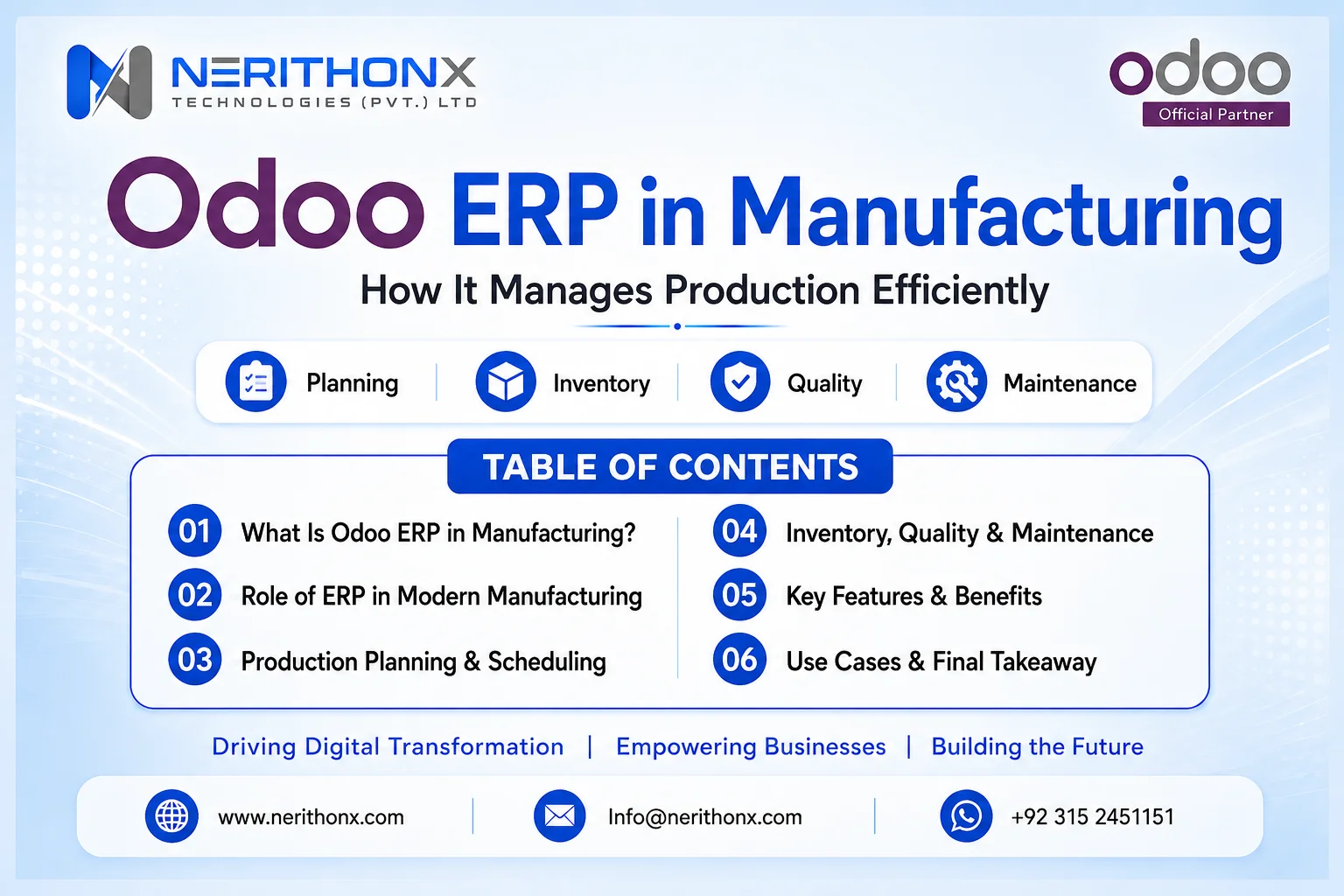
Manufacturing companies manage production through planning, inventory control, and shop floor operations—but when these processes are disconnected, inefficiencies such as delays, stock issues, and limited visibility arise.
Odoo ERP helps manufacturing companies manage production efficiently by integrating production planning, inventory management, quality control, and maintenance into a single system. This unified approach connects every stage of the production cycle, enabling real-time coordination and data-driven decision-making. Platforms like Odoo are widely explored by organizations and technology providers such as NerithonX Technologies to understand how integrated systems can improve manufacturing performance.
With features like Master Production Scheduling (MPS), multi-level Bills of Materials (BoM), shop floor tracking, and inventory integration, Odoo ensures accurate planning, streamlined workflows, and consistent product quality.
As a result, manufacturers can reduce lead times, optimize resources, and gain full visibility over operations—key factors in improving overall production efficiency.
In the following sections, we will explore how Odoo ERP manages production processes and why it plays a critical role in modern manufacturing systems.
What Is Odoo ERP in Manufacturing?
Odoo ERP in manufacturing refers to an integrated system that connects and manages core production processes within a single digital platform. It enables manufacturers to handle production planning, Bills of Materials (BoM), work orders, inventory control, quality checks, and maintenance operations in a unified environment.
The core purpose of Odoo ERP is to centralize manufacturing data and automate process coordination. Instead of relying on separate tools or manual tracking, manufacturers use Odoo to ensure that materials, resources, and production schedules are aligned in real time. This reduces operational gaps and improves accuracy across the entire production lifecycle.
Role of ERP in Modern Manufacturing Systems
In modern manufacturing, where operations are increasingly complex and data-driven, ERP systems play a critical role in ensuring efficiency and control. Odoo ERP acts as a central system that connects production, supply chain, and operational workflows, allowing manufacturers to monitor and manage activities from a single interface.
It supports real-time decision-making by providing visibility into production status, inventory levels, and resource utilization. This is especially important in environments that require multi-level production planning, demand forecasting, and strict quality compliance.
By integrating all manufacturing functions, Odoo ERP helps eliminate data silos, streamline communication between departments, and maintain consistency across processes—making it an essential component of modern manufacturing systems.
For more details about Odoo’s official manufacturing capabilities, businesses can explore the official Odoo Manufacturing page.
How Odoo ERP Manages Manufacturing Production Processes
Odoo ERP manages manufacturing production by connecting planning, execution, inventory, quality, and maintenance into a single, data-driven workflow. Each process is synchronized through real-time information, ensuring that production activities remain efficient, traceable, and aligned across the entire operation.
Production Planning and Scheduling with MPS
Odoo ERP manages production planning using Master Production Scheduling (MPS), which aligns demand forecasts with available resources and production capacity. Manufacturing orders are generated based on sales demand, inventory levels, and lead times, allowing companies to maintain a balanced and responsive production schedule.
This ensures optimized workload distribution, reduced downtime, and the ability to adjust production plans dynamically as demand changes.
Managing Bills of Materials (BoM) and Product Structures
Odoo ERP manages product structures through multi-level Bills of Materials (BoM), enabling manufacturers to define components, sub-assemblies, and routing operations with precision.
This structured approach ensures accurate material planning, clear product hierarchy, and consistent cost tracking across all production stages, improving both traceability and operational control.
Shop Floor Control and Work Order Tracking
Odoo ERP digitizes shop floor operations by managing work orders and manufacturing orders (MOs) in real time. Production activities are tracked through connected interfaces such as tablets or barcode systems, allowing operators to update progress instantly.
This enhances visibility into work center performance and ensures that production tasks are executed accurately and without delays.
Inventory Integration with Production Operations
Odoo ERP integrates inventory directly with production workflows, ensuring that material consumption and stock updates occur automatically during manufacturing.
This integration enables:
- Real-time inventory updates during production
- Automatic stock allocation for manufacturing orders
- Better control over stock levels to avoid shortages or excess
As a result, production and inventory remain fully synchronized, supporting a more efficient supply chain.
Quality Control and Compliance Management
Odoo ERP embeds quality control processes within the production workflow, allowing inspections to be performed at critical stages such as incoming materials, in-process operations, and finished goods.
This approach helps manufacturers maintain consistent product standards, detect defects early, and ensure compliance with industry regulations without disrupting production flow.
Manufacturers can also review Odoo’s official Quality app to understand how inspections and quality checks are managed within production workflows.
Maintenance Management and Equipment Efficiency
Odoo ERP manages equipment performance through integrated maintenance planning, supporting both preventive and corrective maintenance strategies.
By monitoring machine usage and performance metrics such as OEE, manufacturers can reduce unexpected breakdowns and maintain continuous production efficiency.
Odoo’s official Maintenance app also supports preventive and corrective maintenance for manufacturing equipment.
Key Features of Odoo ERP for Manufacturing Operations
Odoo ERP provides a set of integrated features that enable manufacturers to manage production operations with precision, visibility, and control. These features are designed to streamline workflows, reduce manual intervention, and ensure that every stage of manufacturing is connected through real-time data.
Real-Time Production Monitoring
Odoo ERP enables real-time monitoring of production activities by tracking manufacturing orders, work orders, and work center performance as they happen. This allows manufacturers to identify delays, monitor progress, and make immediate adjustments when needed.
With centralized dashboards and live data updates, decision-makers gain continuous visibility into production status, helping maintain efficiency and minimize disruptions.
Multi-Level BoM and Routing
Odoo ERP supports multi-level Bills of Materials (BoM), allowing manufacturers to manage complex product structures that include sub-assemblies and multiple components. Routing capabilities define the sequence of operations required to manufacture each product.
This ensures accurate material planning, clear production workflows, and better control over manufacturing costs and processes.
Automated Procurement and Reordering
Odoo ERP automates procurement by triggering purchase requests or RFQs based on production demand and inventory levels. When materials fall below predefined thresholds, the system automatically initiates replenishment.
This reduces manual intervention, prevents stock shortages, and ensures that production continues without interruptions due to missing materials.
Warehouse and Logistics Coordination
Odoo ERP integrates warehouse operations with manufacturing, enabling efficient coordination of material movement between storage locations and production lines. It supports multi-warehouse management, internal transfers, and optimized picking processes.
This improves inventory accuracy, reduces handling time, and ensures that materials are available at the right place and time for production.
Barcode and Traceability Systems
Odoo ERP incorporates barcode systems and traceability features to track materials and products throughout the manufacturing process. Each item can be monitored using lot or serial numbers, ensuring full visibility from raw materials to finished goods.
This capability is essential for maintaining traceability, supporting quality control, and meeting compliance requirements in regulated industries.
Benefits of Using Odoo ERP in Manufacturing
Odoo ERP delivers measurable improvements in manufacturing performance by connecting production processes, data flows, and operational decision-making within a single system. This integration enables manufacturers to move from reactive operations to a more controlled, efficient, and data-driven production environment.
Improved Operational Visibility
Odoo ERP provides end-to-end visibility across manufacturing operations by centralizing data from production, inventory, and supply chain activities. Manufacturers can monitor production status, track material availability, and analyze work center performance in real time.
This level of visibility helps identify bottlenecks early, maintain transparency across departments, and ensure that all stakeholders are aligned with current production conditions.
Reduced Lead Times and Costs
By automating production planning, inventory management, and procurement processes, Odoo ERP reduces delays and eliminates inefficiencies that typically increase lead times. Accurate scheduling and synchronized workflows ensure that materials and resources are available when needed.
This leads to lower operational costs, reduced waste, and faster production cycles, ultimately improving overall manufacturing efficiency.
Better Resource Utilization
Odoo ERP optimizes the use of resources by aligning production schedules with available labor, machinery, and materials. Workloads are distributed efficiently across work centers, minimizing idle time and preventing overloading.
This ensures that manufacturing resources are used effectively, improving productivity without increasing operational complexity.
Data-Driven Decision Making
Odoo ERP enables data-driven decision-making by providing real-time insights into key manufacturing metrics such as production performance, inventory levels, and equipment efficiency. Centralized dashboards and reports allow managers to evaluate trends and respond quickly to operational changes.
This empowers manufacturers to make informed decisions based on accurate data, improving both short-term execution and long-term strategic planning.
Real-World Manufacturing Use Cases of Odoo ERP
Odoo ERP supports a wide range of manufacturing environments by adapting to different production models, product complexities, and operational requirements. Its modular structure allows manufacturers to configure workflows based on how production is executed in real-world scenarios.
Discrete Manufacturing
In discrete manufacturing, where products are assembled from distinct components (such as automotive parts, electronics, or machinery), Odoo ERP manages production through structured Bills of Materials (BoM), routing, and work orders.
Manufacturers use Odoo to coordinate multi-level assemblies, track component usage, and monitor each stage of production. This ensures accurate product configuration, better control over assembly processes, and full traceability of parts throughout the production cycle.
Process Manufacturing
In process manufacturing, where production involves formulas, batch processing, or continuous flows (such as food, chemicals, or pharmaceuticals), Odoo ERP manages operations through batch tracking, quantity scaling, and strict quality control.
The system supports:
- Batch and lot traceability for compliance
- Management of co-products and by-products
- Integration of quality checks at each production stage
This enables manufacturers to maintain consistency in production outputs while meeting regulatory and safety standards.
Custom Production Environments
In custom or project-based manufacturing, where products are tailored to specific customer requirements, Odoo ERP provides flexibility in managing unique production workflows. Manufacturers can create customized BoMs, adjust routing processes, and link production orders to specific projects or sales orders.
This approach allows businesses to handle variable production demands while maintaining control over costs, timelines, and resource allocation, ensuring that each custom product meets exact specifications.
Common Challenges in Manufacturing Without ERP
Manufacturing operations that rely on disconnected systems or manual processes often face inefficiencies that impact productivity, cost control, and decision-making. Without an integrated ERP system, production workflows lack synchronization, leading to operational gaps across planning, execution, and inventory management.
Manual Errors and Data Silos
Without ERP, manufacturing data is often stored across spreadsheets, standalone tools, or separate departments. This creates data silos where information is not shared in real time, increasing the risk of inconsistencies and manual errors.
As a result, production teams may work with outdated or inaccurate data, leading to miscommunication, incorrect planning, and reduced operational transparency.
Inefficient Scheduling
In the absence of a centralized system, production scheduling is typically handled manually or through limited tools that do not account for real-time constraints such as machine availability, labor capacity, or material readiness.
This often results in production delays, unbalanced workloads, and underutilized resources, making it difficult to maintain a consistent and efficient production flow.
Inventory Imbalances
Without ERP integration, inventory management is not directly aligned with production activities. This can lead to stock shortages when materials are not available on time, or overstocking when excess inventory is not properly tracked.
Such imbalances increase operational costs, disrupt production schedules, and reduce overall supply chain efficiency.
How to Evaluate ERP Systems for Manufacturing Needs
Evaluating an ERP system for manufacturing requires a structured approach that focuses on operational fit, system capabilities, and long-term adaptability. Manufacturers need to ensure that the ERP solution aligns with production workflows, supports real-time data exchange, and can scale with business growth.
Key Functional Requirements
An effective ERP system should support the core functions of manufacturing, ensuring that all production-related processes are connected and efficiently managed.
Key functional requirements include:
- Production planning and scheduling (e.g., MPS, work orders)
- Bills of Materials (BoM) and routing management
- Inventory and warehouse integration
- Quality control and compliance tracking
- Maintenance management and equipment monitoring
These capabilities ensure that the ERP system can handle end-to-end manufacturing operations while maintaining accuracy and process consistency.
Scalability and Integration Considerations
Beyond core functionality, manufacturers must evaluate how well an ERP system can scale and integrate with existing or future systems. As production complexity increases, the ERP should be able to accommodate additional users, modules, and operational requirements without disrupting performance.
Important considerations include:
- Ability to scale across multiple warehouses or production units
- Integration with supply chain, accounting, and external systems
- Flexibility to adapt to different manufacturing models
- Support for data-driven reporting and analytics
A scalable and well-integrated ERP system ensures long-term usability and enables manufacturers to evolve their operations without needing frequent system replacements.
Common Mistakes When Using ERP in Manufacturing
While ERP systems like Odoo provide strong capabilities for managing manufacturing operations, their effectiveness depends on how well they are implemented and maintained. Misalignment between system usage and operational processes can reduce efficiency instead of improving it.
Poor Data Management
ERP systems rely on accurate and consistent data to function effectively. When data such as Bills of Materials (BoM), inventory levels, or production parameters are incomplete or incorrect, it directly impacts planning and execution.
Common issues include outdated records, duplicate entries, and inconsistent data formats, which can lead to inaccurate production schedules, inventory mismatches, and unreliable reporting. Maintaining clean, structured, and regularly updated data is essential for ensuring system accuracy.
Lack of Process Alignment
A common mistake is implementing an ERP system without aligning it with existing manufacturing workflows. If production processes are not clearly defined or standardized before ERP adoption, the system may not reflect real operational needs.
This results in inefficiencies such as improper use of modules, workflow disruptions, and reduced user adoption. Aligning ERP configuration with actual production processes ensures that the system supports operations rather than complicating them.
Conclusion
Odoo ERP helps manufacturing companies manage production efficiently by integrating planning, execution, inventory, quality control, and maintenance into a single, connected system. Instead of relying on fragmented tools or manual coordination, manufacturers use Odoo to align every stage of the production process—from demand planning and Bills of Materials (BoM) management to shop floor tracking and inventory synchronization. Industry-focused providers such as NerithonX Technologies often explore and implement these integrated workflows to demonstrate how unified systems improve manufacturing efficiency.
By enabling real-time visibility, automated workflows, and data-driven decision-making, Odoo ERP reduces operational inefficiencies such as production delays, inventory imbalances, and resource misallocation. Features like Master Production Scheduling (MPS), multi-level BoM, quality checks, and maintenance management work together to create a structured and scalable production environment.
Across different manufacturing models—including discrete, process, and custom production—Odoo ERP provides the flexibility to adapt while maintaining control, traceability, and consistency. At the same time, avoiding common challenges such as poor data management and lack of process alignment is essential to fully realize its benefits.
Overall, Odoo ERP plays a critical role in modern manufacturing by transforming disconnected operations into a unified, efficient, and data-driven production system.
FAQS :
What makes Odoo ERP suitable for manufacturing companies?
Odoo ERP is suitable for manufacturing because it combines production planning, inventory management, quality control, and maintenance within one system. This integration allows manufacturers to manage operations without relying on multiple disconnected tools, improving coordination and efficiency.
How does Odoo ERP improve production planning accuracy?
Odoo ERP improves planning accuracy by using real-time data from inventory, demand, and production capacity. It helps manufacturers create realistic schedules, adjust plans based on changes, and avoid overproduction or delays.
Can Odoo ERP handle complex manufacturing processes?
Yes, Odoo ERP supports complex manufacturing processes through multi-level product structures, detailed routing, and flexible workflows. It can manage both simple and highly structured production environments with multiple components and stages.
How does Odoo ERP support inventory control during production?
Odoo ERP links inventory directly with production activities, ensuring that material consumption and stock updates happen automatically. This helps maintain accurate stock levels and prevents issues like material shortages or excess inventory.
Is Odoo ERP useful for small and medium-sized manufacturers?
Odoo ERP is designed to be modular and scalable, making it suitable for small and medium-sized manufacturers as well as larger enterprises. Businesses can start with essential features and expand as their operations grow.
How does Odoo ERP help reduce production delays?
Odoo ERP reduces delays by synchronizing production schedules with resource availability and inventory levels. Automated workflows and real-time tracking help identify potential issues early, allowing manufacturers to take corrective action quickly.
What role does data play in Odoo ERP for manufacturing?
Data is central to how Odoo ERP operates. It uses real-time information from different processes to provide insights, automate decisions, and ensure that all production activities are aligned and up to date.
Can Odoo ERP support quality standards in manufacturing?
Yes, Odoo ERP allows manufacturers to define and monitor quality processes throughout production. This helps maintain consistency, improve product reliability, and meet industry-specific standards.
How does Odoo ERP adapt to different manufacturing industries?
Odoo ERP is flexible and can be configured to support various industries, including discrete, process, and custom manufacturing. Its modular structure allows businesses to tailor workflows based on their specific production requirements.
What are the long-term benefits of using ERP in manufacturing?
Over time, ERP systems like Odoo help manufacturers improve operational efficiency, maintain better control over processes, and make more informed decisions. This leads to sustainable growth, improved productivity, and stronger overall performance.



2 Responses
With Odoo ERP, I imagine the real-time data analysis must really help manufacturers stay ahead of production delays or quality control issues. The impact on operational efficiency must be significant.
This article does a great job highlighting how Odoo ERP can streamline production management for manufacturing companies. I especially appreciated the emphasis on integration and real-time visibility—key factors that often make or break production efficiency. It’s a timely reminder of how the right ERP solution can support scalable growth while keeping operations agile and data-driven.