Manufacturers often struggle with delayed orders, material shortages, poor scheduling, overstocking, understocking, manual spreadsheets, and weak coordination between sales, inventory, purchasing, production, and quality teams. This is where production planning software becomes important.
Instead of planning production manually in Excel or disconnected tools, manufacturers can use a connected system to plan what to produce, when to produce, how much to produce, which raw materials are required, and how production progress is moving on the shop floor.
For growing manufacturers and SMEs, production planning is not only about making products. It is about controlling materials, machines, labor, inventory, quality, delivery dates, and cost. A good ERP-based planning system helps teams work from one source of truth.
What Is Production Planning Software?
Production planning software is a business system that helps manufacturers plan, schedule, track, and control production activities.
In simple words, it helps answer important questions:
- What should we produce?
- How much should we produce?
- When should production start?
- Which raw materials are required?
- Are the materials available in stock?
- Which machines, work centers, or labor resources are needed?
- Is production running on time?
- Are finished goods ready for delivery?
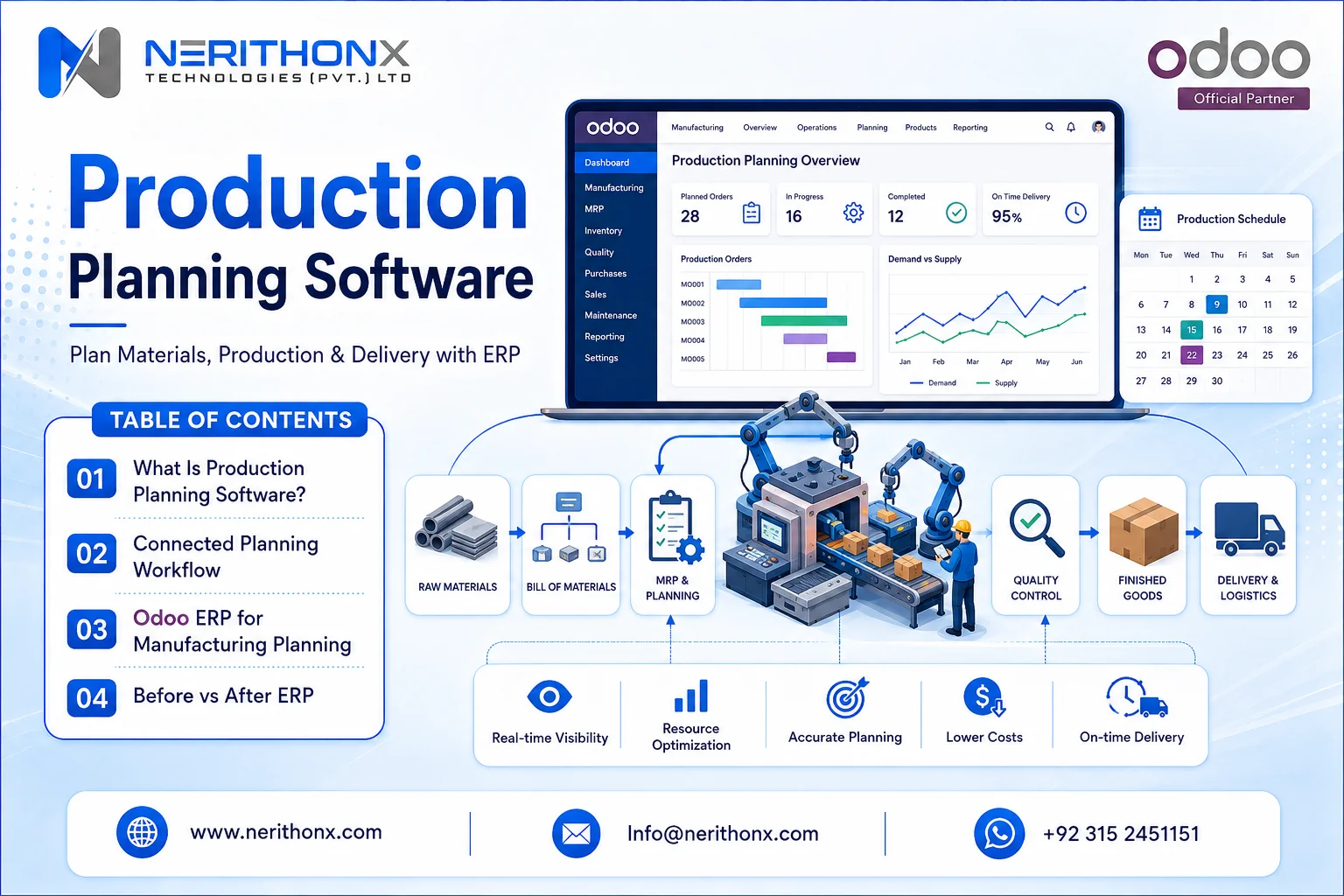
Production planning software connects demand, inventory, purchasing, manufacturing, quality, and reporting. In an ERP system, it becomes even more powerful because production data is connected with sales, accounting, purchase, warehouse, and management reports.
Modern manufacturing systems like Odoo include manufacturing orders, bills of materials, work centers, work orders, master production schedule, inventory integration, shop floor tracking, and quality workflows. Odoo’s official documentation explains that Odoo Manufacturing helps manufacturers schedule, plan, and process manufacturing orders, while also supporting shop floor work order control.
Why Production Planning Matters in Manufacturing
Production planning matters because manufacturing depends on timing, materials, people, machines, and customer commitments.
Without proper planning, one small mistake can affect the full production chain. For example, if raw material is not available, machines may stop. If production starts late, delivery may be delayed. If inventory records are wrong, the sales team may promise products that are not actually available.
Good production planning helps manufacturers:
- Meet customer demand more accurately
- Avoid material shortages
- Use machines and labor better
- Reduce production delays
- Improve delivery commitments
- Control production cost
- Improve visibility across departments
- Reduce dependency on manual follow-ups
For SMEs, this is very important because they usually have limited resources. Better planning helps them use available stock, machines, and workers more efficiently.
Common Problems Without Production Planning Software
Many manufacturers still manage production through Excel sheets, WhatsApp messages, manual registers, and disconnected software. This may work at a very small level, but it becomes difficult as production grows.
Common problems include:
- Manual spreadsheets with outdated information
- Wrong stock availability
- Late purchase requests
- Raw material shortages
- Unplanned machine downtime
- Overproduction of slow-moving products
- Underproduction of high-demand products
- Poor quality tracking
- No real-time production visibility
- Disconnected sales, inventory, production, and accounting teams
- No clear production cost report
- Difficulty tracking work-in-progress
- Delayed customer deliveries
When teams work separately, management cannot see the real position of the business. Sales may have one number, inventory may have another number, and production may be working on a different plan.
Production planning software solves this by connecting departments and creating a structured workflow.

Key Features of Production Planning Software
The best production planning software should support the complete manufacturing workflow, not only basic scheduling.
Demand Forecasting
Demand forecasting helps manufacturers estimate future demand based on sales trends, confirmed orders, seasonal demand, and business forecasts.
It helps businesses prepare materials and production capacity before demand becomes urgent.
Master Production Schedule
A master production schedule helps plan production quantities across days, weeks, or months. It gives the production team a clear view of what should be produced and when.
Odoo’s Master Production Schedule feature can be enabled from the Manufacturing app settings and can plan requirements across daily, weekly, or monthly periods.
Manufacturing Orders
Manufacturing orders are the main documents used to manage production. They define what product needs to be produced, the quantity, required components, and production status.
A manufacturing order helps track production from planning to completion.
Bill of Materials
A Bill of Materials, or BoM, lists the components and quantities required to produce a finished product. In Odoo, BoMs act as blueprints for manufactured products and may also include operations and instructions.
For example, if a company manufactures detergent, the BoM may include chemicals, packaging material, labels, cartons, and other inputs.
Material Requirements Planning
Material Requirements Planning, or MRP, helps calculate what materials are needed, how much is needed, and when they are needed. Investopedia explains MRP as a software-based system that helps businesses manage inventory and production by estimating raw material needs and planning production and deliveries.
MRP depends on accurate data. If stock, BoM, or demand data is wrong, the planning result can also be wrong.
Capacity Planning
Capacity planning helps manufacturers understand whether available machines, labor, and work centers can handle planned production.
It helps avoid unrealistic schedules and production bottlenecks.
Work Centers and Routing
Work centers are production areas, machines, or departments where work is performed. Routing defines the steps required to manufacture a product.
Odoo documentation explains that work centers are used to process work orders, track costs, make schedules, plan capacity, organize equipment, and track efficiency.
Production Scheduling
Production scheduling helps decide the exact timing of production activities. It helps answer:
- Which job should start first?
- Which machine will be used?
- How long will the operation take?
- What is the expected finish time?
Good scheduling reduces idle time and improves delivery planning.
Inventory Integration
Production planning software should be connected with inventory. When production is planned, the system should check raw material availability automatically.
This helps prevent production from starting when required components are unavailable.
Purchase Planning
If materials are short, the system should help create purchase requirements or purchase orders.
This improves coordination between production and purchasing teams.
Quality Control
Quality control helps ensure that products are checked during or after production. In Odoo, quality control points can automatically create quality checks for manufacturing and other operations.
This helps manufacturers reduce defects, improve consistency, and record quality results properly.
Shop Floor Tracking
Shop floor tracking helps workers update production progress directly from the production floor.
It can include work order status, time tracking, material consumption, scrap, quality checks, and maintenance requests.
Reporting and Dashboards
Reports help management see production status, delays, material usage, cost, efficiency, and output.
A good dashboard should show real-time information instead of waiting for manual reports.
Cost Tracking
Production planning software should help track raw material cost, labor cost, operation cost, scrap cost, and finished goods cost.
This helps management understand profitability and pricing.
Multi-Warehouse and Multi-Company Support
Manufacturers with multiple branches, factories, or warehouses need proper stock visibility across locations.
Multi-warehouse support helps manage raw material movement, finished goods transfer, and production planning across different sites.
Integration with Accounting and Sales
Production should not be isolated. It should connect with sales orders, purchase orders, inventory valuation, accounting, and customer delivery.
This is where ERP production planning becomes valuable.

How Production Planning Software Works
A practical production planning workflow usually works like this:
- Sales demand or forecast is entered into the system.
- The system checks finished goods and raw material inventory.
- The Bill of Materials identifies required components.
- MRP calculates material requirements.
- Purchase planning starts if stock is short.
- Manufacturing orders are created.
- Work centers and operations are scheduled.
- Production is tracked on the shop floor.
- Quality checks are performed.
- Finished goods are moved to inventory.
- Reports show cost, delays, efficiency, and output.
This workflow helps every department work together.
Sales knows what can be delivered. Inventory knows what stock is available. Purchase knows what needs to be ordered. Production knows what to manufacture. Quality knows what to inspect. Management gets clear reporting.
Production Planning Software vs MRP vs ERP
These terms are connected, but they are not exactly the same.
Production planning software
focuses on planning, scheduling, and tracking production activities.
MRP software
focuses mainly on material requirements, BoM, inventory, and production needs. It helps calculate what materials are required and when they should be available.
ERP software
connects production with the full business, including sales, purchase, inventory, accounting, HR, CRM, reporting, and management.
Investopedia explains that ERP is broader than MRP because ERP connects more business functions, while MRP focuses on production and inventory planning.
For growing businesses, ERP-based production planning is often better because manufacturing does not work alone. It depends on sales orders, suppliers, stock, accounts, delivery, and customer commitments
Benefits of Production Planning Software for Manufacturers
Production planning software gives practical benefits to manufacturers.
Better Production Visibility
Teams can see what is planned, what is in progress, what is delayed, and what is completed.
Fewer Delays
When material requirements, purchase planning, and scheduling are connected, delays can be reduced.
Improved Inventory Control
The system helps prevent overstocking, understocking, and negative stock situations.
Reduced Manual Work
Teams do not need to update multiple Excel files or manually follow up for every production status.
Better Resource Utilization
Machines, workers, and work centers can be planned more effectively.
Improved Customer Delivery
When production schedules are realistic, sales teams can give better delivery commitments.
Better Coordination Between Departments
Sales, purchase, inventory, production, quality, and accounts work from connected data.
Better Quality Control
Quality checks can be recorded properly during manufacturing.
More Accurate Reporting
Management can see real-time production performance, cost, and output.
Scalable Growth
As the business grows, the system can support more products, warehouses, users, and workflows.

How Odoo ERP Supports Production Planning
Odoo ERP supports production planning through a connected set of applications.
Odoo Manufacturing helps manage manufacturing orders, BoMs, work centers, work orders, and production planning. Odoo Inventory connects stock levels, locations, warehouses, receipts, deliveries, and internal transfers. Odoo Purchase helps plan material purchasing. Odoo Sales connects customer demand with production. Odoo Quality supports quality checks. Odoo Accounting helps connect production and inventory with financial records. Odoo Maintenance can support machine maintenance when needed.
Important Odoo production planning features include:
- Odoo Manufacturing
- Odoo Inventory
- Odoo Purchase
- Odoo Sales
- Odoo Quality
- Odoo Accounting
- Odoo Maintenance
- Odoo Shop Floor
- Master Production Schedule
- Bills of Materials
- Work Centers
- Work Orders
- Manufacturing Orders
- Reporting and dashboards
Odoo’s official documentation also highlights shop floor usage, where workers can control work orders in real time and trigger quality issues, feedback loops, and maintenance operations.
For SMEs, Odoo can be useful because it connects planning, inventory, purchase, production, quality, and accounting in one ERP system instead of using separate tools.
When Should a Business Use Production Planning Software?
A business should consider production planning software when manual planning starts creating delays, confusion, or cost problems.
Common signs include:
- Production delays are increasing
- Stock becomes negative or unavailable
- Planning is done in Excel
- Teams do not know real-time production status
- Purchasing is reactive
- Delivery dates are missed
- Quality checks are not recorded properly
- Management cannot see production cost clearly
- Business is growing and manual planning is becoming difficult
- Multiple warehouses or branches are hard to control
- Raw material planning is not accurate
- Production depends too much on one person’s memory
If these problems are happening regularly, the business needs a proper planning system.
How to Choose the Best Production Planning Software
Choosing the right production planning software depends on your business size, workflow, and manufacturing complexity.
Use this checklist:
- Does it match your manufacturing type?
- Does it support BoM and routing?
- Does it support MRP?
- Can it manage work centers and operations?
- Can it connect with inventory?
- Can it support purchase planning?
- Does it provide real-time reporting?
- Is it easy for production users?
- Can it be customized?
- Does it support training and user adoption?
- Is it cloud-based, on-premise, or both?
- Can it scale as the business grows?
- Does it support multi-warehouse or multi-company needs?
- What is the total cost of ownership?
- Is there a reliable implementation partner?
Software alone is not enough. The implementation process matters a lot. A good ERP partner should understand your real workflow before configuration.
Common Implementation Mistakes to Avoid
Production planning software can fail if it is implemented without proper preparation.
Avoid these mistakes:
- Starting without process mapping
- Importing dirty or wrong data
- Ignoring user training
- Over-customizing too early
- Not defining BoMs correctly
- Not setting proper inventory rules
- Not involving production users
- Skipping testing
- Not planning post-go-live support
- Using the system only as a data entry tool
- Not checking reports before going live
MRP and production planning depend heavily on accurate data. Wrong inventory, wrong BoM, or wrong lead time can create wrong planning results.
Production Planning Software for Global Manufacturers
Manufacturers in Pakistan, UAE, Saudi Arabia, UK, USA, Canada, Europe, and other regions face similar planning challenges. Demand changes, supply chain delays, cost pressure, labor coordination, inventory accuracy, quality control, and customer delivery expectations affect businesses worldwide.
A flexible ERP system can be adapted to different industries, local requirements, currencies, warehouses, taxes, and workflows.
This makes ERP-based production planning useful for:
- Production planning software in Pakistan
- Production planning software in UAE
- Production planning software in Saudi Arabia
- Production planning software in UK
- Production planning software in USA
- Production planning software in Canada
- Production planning software in Europe
- Odoo production planning software for global businesses
Current supply chain research also shows why connected planning is becoming more important. KPMG expects AI to become embedded in supply chain planning and risk management tools in 2026, while IFS notes that manufacturers are moving toward continuous supply chain intelligence and scenario planning.
For manufacturers, this means clean ERP data and connected workflows are becoming more important for future planning and automation.
How NerithonX Technologies Helps
NerithonX Technologies helps businesses plan, implement, customize, integrate, train, and support Odoo ERP workflows.
For manufacturing businesses, NerithonX Technologies can support:
- Odoo implementation
- Odoo customization
- Odoo integration
- Odoo migration
- Odoo support and maintenance
- Odoo training
- ERP consulting
- Business automation
- Manufacturing workflow planning
- Inventory and production process improvement
- Reporting and dashboard setup
- User training and post-go-live support
NerithonX’s website describes its Odoo services around implementation, customization, integration, migration, support, and training for SMEs and growing businesses.
The goal is not only to install software. The goal is to build a practical ERP workflow that supports daily production, inventory control, purchasing, quality, reporting, and business growth.
Final Thoughts
Production planning software helps manufacturers move from manual, disconnected planning to a more controlled and visible production system.
The right ERP-based planning system helps manufacturers improve visibility, reduce manual work, plan materials better, schedule production more accurately, control inventory, improve quality, and make smarter business decisions.
For SMEs and growing manufacturers, production planning software is not just a technical tool. It is a practical way to connect sales, inventory, purchase, production, quality, accounting, and management in one workflow.
When implemented properly, Odoo ERP can support production planning through manufacturing orders, BoMs, MRP, work centers, master production schedule, shop floor tracking, quality checks, inventory, purchase, accounting, and reporting.
Need production planning software for your manufacturing business?
NerithonX Technologies can help you plan, implement, customize, and support Odoo ERP workflows for production, inventory, purchasing, quality, and reporting.
FAQ
Frequently Asked Questions
What is production planning software?
Production planning software helps manufacturers plan what to produce, when to produce, how much to produce, which materials are needed, and how production progress will be tracked.
Why do manufacturers need production planning software?
Manufacturers need it to reduce delays, avoid material shortages, improve scheduling, control inventory, track production, improve quality, and make better business decisions.
What is the difference between production planning software and MRP?
Production planning software focuses on planning and scheduling production. MRP focuses on material requirements, inventory, BoM, and production needs.
Is Odoo good for production planning?
Yes, Odoo can support production planning through Manufacturing, Inventory, Purchase, Sales, Quality, Work Centers, Work Orders, Master Production Schedule, and reporting.
Can small manufacturers use production planning software?
Yes. Small manufacturers can use production planning software to replace Excel, reduce manual errors, improve stock control, and manage production more professionally.
What features should production planning software include?
It should include demand forecasting, master production schedule, BoM, MRP, manufacturing orders, capacity planning, work centers, scheduling, inventory integration, quality control, shop floor tracking, and reports.
How does production planning software reduce delays?
It reduces delays by checking material availability, planning purchases on time, scheduling work centers, tracking production progress, and giving teams real-time visibility.
How do I choose the right production planning software?
Choose software based on your manufacturing process, business size, BoM needs, inventory visibility, ERP integration, reporting, customization, scalability, training, and implementation support.
Can NerithonX Technologies help implement Odoo for production planning?
Yes. NerithonX Technologies helps businesses implement, customize, integrate, migrate, train, and support Odoo ERP workflows for production planning, inventory, purchasing, quality, and reporting.