Prices checked on July 24, 2026. Displayed sample context: USD on Odoo’s official pricing pages. Regional prices, currency, taxes, billing terms, and promotions can differ.
Disclosure: NerithonX Technologies provides Odoo services. Official Odoo charges are identified separately from implementation and partner-service costs.
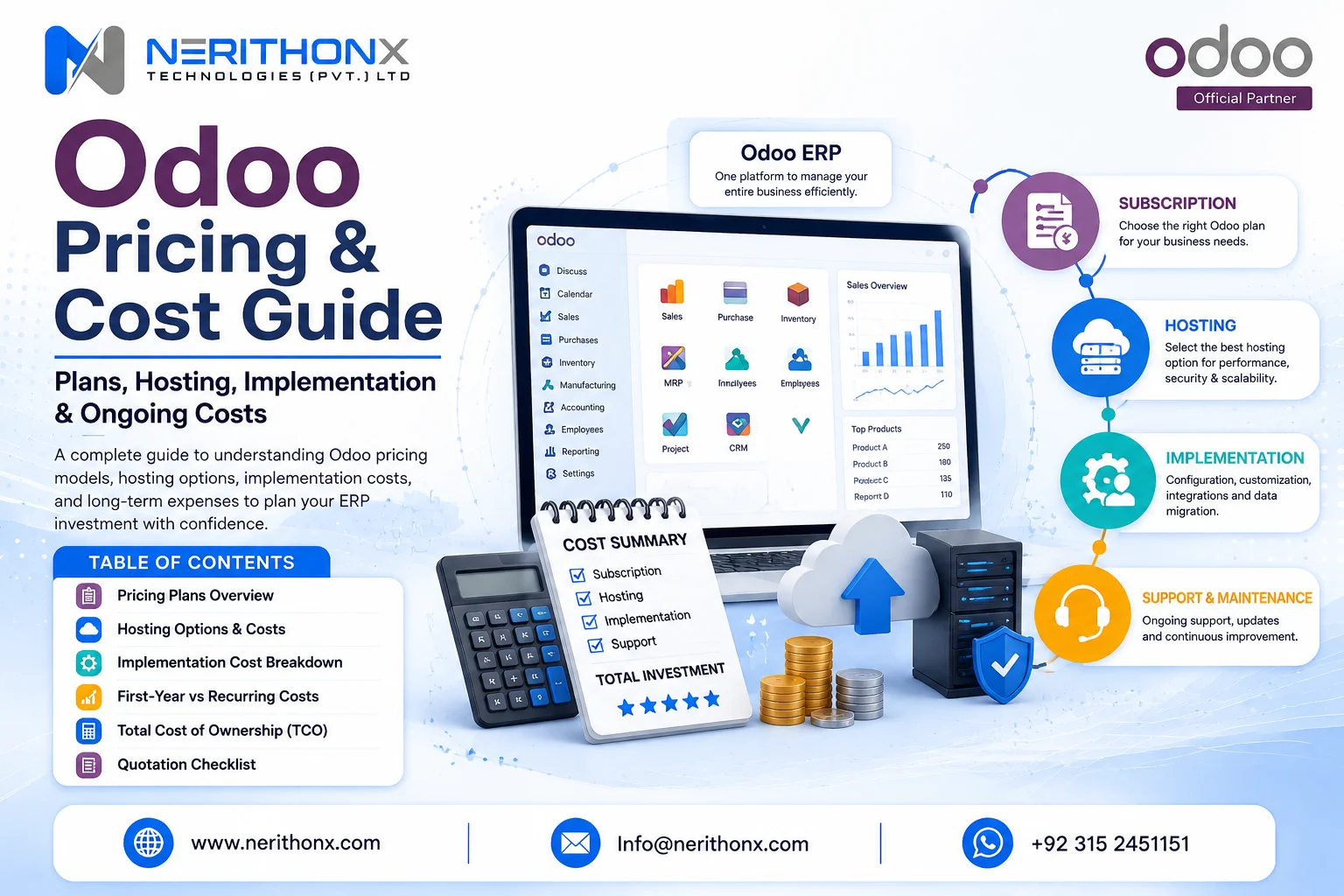
Odoo pricing includes free and paid options, but the software licence is only one part of a realistic enterprise resource planning (ERP) budget. The official Odoo pricing page currently presents One App Free, Standard, and Custom options. Your total depends on country, currency, annual or monthly billing, paid internal users, hosting, implementation scope, migration, customization, integrations, training, support, and long-term maintenance.
Direct answer: Odoo can start at $0 under One App Free or Community conditions. Paid Enterprise plans are priced per internal user. A complete budget must add hosting where applicable, delivery services, data work, integrations, training, support, upgrades, internal staff time, and contingency.

Odoo Pricing at a Glance
Option | Licence model | Hosting | Users | Main use case | Important limitation | Verify |
Community Edition | No Enterprise subscription | Self-managed | Defined by deployment | Technically capable teams needing verified Community features | Ownership costs remain | Apps, hosting, support, upgrades |
One App Free | $0 for one app under stated conditions | Odoo Online | Unlimited wording applies under plan terms | A genuine single-app requirement | Adding another app can trigger a paid plan | Dependencies and plan-change rules |
Standard | Paid per internal user | Odoo Online | Licensed internal users | Multiple standard Odoo apps | No custom server modules; Custom features can trigger upsell | Regional rate and workflow fit |
Custom | Paid per internal user | Online, Odoo.sh, or on-premise | Licensed internal users | Studio, multi-company, API, custom modules | Odoo.sh and custom-code maintenance are separate | Infrastructure and technical scope |

Why Odoo Does Not Have One Universal Price
Odoo pricing varies because regional price lists, currency, tax, billing term, first-year discounts, internal-user count, edition, plan, hosting, applications, data, custom development, integrations, implementation, and support differ.
Featured-snippet answer: Odoo has no single global price. The subscription depends on region, billing term, plan, and paid internal users. The full budget also includes hosting where required, implementation, migration, customization, integrations, training, support, internal staff time, upgrades, and future growth. Any comparison must use stated assumptions and a date.
The sample USD page checked on July 24, 2026 showed Standard at $24.90 per user per month for the first year when billed annually, against a displayed $31.10 list figure. Custom showed $49.00, against $61.00. The discount applies to initial users for 12 months. Monthly billing and local rates can differ.
How Odoo's Pricing Model Works
Odoo is modular software, but the current paid Standard and Custom subscriptions include broad application access for one per-user fee. The number of selected apps still changes the implementation effort because each process requires configuration, data, testing, security, and training.
An internal user normally accesses the backend to create, view, or edit business records. Portal customers, suppliers, and public website visitors are treated differently. One App Free uses another model, while Community Edition has no Enterprise subscription licence.
Odoo Community Edition Pricing
Community Edition is open-source software without an Odoo Enterprise subscription charge. The business must still obtain and operate infrastructure, configure the system, migrate data, maintain modules, monitor security and backups, support users, and plan upgrades.
Community modules may close functional gaps, but their quality, compatibility, documentation, and support vary. A capable internal team or managed provider may be necessary.
Zero licence cost does not mean zero ownership cost. Verify every required application and capability against the current version instead of relying on a generic Community-versus-Enterprise checklist.
Odoo Enterprise Pricing
Enterprise uses paid internal-user subscriptions and provides licensed applications and official services under Odoo’s current terms. It includes Standard and Custom plan choices, regional rates, billing options, and possible first-year discounts.
The subscription does not automatically include implementation, data migration, every integration, partner training, Odoo.sh infrastructure, third-party apps, usage credits, or custom-code maintenance. Long-term planning should use the renewal figure, expected user growth, and the cost of operational support.
One App Free Explained
One App Free provides one selected application on Odoo Online for unlimited users under official conditions, including required dependency apps. Odoo’s pricing FAQ says multiple companies are allowed and Studio can be selected as the free app.
Adding another non-dependent app normally triggers a paid plan. Custom server modules and many integrations do not fit this route.
Hypothetical example: A small association using only standard Invoicing may qualify. Adding CRM, custom integration, or broader operations requires a new budget.
Odoo Standard Plan Explained
Standard provides all Odoo applications through Odoo Online and supports standard configuration. Odoo manages the SaaS infrastructure, backups, updates, and platform maintenance under its service terms.
Standard is suitable when Odoo Online and standard workflows meet the requirement. Custom server modules are not supported on Odoo Online. Studio, multi-company, and external API requirements can move a database to Custom under current rules. Verify external integrations carefully: an outbound connection initiated by an Odoo app can differ from external software calling Odoo’s API.
Odoo Custom Plan Explained
Custom includes all applications and supports Odoo Studio, multi-company operation, external API access, and deployment on Odoo Online, Odoo.sh, or on-premise. It is the relevant plan when custom modules, third-party server apps, or deeper integrations are required.
Custom-plan subscription pricing does not include Odoo.sh infrastructure. Custom code also creates design, testing, documentation, deployment, maintenance, security, and upgrade work. On-premise deployments shift infrastructure responsibility to the customer or hosting provider.
One App Free vs Standard vs Custom
Area | One App Free | Standard | Custom |
Applications | One app plus dependencies | All apps | All apps |
Licence | Free under conditions | Per internal user | Per internal user |
Hosting | Odoo Online | Odoo Online | Online, Odoo.sh, on-premise |
Studio | Available when selected as free app; otherwise verify | Not included as a Custom feature | Included |
Multi-company | Available under One App Free terms | Triggers Custom | Included |
External API | Requires verification | Not included for external calls | Included |
Custom modules | Not included | Not included | Available on suitable hosting |
Third-party server apps | Not included | Not included | Available on Odoo.sh/on-premise |
Complexity | Low when genuinely one app | Low to medium | Medium to high |
Main external costs | Setup, data, training | Implementation, data, training | Hosting, implementation, code, integration, maintenance |
What Counts as a Paid Odoo User?
People using the backend for internal work are generally paid users. This includes sales, finance, warehouse, management, and external accountants with backend access.
Portal customers, suppliers, and public visitors are normally free external users. Plan licences from actual roles and permissions. Do not share accounts to reduce cost.
Example: Ten sales, three finance, five warehouse, and two management users may require 20 internal accounts; hundreds of portal customers do not automatically require paid licences. Verify the structure with Odoo or an authorized partner.
Does Odoo Pricing Vary by Country?
Yes. Odoo can display regional rates, currencies, taxes, billing terms, and promotions. Partner services, hosting, localization, and local integrations also affect the project budget.
A USD figure may not apply in Pakistan, UAE, Saudi Arabia, UK, USA, Canada, or Europe. Open the official page from the buying country and save a dated quotation.
Odoo Hosting Costs
Odoo Online
Odoo Online is software as a service (SaaS). Odoo manages infrastructure, daily backups, updates, and the standardized environment. It suits standard implementations but does not support custom server modules or Apps Store server modules.
Odoo.sh
Odoo.sh supports customized Enterprise deployments with GitHub, development, staging, production, continuous integration, shell access, monitoring, and backups. Infrastructure is separate from Enterprise licences.
In the USD configurator checked July 24, 2026, annual-billing components displayed $57.60 per worker/month, $0.20 per GB/month, and $14.40 per staging environment/month. Shared limits, dedicated hosting, and region can change the total.
On-Premise or Self-Hosted Odoo
Self-hosting requires infrastructure, administration, hardening, monitoring, backups, disaster recovery, updates, database work, DevOps, and support. It is not free hosting.
Hosting | Compatible route | Custom code | Responsibility | Main drivers | Best fit | Main risk |
Odoo Online | Free, Standard, Custom | No server modules | Odoo | Subscription and project services | Standard cloud use | Functional limits |
Odoo.sh | Custom Enterprise | Yes | Shared | Workers, storage, staging, capacity | Managed custom use | Scaling and code upkeep |
On-premise | Community or Custom | Yes | Customer/provider | Infrastructure, people, security, recovery | Control requirements | Underfunded operations |

Odoo Implementation Cost
Implementation is separate from licensing. It can include discovery, requirements analysis, process mapping, solution design, configuration, data preparation, migration, customization, integrations, reports, testing, user acceptance testing, training, go-live, hypercare, project management, and documentation.
Cost depends on scope, not a universal rate. A credible estimate must identify deliverables, responsibilities, assumptions, exclusions, acceptance criteria, and change control. Review the Odoo implementation process before comparing quotations.
Main Factors Affecting Odoo Implementation Cost
Factor | Why budget changes | Question | Cost-control action |
Users and companies | More roles, access, training, consolidation | Who needs backend access? | Design roles early |
Apps and processes | Each workflow adds setup and testing | Which processes are in phase one? | Separate must-haves |
Locations and localization | Adds tax, currency, warehouse, and legal setup | Which entities and countries? | Validate local scope |
Data volume and quality | Cleanup and reconciliation consume effort | What history is required? | Clean before migration |
Fields, workflows, reports | Can require low-code or development | Is standard output acceptable? | Prototype standard first |
Integrations | Mapping and error handling add lifecycle cost | Which objects and owners? | Document interfaces |
Manufacturing/eCommerce | Adds complex transactions and testing | Which variants and exceptions? | Use representative cases |
Timeline and availability | Compression increases coordination risk | Are business experts available? | Agree realistic milestones |
Training and support | Adoption requires role-based preparation | Who trains new staff? | Build internal champions |

Odoo Data Migration Cost
Migration depends on source systems, record volume, duplicates, mapping, history, attachments, opening balances, product and partner data, inventory quantities, trial runs, reconciliation, and cutover.
Importing clean master data is usually simpler than rebuilding complete historical transactions and relationships. Historical migration may require transformation logic, archived evidence, accounting validation, and repeated tests. Use Odoo data migration planning to define what moves, what remains archived, and what must reconcile.
Odoo Customization Cost
Configuration uses standard settings, access rights, stages, sequences, workflows, and reports. Low-code customization may add Studio fields, views, automations, and approval steps. Custom development can create modules, Python or JavaScript logic, interfaces, complex automation, or external-service connections.
Development cost is only the beginning. Testing, documentation, deployment, support, security review, maintenance, and upgrades continue. Unnecessary customization increases technical debt, so evaluate standard features before using Odoo customization services.
Odoo Integration Cost
Integrations can connect commerce, payments, shipping, banks, accounting, CRM, marketplaces, telephony, government systems, or proprietary software through connectors, APIs, or middleware.
Budget systems, objects, fields, direction, frequency, volume, authentication, conflicts, errors, monitoring, testing, and maintenance.
Object | Source | Destination | Direction | Frequency | Conflict rule | Error owner |
Customer | Defined master | Other system | One/two-way | Event or batch | Master wins | CRM owner |
Product | Product master | Sales channels | Outbound | Scheduled | Source wins | Product team |
Order | Commerce channel | Odoo | Inbound | Near real time | Reject duplicate ID | Operations |
Payment status | Odoo/payment service | Other system | Controlled | Event | Posted state wins | Finance |
Document these fields before scoping Odoo integration requirements.
Odoo Training, Support and Maintenance Costs
Budget administrator, end-user, department, and new-employee training. Include materials, practice environments, go-live support, functional and technical support, bug handling, monitoring, small improvements, custom-module maintenance, and upgrade preparation.
Odoo subscription support and implementation-partner support can cover different activities. Define service hours, channels, response targets, priority rules, exclusions, and responsibility for custom code. Odoo support and maintenance and Odoo user training should be scoped separately.
Third-Party Apps and In-App Purchase Costs
Apps Store modules may have one-time or recurring fees, dependencies, version limitations, and separate vendor support. Check source-code access, maintenance, upgrade compatibility, and replacement risk.
Usage-based services can include SMS, document digitization, contact autocomplete, lead generation, or other in-app purchases. External providers may also charge transaction, message, storage, or API fees. Verify current terms for every service.
Hidden or Frequently Missed Odoo Costs
Frequently missed costs include internal project management, subject-matter experts, data cleanup, testing, productivity loss during transition, change management, custom-code maintenance, future users, storage, Odoo.sh scaling, new integrations, app renewals, retraining, documentation, business continuity, upgrade tests, post-launch improvements, and contingency.
These costs reflect ownership beyond software access.
First-Year Cost vs Recurring Annual Cost
First-year costs | Recurring annual costs |
Discovery and process design | Subscription renewals |
Implementation and configuration | Hosting and scaling |
Migration and cleanup | Support and maintenance |
Customization and integration | Credits and app renewals |
Initial training and setup | New-user training |
Testing, go-live, hypercare | Improvements and upgrade preparation |
The first year is often higher because it contains project creation and transition work. A stable operating year may be lower, but growth, improvements, or upgrades can increase it again.
How to Calculate Odoo Total Cost of Ownership
First-year cost = software subscription + hosting + implementation + data migration + customization + integrations + third-party apps + training + internal staff time + contingency.
Recurring annual cost = subscription renewals + hosting + support + app renewals + usage credits + maintenance + training + improvements + upgrade preparation.
Three-year total cost of ownership (TCO) = first-year cost + year-two recurring cost + year-three recurring cost + planned growth + upgrade or expansion budget.
Use amounts from dated official quotes and scoped service proposals. State users, plan, billing, country, apps, hosting, data, integrations, and growth assumptions beside every result.

Practical Odoo Cost Scenarios
These scenarios are hypothetical.
Scenario 1: Small Service Business
Five users need CRM, Sales, Invoicing, clean data, and no custom development. Compare Standard with One App Free only if one app is enough. Main risk: assuming later apps remain free.
Cost component | Evidence | Your amount |
Subscription | Official regional quote | ______ |
Setup, data, training | Scope quotation | ______ |
Support and contingency | Service/risk plan | ______ |
Scenario 2: Retail or eCommerce Company
Fifteen users need Sales, Inventory, Purchase, Accounting, eCommerce, payments, shipping, and product migration. Standard fits only without Custom-only integrations or modules. Main risk: under-scoping products, stock, payments, and logistics.
Cost component | Evidence | Your amount |
Users and hosting | Official quote | ______ |
Migration and integrations | Technical scope | ______ |
Testing, training, support | Project quote | ______ |
Scenario 3: Manufacturing Company
Forty users need CRM, Sales, Purchase, Inventory, Manufacturing, Quality, Maintenance, Accounting, reports, and migration. Test standard functionality; Custom and Odoo.sh may be needed. Main risk: undefined manufacturing exceptions.
Cost component | Evidence | Your amount |
Subscription and Odoo.sh | Official configurator | ______ |
Implementation and migration | Detailed scope | ______ |
Reports, code, support | Technical proposal | ______ |
Scenario 4: Multi-Company International Business
Eighty users need legal entities, currencies, localizations, integrations, approvals, and consolidated reporting. Custom is likely; hosting depends on code and control. Main risk: weak global governance.
Cost component | Evidence | Your amount |
Licences and hosting | Regional official quote | ______ |
Localization and integrations | Country/interface scopes | ______ |
Governance, training, support | Programme budget | ______ |
Is Odoo Expensive?
Odoo cannot be labelled cheap or expensive without a defined scenario. Community may avoid an Enterprise licence but require technical ownership. A standard cloud project with simple processes may be economical. A multi-company manufacturing transformation with migration and integrations can require substantial investment.
Compare total cost with the processes covered, systems replaced, risk, integration burden, and expected operational value. Return on investment should use documented assumptions rather than guaranteed savings.
Odoo Pricing Compared With Separate Business Applications
Odoo may consolidate CRM, accounting, inventory, eCommerce, helpdesk, projects, reporting, and middleware, reducing duplicate data and vendor coordination.
Separate specialist tools may provide stronger departmental capability. Their total includes subscriptions, integrations, reconciliation, security, reporting, migration, and vendor management. Compare equivalent business scope and three-year ownership; Odoo is not automatically cheaper.
How to Reduce Odoo Costs Without Creating Future Problems
Define scope, rank must-haves, start with standard features, clean data, limit custom code, phase delivery, licence genuine internal users, use portals correctly, document integrations, train key users, assign an owner, test, budget support, review third-party apps, plan upgrades, and include contingency.
Cost control removes waste. False economy skips essential data, testing, training, security, support, or maintenance and creates rework.
When the Cheapest Odoo Option Can Cost More Later
Community can cost more without technical capacity. Standard can fail when custom integrations are essential. Unsupported modules, weak hosting, skipped testing, poor migration, no training, excessive customization, and no upgrade plan create rework.
Choose the least complex option that satisfies documented requirements, not merely the lowest licence figure.
How to Choose the Right Odoo Plan
Requirement | Likely option | Condition |
One supported app | One App Free | Dependencies and limits are acceptable |
Multiple standard apps | Standard | Odoo Online and standard workflows fit |
Studio, multi-company, API, code, Odoo.sh, on-premise | Custom | Technical ownership is budgeted |
No Enterprise licence, strong technical team | Community | Required functions and ownership are funded |
Evaluate apps, users, Studio, API, companies, hosting, integrations, data control, skills, upgrades, budget, and growth. No plan is universally best for every SME.
What Information Is Needed for an Accurate Odoo Quote?
Provide country, currency, companies, internal users, growth, apps, current systems, processes, locations, languages, localizations, data sources, volumes, history, integrations, reports, approvals, custom fields, modules, hosting, security, training, support, timeline, owner, budget, and future phases.
The quote should separate subscription, hosting, implementation, migration, customization, integration, training, support, taxes, assumptions, exclusions, acceptance criteria, and change-request rates.

Conclusion
Odoo pricing is more than a subscription. Exact licence rates must come from the current regional page, while implementation scope is often the largest variable. Community, One App Free, Standard, and Custom serve different needs.
A realistic budget separates first-year and recurring costs, models three-year growth, and tests standard functionality before custom development. Accurate quotes require documented users, processes, data, hosting, integrations, training, and support.
Need a realistic Odoo budget?
NerithonX Technologies can prepare a scope-based estimate after reviewing your requirements
FAQ
Frequently Asked Questions
How much does Odoo cost?
Odoo cost depends on the regional price list, plan, billing term, paid internal users, hosting, and project scope. In the USD context checked on July 24, 2026, Odoo displayed One App Free at $0 and first-year annual-billing rates of $24.90 for Standard and $49.00 for Custom per user per month. Always recheck your local official page.
Is Odoo completely free?
Odoo is not always completely free to own. One App Free can provide one supported app on Odoo Online under stated conditions, and Community Edition does not require an Enterprise subscription licence. However, hosting, implementation, administration, migration, integrations, custom development, third-party modules, support, training, backups, security work, and upgrades can still create costs.
What is included in Odoo One App Free?
One App Free provides one selected Odoo application for unlimited users on Odoo Online, including required dependency apps according to Odoo’s current pricing page. It can also allow multiple companies, while choosing Studio as the free app is possible. Installing another non-dependent app, or using requirements outside the plan’s conditions, can move the database to a paid plan.
What is the difference between Odoo Standard and Custom?
Standard provides all Odoo applications on Odoo Online for standard configurations. Custom adds requirements such as Odoo Studio, multi-company operation, external API access, custom modules, and Odoo.sh or on-premise deployment options. Odoo.sh infrastructure remains separately priced. Exact inclusions and automatic plan changes should be verified against the current official pricing page and your database configuration.
Does Odoo charge per user or per app?
Odoo’s current paid Standard and Custom plans are generally priced per paid internal user, with access to the included Odoo application suite rather than a separate subscription price for each app. One App Free follows a different model. Selected apps can still change implementation, training, storage, integration, and support costs even when the software subscription includes broad application access.
Which Odoo users require a paid licence?
A paying user is generally a person who accesses the Odoo backend to create, view, or edit business documents. This can include employees and an external accountant working inside the backend. Customers, suppliers, and website visitors using portal or public access are normally not paying internal users. Confirm unusual roles and access patterns with Odoo or an authorized partner.
Are portal users charged?
Portal users are generally not charged as paid internal users when they only use portal access for activities such as viewing invoices, orders, deliveries, or shared documents. Public website visitors are also treated differently from backend users. Access rights must be configured correctly, and a portal account should not be used to avoid licensing a person who genuinely performs internal backend work.
Does Odoo pricing vary by country?
Yes, Odoo pricing can vary by country or region. The official site may display a local currency, regional list price, tax treatment, billing options, or introductory discount based on location. A price viewed in Pakistan, the UAE, Saudi Arabia, the UK, the USA, Canada, or Europe may not apply elsewhere. Open the official pricing page from your own country before budgeting.
Is hosting included in Odoo pricing?
Odoo Online hosting is included with applicable One App Free, Standard, and Custom subscriptions. Custom customers can instead use Odoo.sh or on-premise deployment. Odoo.sh infrastructure is priced separately, while self-hosting requires servers, administration, security, monitoring, backups, and disaster recovery. Hosting inclusion therefore depends on the selected plan and deployment model.
How much does Odoo.sh cost?
Odoo.sh cost is calculated separately from the Enterprise user subscription. In the USD configurator context checked on July 24, 2026, Odoo displayed components including $57.60 per worker per month, $0.20 per GB per month, and $14.40 per staging environment per month. Capacity, dedicated hosting, region, billing term, and current configurator values must be verified before purchase.
Is Odoo Community cheaper than Enterprise?
Odoo Community can avoid the Enterprise subscription licence, but it is not automatically cheaper in total. A business may need hosting, technical administrators, implementation, community modules, custom development, backups, monitoring, support, and upgrade work. Enterprise adds licensed capabilities and official services. Compare the required functions and three-year ownership cost rather than licence fees alone.
How much does Odoo implementation cost?
Odoo implementation cost has no reliable universal figure because it depends on users, companies, apps, locations, process complexity, data, integrations, reports, localization, training, testing, timeline, and internal availability. Software pricing does not include a complete implementation project. Request a scope-based quotation that separates discovery, configuration, migration, customization, integration, training, project management, go-live, and support.
What affects Odoo customization cost?
Customization cost depends on whether the need is standard configuration, low-code Studio work, a custom module, a new interface, automation, reporting, or integration. Complexity, test coverage, documentation, deployment, security review, maintenance, and future version upgrades also matter. Unnecessary customization increases technical debt, so businesses should first confirm whether standard Odoo functionality can meet the requirement.
Does Odoo charge extra for integrations?
Odoo’s subscription does not automatically include the design and delivery of every integration. External API access is associated with the Custom plan, while some outbound connections can be standard features. Connectors, middleware, development, mapping, testing, monitoring, usage charges, and third-party services may add costs. Scope each data object, direction, frequency, error process, and system owner before estimating.
Are Odoo upgrades free?
Odoo states that upgrade services for standard applications are included with applicable Enterprise subscriptions, subject to its agreement and service scope. This does not mean every upgrade-related activity is free. Custom modules, third-party code, data cleanup, testing, user training, process changes, integrations, and deployment support may require additional work. Community and self-managed environments need their own upgrade planning.
Are training and support included?
Odoo’s paid plans include access to official support and eLearning under the current terms, but that does not cover every implementation, training, configuration, or custom-code request. A partner support agreement may include functional assistance, technical troubleshooting, monitoring, small improvements, or service levels. Clarify channels, hours, response targets, exclusions, and the boundary between Odoo and partner responsibilities.
What are the frequently missed costs of Odoo?
Frequently missed costs include internal project management, subject-matter expert time, data cleanup, user acceptance testing, transition productivity loss, change management, custom-code maintenance, added users, storage growth, Odoo.sh scaling, app renewals, integration monitoring, retraining, documentation, business continuity, upgrade testing, and post-launch improvements. A contingency amount should also be assigned to defined risks, not used as an unexplained surcharge.
How can a business estimate its Odoo budget?
Estimate Odoo by separating first-year and recurring costs. First-year cost should include subscription, hosting, discovery, implementation, migration, customization, integrations, apps, training, internal time, and contingency. Recurring cost should include renewals, hosting, support, credits, app fees, maintenance, training, improvements, and upgrade preparation. Add planned user, data, company, and functional growth for a three-year total.
Which Odoo plan is best for a small business?
There is no single best plan for every small business. One App Free may suit a genuine one-app requirement. Standard may suit multiple standard applications on Odoo Online without custom server modules. Custom may be needed for Studio, multi-company, API, custom modules, Odoo.sh, or on-premise. Community can suit businesses with suitable technical resources and verified feature requirements.
How can I get an accurate Odoo quotation?
Provide the country, billing currency, companies, internal users, expected growth, required apps, processes, locations, languages, currencies, accounting localization, data volumes, history, integrations, reports, approvals, custom fields, hosting preference, training, support, timeline, and project owner. A credible quotation should separate subscription, hosting, implementation, migration, customization, integration, training, taxes, assumptions, exclusions, and change-request rates.